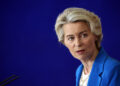
There is a red thread, a fairly strong one at that, linking the State of the Union Address delivered on 10 September in Strasbourg by Ursula von der Leyen and the one delivered today, in Brussels, by Mario Draghi.
It is a thread that stretches through many of the comments we have been writing and saying for years, but which now, taken in hand by von der Leyen and Draghi, can become a “plumb line” that falls in all the Union’s chancelleries. A thread that, like a pendulum, swings slightly and writes, on the dust of a way of thinking and acting that has covered the desks of prime ministers, a clear sentence: it is time for you to become adults.
A similar appeal was made by Christine Lagarde in 2015, at the height of the Greek debt crisis, when she was head of the International Monetary Fund, calling on everyone to address the issue urgently.
The problem comes up again, because in fact it has always been on the table, ten years later, and it is the cancer of the Union, as Mario Draghi put it most elegantly this morning.
The question is, however, that now the European institutions (and the former head of the ECB is in fact one too) are trying to shake the states out of their selfish, nationalistic slumber, of tiny nations in a small continent, which is still quite rich (thanks to the Single Market) but which is rapidly losing rankings, jobs, population, youth, future.
Europe faces a time of struggle, von der Leyen said in Strasbourg, and asked herself, or rather, asked her partners whether the Union “has the stomach for this struggle? Do we have the unity and sense of urgency? Do we have the political will and the political capacity to compromise? Or do we just want to fight among ourselves? Being paralysed by our divisions?”
Today, Draghi commented on the lack of progress one year after the presentation of his report, explaining that when describing the Union’s cumbersome decision-making process, “too often excuses are found to justify this slowness. It is said that this is simply how the EU is structured. That a complex process involving many actors must be respected. Sometimes inertia is even presented as respect for the rule of law.” And he explicitly accused that “this is complacency. Competitors in the US and China are much less constrained, even when they act within the law. To continue as usual is to resign oneself to being left behind.”
Draghi was even more explicit: “European citizens and businesses appreciate the diagnosis, clear priorities, and action plans. But they also express growing frustration. They are disappointed by the slowness with which the EU is moving. They feel that we cannot keep up with the speed of change happening elsewhere. They are ready to act, but fear that governments have not understood the gravity of the moment.”
The attack on governments is clear, explicit, argued and, above all, right. Right precisely in the analysis of the facts, no political judgement is needed to share it. The EU manages to get bogged down on sanctions against Russia, but also on rules for fishing any marginal animal, on rules for banks, on work safety regulations, on the protection of trainees, on rules for invoicing.
These nationalist attitudes, briefly defending particular interests (think of how a small category like beach resorts enslaves Italy) are in fact massive amounts of concrete poured into the backpack of growth, carried out by governments that in reality, if they were not within the EU and the Single Market, would lead completely insignificant countries globally and regionally, which would be among the least wealthy countries on the globe (other than participating, for those who are in it, in that pitiful fiction that is the G7).
The issue will worsen shortly, when other countries, rightly so, will join the Union, and we will be 35, then 40 countries: what will become of us if, in turn, the small vision of local leaders bogs down the ability of the overall bloc to move forward?
But is it possible that we admit, because it is true, that the richest market in the world has a ridiculous defence system that is incapable of protecting its citizens, because it is designed on the basis of national industries that arm armies barely able to defend their barracks, and not even for that long? We are almost all members of NATO, but we know, and it is clear from the facts, that NATO does not exist without the US. That it can be weakened without its overseas ally is fair enough, but that without Washington it cannot even organise a parade is going too far.
This is what Draghi and von der Leyen said, and it is the ultimate appeal. An authoritative appeal, demonstrated by the facts in its realism, an appeal to which, if the governments are deaf, the citizens must respond, as Draghi pointed out, by making themselves heard, demanding not to be left on their own for petty power quarrels.
English version by the Translation Service of Withub