
Brussels – The post-pandemic economic recovery has not exactly been business-friendly. The National Recovery Plans (NRPs) and the funds from the Recovery Fund that support them have been little used to create an environment conducive to business development, and Italy is no exception, according to a European Court of Auditors report dedicated to the issue. A total of EUR 109 billion was allocated to boost Europe’s business environment and the creation, development, and running of companies in EU countries. Yet, the Member States “have only partially addressed problems” with the business environment, the Luxembourg auditors note.
The underlying problem lies in the reforms that were expected. The business environment results from a combination of factors and spheres, including labor market structure and rules, the regulatory framework, tax and business insolvency rules, access to finance, and the public administration. These are all areas in need of change, and for Italy, that means finally delivering on the public-sector reform that has been promised and postponed for over a decade. 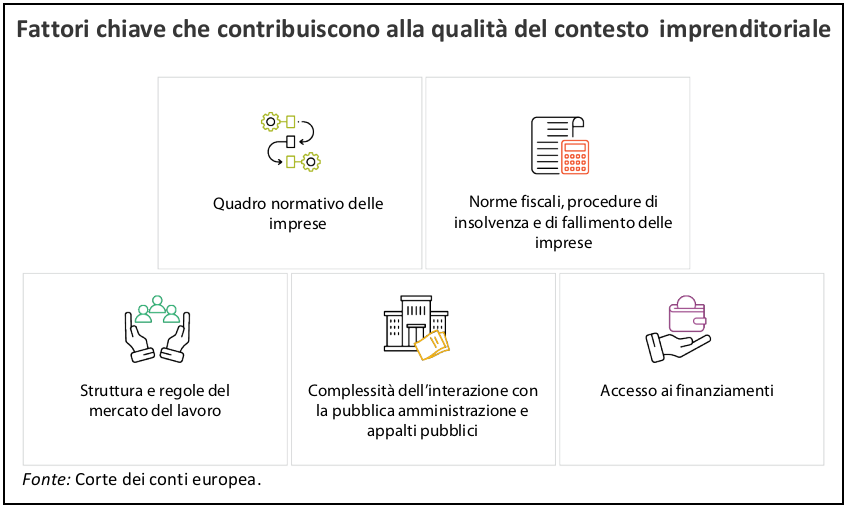
Speaking of Italy, even the Meloni government doesn’t shine when it comes to progress that could help relaunch businesses. Actions related to the business environment “are addressed only marginally by the reforms and investments” linked to the commitments under the Recovery Fund, the Court of Auditors said in its over 70-page report. To be fair, the problem is not just Italian, it concerns 15 other Member States (Austria, Belgium, Bulgaria, Estonia, France, Germany, Ireland, Latvia, Lithuania, Malta, Poland, Czech Republic, Romania, Slovakia, and Slovenia), but the Italian figure stands out since Italy, with a EUR 191,5 billion euros between grants (68.8 billion) and loans (122.6 billion), is the primary beneficiary of the post-pandemic recovery funds.
For Italy and its European partners, the advice is the same: accelerate with reforms. “The RRF could help make it easier to do business, but its potential has not been fully exploited,” said Ivana Maletić, European Court of Auditors member leading the audit. “The EU has used the pandemic recovery money as a carrot for EU countries to undertake important business-environment reforms, but the results are mainly not there yet.” It is therefore time to support businesses, also in the light of new, more uncertain and turbulent business environments, and in the light of the needs identified by Mario Draghi in his report on competitiveness.
The one produced by the Court of Auditors is not the first report on the recovery mechanism and its implementation by States. So far, a widespread situation has emerged in which resources are being used in ways detached from, and far from achieving, the stated objectives. From the risk of duplicate projects and funds being spent twice for the same purposes, to shortcomings in the sustainability agenda and delays in reforms and spending, the auditors in Luxembourg are highlighting a distinctly European story, one that risks falling short of success.
English version by the Translation Service of Withub