



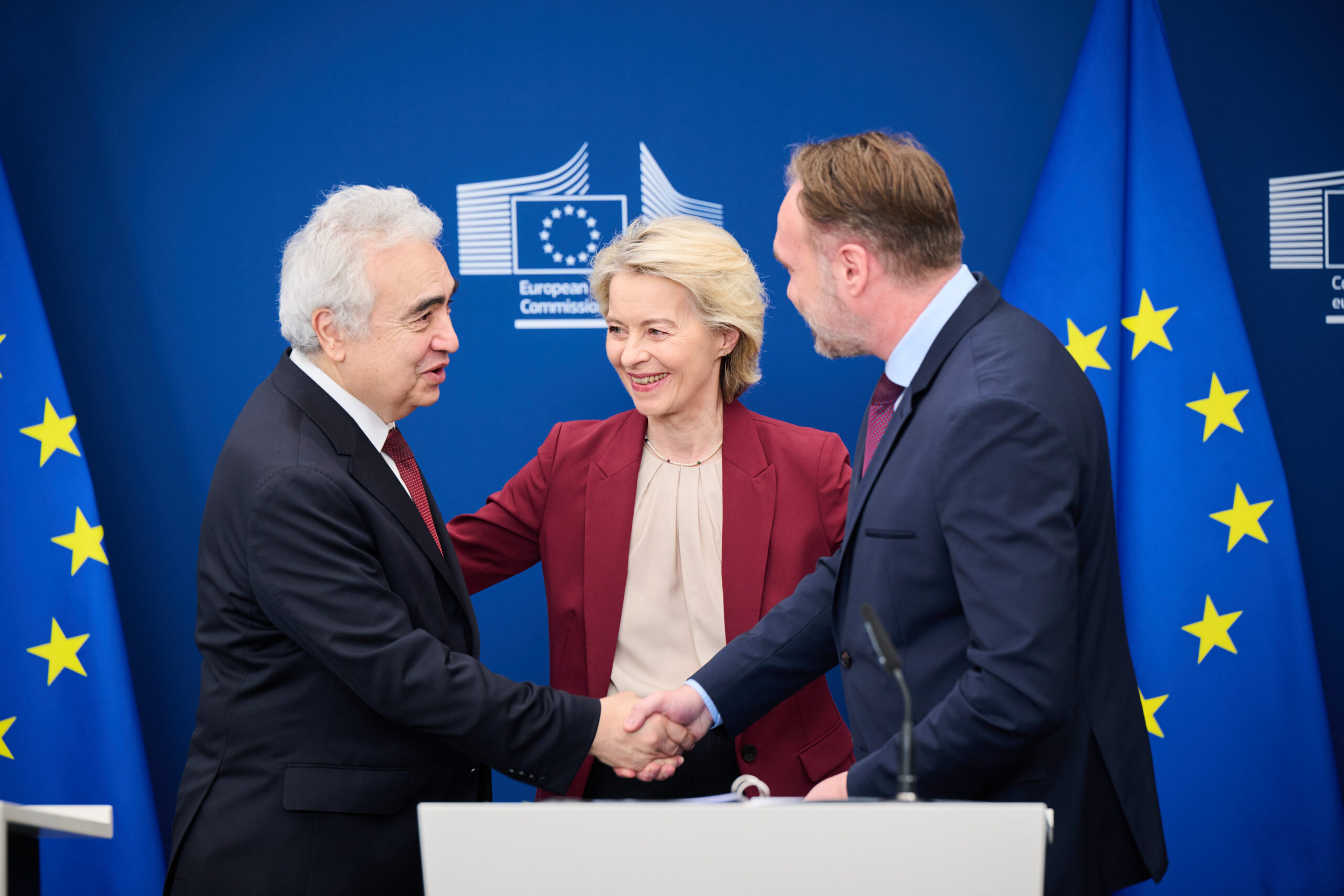
Brussels – The European Union will eliminate all natural gas imports from Russia by autumn 2027. “Today we close the taps,” rejoiced EU Energy Commissioner Dan Jørgensen, announcing the agreement among EU co-legislators on the roadmap the European Commission proposed in June. Indeed, compared to the original timetable, member states and the European Parliament chose to accelerate further to end energy dependence on Moscow.
“A good day for Europe, a good day for Ukraine, and a very bad day for Russia,” Jørgensen said at a brief press conference together with Ursula von der Leyen. The EU leader rattled off some figures, which “speak for themselves.” Since the start of the war in Ukraine, Russian gas imports – LNG and pipelines – have dropped from 45% to 13% of total EU imports, coal imports from 51% to zero, and oil imports from 21% to 2%. The EU was bankrolling Moscow to the tune of 12 billion euros a month. “Now we are down to 1.5 billion per month, still too much, and we aim to bring this figure down to zero,” said the European Commission president.
In essence, the Regulation introduces a legally binding, step-by-step ban on imports of liquefied natural gas (LNG) and pipeline gas from Russia, with a total ban from the end of 2026 and autumn 2027, respectively. “Six weeks after this Regulation enters into force, new short-term and long-term contracts will be prohibited. Then, we will deal with the remaining imports under existing contracts,” Jørgensen explained.

Under the terms of the agreement reached by the Council and Parliament, for short-term supply contracts concluded before 17 June 2025, the ban on Russian gas imports will apply from 25 April 2026 for LNG and from 17 June 2026 for pipeline gas. For long-term contracts for LNG imports, the ban will apply from 1 January, 2027, in line with the 19th sanctions package adopted in October; for long-term contracts for gas imports via pipeline, the ban will come into effect on 30 September 2027, provided that member states are on track to fulfill the storage filling targets foreseen in the gas storage regulation, and at the latest on 1 November 2027. In its original proposal, the European Commission had envisaged definitively closing the taps by 31 December 2027.
All Member States will have to submit national plans for diversifying their gas supplies. A requirement that also applies to those member states that continue to import Russian oil: Hungary and Slovakia, to which the EU had so far granted an exemption. The compromise reached overnight foresees that the European Commission will present a proposal in the coming months to end Russian oil imports to Budapest and Bratislava by the end of 2027. Hungary and Slovakia, landlocked countries and politically close to Moscow, had also strenuously opposed this during negotiations among the member states.
The regulation provides for “effective, proportionate and dissuasive” penalties for non-compliance with the deadlines. It maintains the suspension clause, which the Commission may activate in the event of risks to the security of energy supply of one or more member states. The EU Council and European Parliament indicated that the temporary suspension should be based on “strict necessity,” on a “state of emergency as declared by a member state, and only for a limited period and covering short-term supply contracts.”
Finally, the Commission is required to review the implementation of the regulation within two years of its entry into force to assess its impact. However, in Brussels’ plans, the path taken is one-way: “We will never go back to our dangerous dependence on Russia. To volatile supplies and market manipulation. To energy blackmail and economic exposure,” Jørgensen made clear.
English version by the Translation Service of Withub





![La video riunione dell'Eurogruppo [27 marzo 2026. Foto: European Council]](https://www.eunews.it/wp-content/uploads/2026/03/eurogruppo-260327-120x86.jpg)
