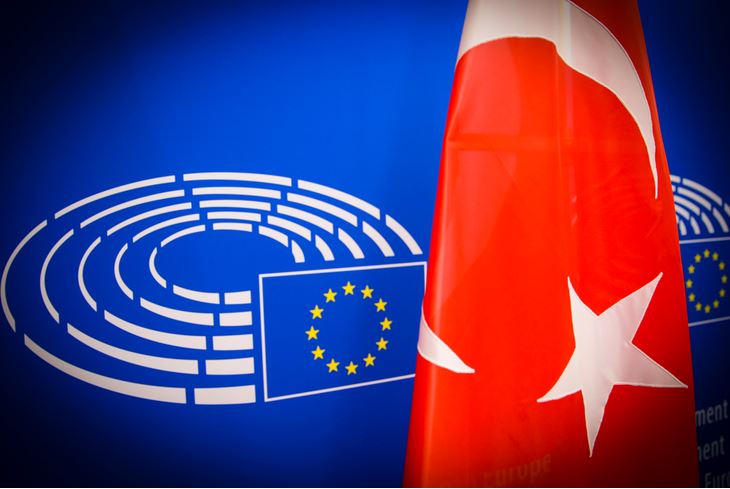
Brussels – Turkey is not making progress on its path towards the European Union. In addition, at present, the country led by Recep Tayyip Erdoğan is “lacking EU accession momentum due to democratic backsliding.” This is the view of the Committee on Foreign Affairs in the European Parliament, in a report – adopted today (15 April) with 44 votes in favor, 10 against, and 17 abstentions – which, on the one hand, calls on Ankara to take action on democratic reforms and, on the other, criticizes the “limited response of other European institutions” to the country’s disappointing developments, urging them to “take a stronger and more vocal stance in defense of democratic standards and the rule of law in Turkey.”
The European Parliament’s view on Ankara’s path towards the EU has remained unchanged over the past few years. Back in July 2023, the Committee on Foreign Affairs had already been asked to give its opinion on the same question — Turkey’s accession to the EU: yes or no? — and the outcome had been identical. In fact, Turkey has been in a deadlock in the accession process since 2018, when negotiations were frozen due to the deterioration of the rule of law, fundamental rights, and democracy. As a result, the EU has deemed Turkey incompatible with the accession criteria.
The application to join the Union was first submitted in 1987, when the European Economic Community (EEC) comprised 12 Member States. Today, 39 years later, structural problems remain, standing in the way of Ankara’s accession. The European Parliament’s committee calls on Turkey to “tackle persistent deficiencies in the areas of the rule of law, human rights, democratic standards, freedom of the press and other fundamental freedoms, as well as to respect good neighbourly relations and international law.” Particular emphasis is placed on the need to “strengthen judicial independence, safeguard freedom of expression, protect journalists and the rights of local authorities, and put an end to politically motivated trials.“
Despite everything, Turkey remains a country of strategic importance for the European Union, as well as a NATO ally, and MEPs highlight its significance due to its “growing presence and influence in areas critical to international security and EU strategic interests, such as the Black Sea region, including Ukraine, the South Caucasus, and the Middle East.” For these reasons, “the report highlights the importance of reinforcing EU-Turkey cooperation on regional security matters, particularly in light of the evolving geopolitical landscape.” MEPs also call for “the modernization of the customs union,” highlighting the importance of “Turkish compliance with outstanding benchmarks to restart the visa liberalization process.” Furthermore, the document calls on the EU and its Member States to maintain and, where possible, increase “financial assistance, stepping up support for Turkish civil society and refugee-led organizations.”
A window of opportunity for stronger cooperation still exists. The rapporteur for the text, the Spanish Socialist Sancho Nachez Amor, explains that “although we see no reason to resume the accession process, given the deterioration in democratic standards and the increasing repression of the opposition and critical voices, there is a window of opportunity to make progress on the rest of the bilateral sectoral agenda.” Such an opening would include “closer cooperation on foreign policy is essential to achieving further progress on security and defense. We also hope to see progress in the ongoing ‘Terror-free Türkiye’ initiative, but this requires determination and a willingness to take risks.”
The ball now passes from the Committee on Foreign Affairs to the European Parliament’s plenary session. The next appointment will therefore be one of the forthcoming sessions in Strasbourg, where the full House will vote on the report.
English version by the Translation Service of Withub
![[credits: Dietmar Rabich / Wikimedia Commons / “Münster, Stadtweinhaus, Beflaggung Ukraine und EU -- 2022 -- 0219” / CC BY-SA 4.0]](https://www.eunews.it/wp-content/uploads/2026/03/ue-ucraina-350x250.jpg)