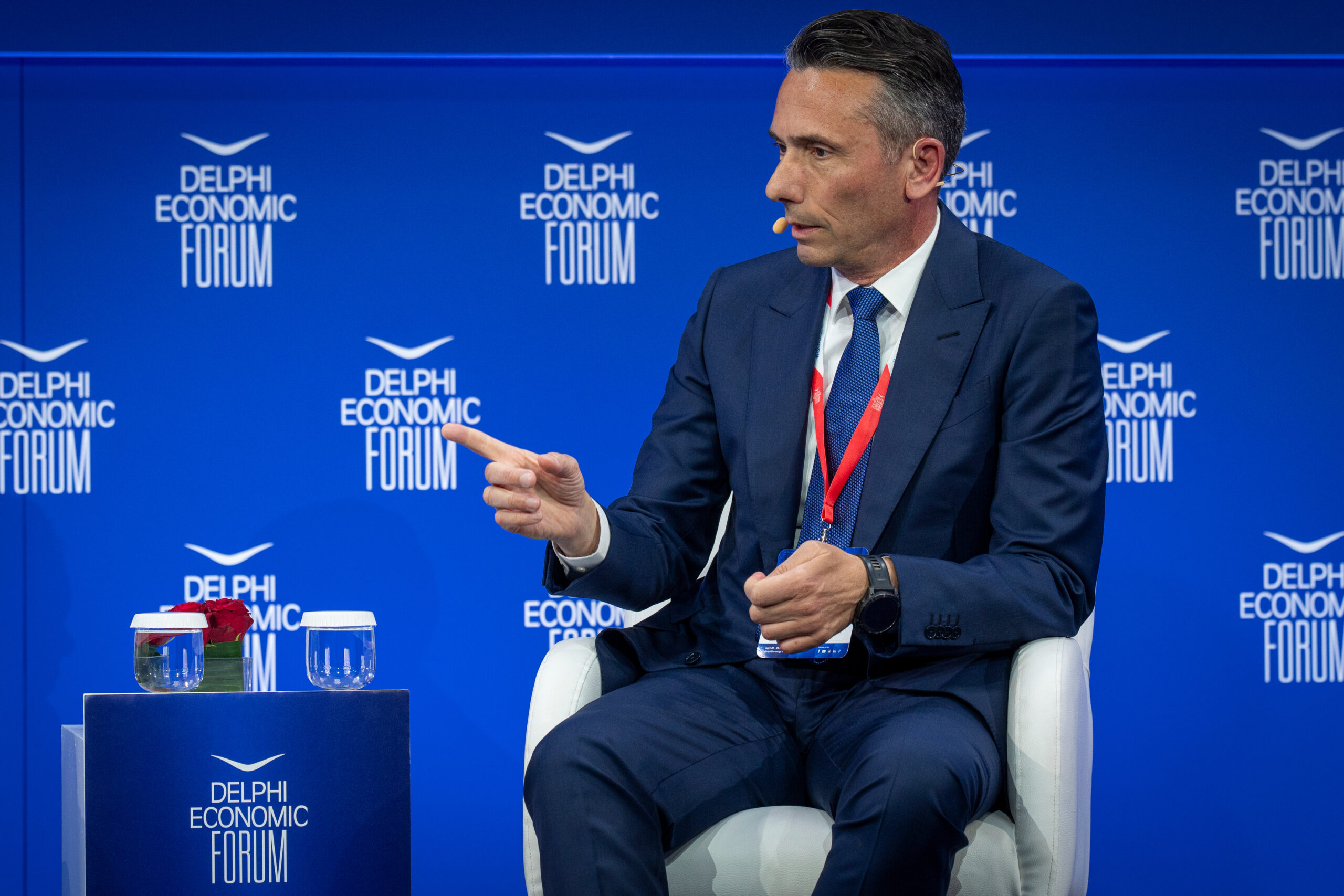
Delphi, by our correspondent – Amid the increasingly heated debate over the future of European tobacco policy, the industry is attempting to make its voice heard, adopting a tone intended to legitimise its role in the dialogue. Speaking is Christos Harpantidis, Vice-President of Philip Morris International for European Affairs, at the eleventh edition of the Delphi Economic Forum, who starts from a clear position: “We are in favour of regulation, both on the fiscal front and in general,” says Harpantidis, reiterating a double yes to the two revisions of key directives under discussion. “So, yes to the TED, yes to the TPD, but with common sense.”
It is precisely this phrase, “common sense”, that recurs several times throughout the interview. For Harpantidis, in fact, the issue is not regulation itself, but how it is implemented. “Someone needs to analyse the problem, understand what the real issue is, and not lump everything together.”
The key point, he insists, is differentiation. “Understanding the problem, identifying the available solutions, and taking the appropriate measures.” According to the manager, several European countries are already moving in this direction, treating the alternatives “correctly” and distinguishing “categories based on their impact on health.” An approach that is still lacking in some European proposals, particularly in the early stages of the revision of the Tobacco Taxation Directive, which are deemed “abnormal,” lacking in “common sense” and without “scientific evidence to support them.”
The criticism becomes more pointed when the discussion turns to the European Commission’s assessment. “Unfortunately, it is not a good report,” he said bluntly, referring to the Revision of the Tobacco Products Directive. “There is a complete lack of economic impact,” and “there is a lack of important scientific evidence.” Additionally, “they are also ignoring third-party science that does not fit the narrative they wish to promote.” A situation that “risks compromising the quality of public policy.”
According to Harpantidis, one of the most serious omissions is illegal trade. “In such serious policies, illicit trade, as it is a major problem in Europe, should be taken into account“, he insists, emphasising how the phenomenon also has direct implications for minors. “The report overlooks significant aspects of today’s reality and should be reassessed,” he adds. “This is a real problem affecting almost all European countries, with effects ranging from tax revenue to consumer safety,” he explains.
Politically, the future of the excise duty directive remains uncertain, amid national resistance and conflicting interests. Yet Harpantidis retains some confidence in the European system. “This is the EU: where there’s a will, there’s a way,” and “when the parties want to end a battle, they find a way to do so.” The differences between countries, from Sweden to Luxembourg, “are understandable,” he notes, but “it is the task of the presidency and the Commission to find a way to overcome this obstacle.”
The discussion then moves on to a broader issue: that of European competitiveness. Here, the assessment is harsher. “We have gone too far,” he says, referring to regulations. “We are too slow and are clearly losing competitiveness,” in a situation where “the figures are clear,” and “no one can dispute them.” The accumulation of regulations has become a real problem, with “fifteen directives” directly affecting the sector, in addition to national legislation.
According to Harpantidis, there is a need for some soul-searching within European institutions. “Europe should not only demand structural changes from Member States,” but also “assess what structural changes are necessary for the Commission itself.” Above all, “it needs a plan to explain to citizens” how to become competitive “in the new era,” he explains.
Then there is the most sensitive issue: the relationship between institutions and the tobacco industry. The term “criminalisation” is mentioned, but with caution. “It’s a strong expression; I wouldn’t want to use it, but I understand its meaning,” he admits. “I travel the world and meet prime ministers and ministers… but I can’t speak to a European Commission official,” he says. A situation he describes as “a legacy of the past” and one that “doesn’t work.”
The message is clear: “We need to launch a serious, truly serious discussion.” According to Harpantidis, the European challenge is not only regulatory, but also cultural and political. And it inevitably requires a more open dialogue between institutions and industry, in a context that remains one of the most complex and heavily regulated in the world.
English version by the Translation Service of Withub