
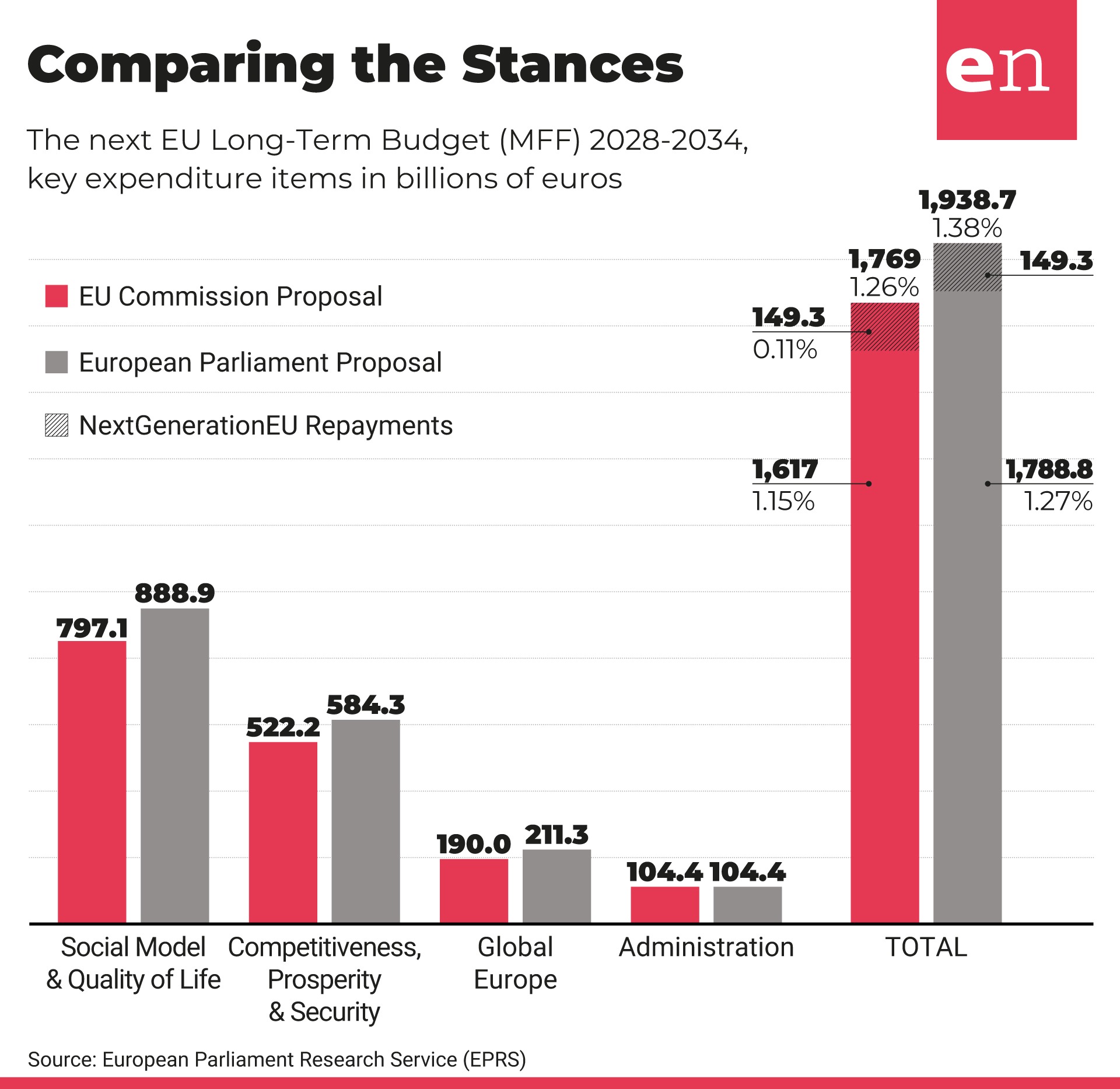
Brussels – An extra 200 billion, on top of the approximately 2,000 billion proposed. Now the European Parliament’s position on the next Multiannual Financial Framework (MFF 2028–2034) is final, leaving no room for doubt: the Chamber has approved the institution’s position in the negotiations on the next budget, confirming the standoff with the Council, which is instead calling for fewer resources, and opening a debate entirely within the European People’s Party (EPP) family. The European centre-right in Parliament has a position, in line with the other groups (Socialists, Liberals, and Greens) in favour of more resources, while within the European Council the leaders, now 11 out of 27 (Austria, Croatia, Finland, Germany, Greece, Latvia, Luxembourg, Poland, Portugal, Sweden, and Hungary), have a completely different stance.
The first to put pressure on the Council is Siegfrid Muresan, Vice-Chair of the EPP Group and rapporteur for the measure: “The European Parliament’s position is clear: we believe it is not possible to do more with less.” So let’s go ahead with the budget increase, because, he argues, “the debt repayment” of the NextGenerationEU post-pandemic recovery programme “should not be at the expense of the programmes’ beneficiaries.” In addition, “we want a separate budget for agriculture and cohesion, as well as legal certainty,” he states, rejecting the approach of his party colleague, European Commission President Ursula von der Leyen, and the idea of lumping everything together.
 The call for an increase of around 10 per cent (€200 billion) serves this purpose precisely: to exclude from the seven-year budget the repayment of loans taken out from the markets to finance the recovery plans (NRRP), which MEPs are calling for to be managed separately, without affecting EU funds, as proposed by the Commission. Manfred Weber, the EPP group leader and also party president, calls for “a strong and solid budget for the future of the EU,” and seeks to flush out those opposed to this programme: “The moment of truth has arrived,” he argues. “Those who are not prepared to give the EU the necessary resources and tackle the issue of ‘own resources’ must be honest and tell us that the only alternative is to make cuts.”
These words fail to convince the Greens, who hit back: “On the one hand, Manfred Weber talks about a strong Europe; on the other, [German Chancellor] Friedrich Merz is presenting documents to Ursula von der Leyen containing reform proposals in favour of deregulation,” says Terry Reintke, co-chair of the Greens, who sends a message to leaders in even clearer terms: “If we want to repay the Next Generation EU debt with a stable budget level, without cutting successful programmes such as Life, Horizon, and Erasmus – which we also need for the transition – we must increase the budget.”
The Socialists also warn: “For Parliament to approve the financial framework , we will need a broad pro-European majority that includes the EPP, S&D, Renew, and the Greens,” says the group leader, Iratxe Garcia Perez, adding that “this vote is a first sign and we will also have to work on the narrative in the Member States so that they understand.”
The real puzzle will therefore lie in the numbers and the alliances, for a dossier that remains divisive — as shown by the votes of a Chamber that is already split, and increasingly so in the Council.
The discontent
There is certainly agreement among the EPP, S&D, RE, and Greens on this issue, but each has something to say. Among the Socialists, the PD representative, Stefano Bonaccini, considers “the 20 per cent cuts to the Common Agricultural Policy (CAP), the elimination of rural development funds, and the exclusion of local authorities from the management of resources to be unacceptable.” The Spanish socialist Juan Fernando Lopez Aguilar shares this view, convinced that “agricultural and cohesion policies must continue to exist under their own names,” thereby rejecting the single fund concept.
The Liberals (RE), through their group leader, Valerie Hayer, are unhappy with the approach to EU funding sources outside the budget, and she therefore makes it clear: “We will not give our consent to the budget unless there is credible progress on own resources.“
Own resources, on the other hand, are one of the reasons why the Conservatives (ECR) are voting against the 2028–2024 MFF proposal: “We oppose the introduction of new own resources and a further centralisation of budget management,” said Nicola Procaccini (FdI), co-chair of the group. In his view, there are also “shortcomings” in the overall approach. “On migration,” he explains, “the approach is still incomplete, and too much emphasis is placed on policies linked to the Green Deal at a time when the EU should be focusing on competitiveness and economic resilience.”
These remarks prompted a reaction from Valentina Palmisano (M5S/laSinistra), who launched an attack on the government and its majority parties: “Tell us about the Stability Pact which you have signed, tell us about the austerity measures and the rearmament programme that you voted for.” In the Council, the Five Star Movement representative continues, “the frugal countries are reorganising themselves, and the Italian government remains silent.” Hence, the message for Procaccini: “We need our own resources, starting with a tax on the windfall profits of energy companies.“
In this debate, the Commissioner responsible for the budget, Piotr Serafin, seeks to “emphasise the concept of timeliness,” which means “the urgency of reaching an agreement in 2026.” The Commission’s draft budget for 2028–2034 is not set in stone; “we must also build a degree of flexibility into the financial framework,” while bearing in mind that “the Commission has proposed a budget that reflects the scale of our common challenges: competitiveness, security, and our global role, while continuing to support cohesion and agriculture.”
English version by the Translation Service of Withub