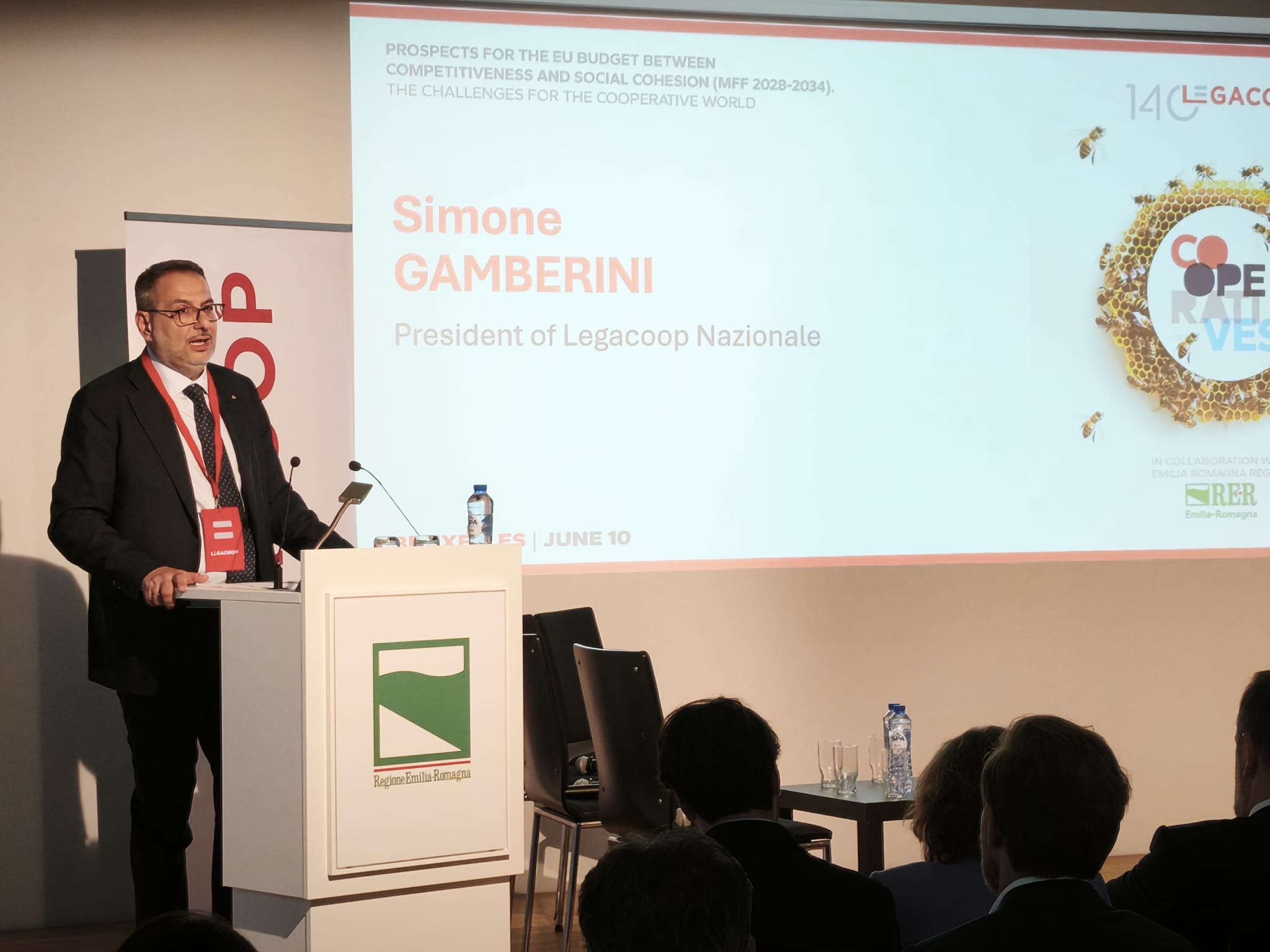
Brussels – “We have organised this meeting with European and national institutions to discuss the 2028–2034 financial framework.” The president of the National League of Cooperatives and Mutual Societies, Simone Gamberini, introduced the high-level conference on the Multiannual Financial Framework (MFF) 2028–2034, held yesterday (10 June) at the EU headquarters of the Emilia-Romagna Region delegation. The event brought together cooperatives, institutions and European networks with a clear message: there can be no competitiveness without social cohesion.
The conference was organised into three parallel thematic round tables (Agri-food, Fisheries and Large-scale Retail; the European Competitiveness Fund and Sectoral Instruments; Social Europe: Culture, Welfare, Housing), followed by a plenary session. “Legacoop wants to understand how we can make room for policies on competitiveness and the maintenance of a model based on social cohesion,” Gamberini explained. He added that it was necessary to “create the conditions to secure more funds, ensuring that resources for competitiveness do not come at the expense of cohesion funds or the CAP, and preserve a governance that does not fragment common policies into too many national plans.” This is the recipe the president recommended. A recipe in which “the cooperative sector represents a business alternative that brings together the centrality of the individual, innovation, sustainability, and competitiveness,” he observed. “The European budget must reflect these principles,” Gamberini reiterated, noting that Legacoop’s main objective is ‘to uphold the idea of a cohesive Europe, where the interests of individual states do not prevail, but rather development and social protection.”
During the plenary session, the Executive Vice-President for Cohesion and Reforms, Raffaele Fitto, also highlighted the role of cooperatives, describing them as “one of the best examples of how economic growth and social value can go hand in hand.” In particular, Fitto acknowledged their importance in “creating jobs, investing in local communities, strengthening the resilience of local areas and, last but not least, contributing to sustainable and inclusive development.” Furthermore, “in many rural, peripheral, or particularly vulnerable areas, cooperatives constitute an essential economic and social pillar,” he pointed out, noting that “their contribution will also be decisive in shaping the new era of European policies.”
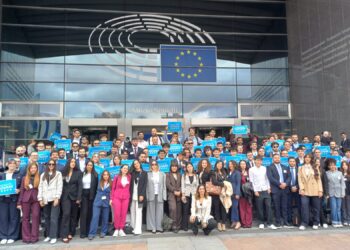
Camilla Laureti, a Member of the European Parliament for the PD (S&D), highlighted the role of cooperatives, particularly during the debate on the MFF in the European Parliament. Referring to a meeting held at the European Parliament with regions, associations, and representatives of the cooperative model, Laureti described coordination with the latter as “essential, especially at a time like this, marked by upheaval and uncertainty.” Similarly, PD MEP Brando Benifei (S&D) stated that “in the fight for an ambitious and balanced European budget, we can count on the support of the cooperative sector and, specifically, of Legacoop.” According to Benifei, “cooperatives are valuable allies because they understand the close link between innovation and social cohesion,” and share the goal of “building European competitiveness that is not based on a race to the bottom on prices, but is founded on the European social model, on the protection of rights and on cohesion.”
English version by the Translation Service of Withub