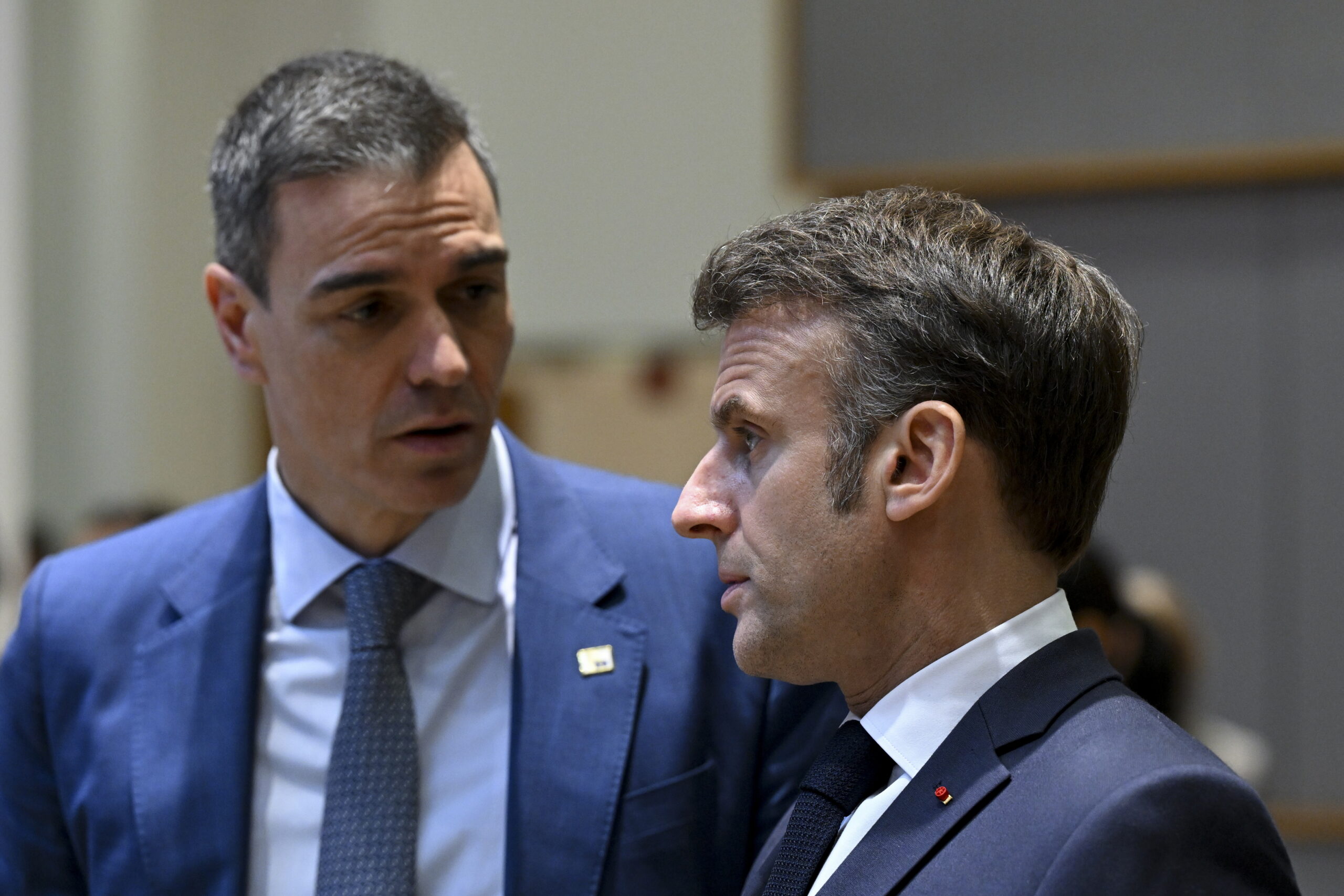
Brussels – A liberal more progressive than a socialist on immigration? This is the paradoxical picture that seems to be emerging from the post-European Council press conference held today (19 June) by the French President, Emmanuel Macron. The President was asked to state his position on the recent approval of the Returns Regulation by the European Parliament and, above all, on the note with which, this morning, fourteen Member States urged all European governments to put it into practice by building new repatriation centres in third countries. At the forefront of this movement, alongside the Italian Prime Minister, Giorgia Meloni, is a social-democratic leader: Denmark’s Prime Minister, Mette Frederiksen.
Although he comes from a much more centrist political background, Macron spoke in no uncertain terms. “France does not support the policy of repatriation hubs for non-EU countries,” the French President stated clearly, before going on to outline the two main reasons for his opposition.
First of all, there is a question of effectiveness because, as Macron explained, “I have never seen one of these centres actually work; in recent months, I have only heard people talking about them and signing agreements.” But above all, this type of project raises serious concerns regarding respect for fundamental human rights. Addressing, indirectly, those countries that have already begun to trial these solutions or intend to do so in the near future, the French President posed a series of rhetorical questions: “What will you do? Will you send people who do not want to return, or whom you are unable to return, to their country of origin to a third country that, perhaps, will accept them in exchange for money? What sort of relationship will you create? On the basis of which human rights?” Macron’s own answer is simple and unequivocal: “I am not sure that these are the fundamental principles upon which our Europe was built.”
While making it clear that Paris supports a migration policy that is “very strict and capable of making repatriation more effective,” the French leader reiterated that “as far as France is concerned, the answer is no to hubs in non-EU countries” and that this refusal is based on “a disagreement both from a pragmatic and a principled standpoint.” Furthermore, Macron challenged the very spirit of the letter signed by Meloni, Frederkisen, and 12 other leaders, namely the aim of giving a fully European dimension to a practice that many liken to outright deportation. “I believe that all this has nothing to do with European policy and that it falls within national competences; for this reason, I will oppose the next EU budget being used to build these centres,” warned the occupant of the Élysée Palace.
While a leading figure from the progressive camp (Frederiksen) is being overtaken on the left by a moderate (Macron), there is another prominent figure on the European left attempting to stem this trend, taking an equally hard line against the Meloni-Frederiksen letter.
The Spanish Prime Minister, Pedro Sánchez, during this afternoon’s press conference, described the solution involving repatriation centres in third countries as a veritable “deception.” The Spanish leader also framed the issue in terms of both pragmatism and values. “Firstly, it will simply be a waste of economic resources—and Europe does not have many of them—and secondly, it sends the wrong message to those countries of origin and transit with which we must instead cooperate and show empathy.” According to Sánchez, the message these states receive from the Return Regulation is simply equivalent to saying: “This is your problem; we’re staying out of it.”
In his tirade, however, the Spanish Prime Minister can also point to the successes of a migration policy of a diametrically opposite nature, which in recent years has enabled the Iberian country’s economy to grow at much faster rates than the rest of Europe. Sánchez outlined the main pillars of his alternative model. The first is the implementation of mechanisms to regularise migrants who have arrived in Spain and were initially classified as undocumented. “This is precisely what businesses are asking of us,” emphasised Sánchez, noting that “social partners know they need labour to fill vacancies in key sectors, such as construction.” The second pillar is integration, on which the Spanish leader’s view is straightforward: “Those people who already live in our country and who contribute to economic development deserve to have the same rights as other citizens.”
With Europe veering ever further to the right, Sánchez’s (and Macron’s) approach is increasingly taking on the characteristics of a fight against windmills. And this is perhaps also why Madrid is trying to rely on “help” from external forces. “If you have any doubts (as to whether the Spanish approach is the right one, ed.), well, talk to the Vatican,” Sánchez concluded his speech. The reference is to the recent statements by Pope Leo XIV, which described remigration as “an unchristian response.” “Let’s try God too, you never know”, sang Ornella Vanoni.
English version by the Translation Service of Withub
![[Foto: Unsplash]](https://www.eunews.it/wp-content/uploads/2026/06/max-bohme-0NWnW2jgY6k-unsplash-350x250.jpg)

![Da sinistra: il presidente del Consiglio europeo, Antonio Costa; il presidente dell'Ucraina, Volodymir Zelensky: la presidente della Commissione europea, Ursula von der Leyen [Bruxelles, 18 giugno 2024. Foto: European Council]](https://www.eunews.it/wp-content/uploads/2026/06/euco_ua260618-120x86.jpg)
![[foto: Saverio De Giglio/imagoeconomica]](https://www.eunews.it/wp-content/uploads/2026/10/cpt-120x86.png)