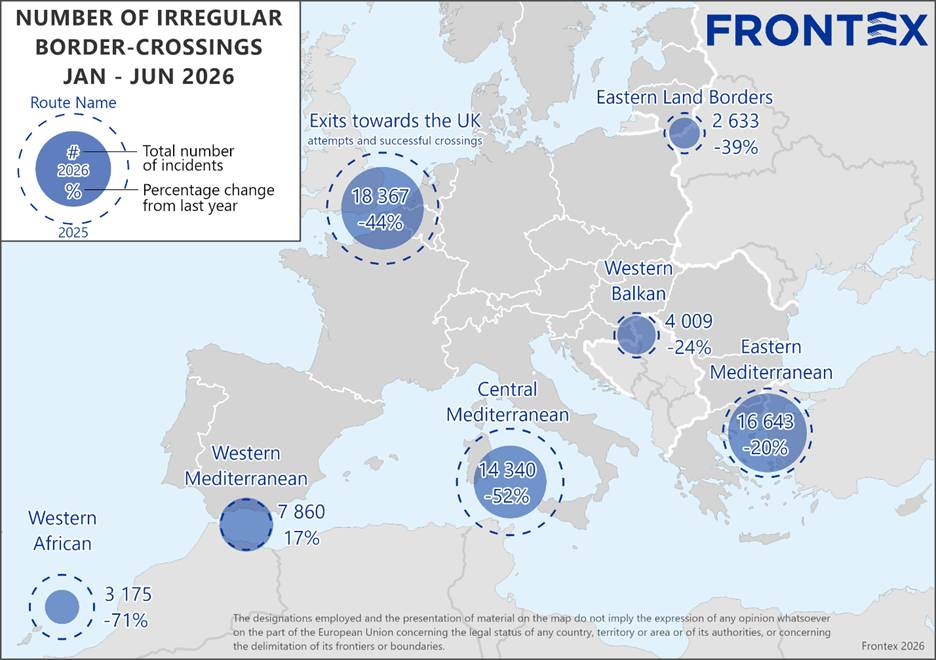
Brussels – The entry into force of the new European Pact on Migration and Asylum coincided with a sharp fall in irregular entries into the European Union: in the first six months of 2026, illegal crossings of the external borders fell by 37 per cent compared with the same period in 2025, totalling just over 49,000 cases. This is according to the latest data released by Frontex, the European Border and Coast Guard Agency, which attributes the result to both the implementation of the new European rules and strengthened cooperation with countries of origin and transit for migration flows.
The Pact on Migration and Asylum, which was finally approved in 2024 and came into force this year, introduces a common system for managing migration within the European Union, with the aim of “making asylum procedures faster and more effective, strengthening external border controls, improving the sharing of responsibilities between Member States and stepping up cooperation with third countries to combat irregular departures and human trafficking”, as stated in the text of the Pact.
It is precisely on these aspects that Frontex’s work is currently focused. According to Executive Director Hans Leijtens, the decline in departures is “the result of sustained cooperation with our partners in the region,” while noting that “behind every number there is a person,” and that tragedies at sea continue to represent a serious humanitarian emergency.
The analysis shows that the eastern and central Mediterranean remain the main entry points into Europe, together accounting for over 60 per cent of irregular crossings. The eastern Mediterranean route recorded over 16,600 arrivals, down by 20 per cent, with the corridor between Libya and Crete remaining the most frequently used. In the Central Mediterranean, there were around 14,300 arrivals – less than half the previous year’s figure – with Libya still the main point of departure and nationals of Bangladesh, Somalia, and Sudan among the most represented nationalities.
The western Mediterranean bucked the trend, being the only major route to record an increase: around 7,900 crossings, representing a 17 per cent increase, driven mainly by departures from Algeria and a gradual shift of smuggling networks towards this route following the tightening of controls in Morocco and on other African routes. The sharpest decline, however, was observed on the West African route, where arrivals fell by 67 per cent thanks to “preventive measures adopted by Mauritania, Senegal, and The Gambia in collaboration with Spain and the European Union.”
Despite the sharp decline in migrant flows, Frontex stresses that the migratory pressure “cannot be considered to have subsided.” The International Organisation for Migration estimates that so far this year, nearly 1,300 people have lost their lives in the Mediterranean while attempting to reach Europe. Furthermore, developments in the Middle East continue to be closely monitored: although the ceasefire reached in June offers a glimmer of hope for the region’s gradual stabilisation, the conflict’s effects and economic consequences could continue to fuel new migratory pressures in the coming months.
English version by the Translation Service of Withub


![[Foto: Unsplash]](https://www.eunews.it/wp-content/uploads/2026/06/daniel-schludi-e1RI3wRelqM-unsplash-350x250.jpg)
![Il consiglio Affari interni, mentre discute di immigrazione [Lussemburgo, 4 giugno 2026. Foto: European Council]](https://www.eunews.it/wp-content/uploads/2026/06/migration-table-350x250.jpg)