Brussels – Asylum applications in the European Union fell in February 2026. However, across the 27 Member States, the number of pending cases is rising, with people still awaiting an initial decision. According to the latest Eurostat bulletin, published today (18 May), in February 2026, the number of people who applied for international protection for the first time in EU countries stood at 46,420, down 21 per cent compared to the same month in 2025 (when the figure was 59,080) and down 9 per cent compared to January 2026. In addition to new applicants, 9,080 people reapplied following a decision on a previous application (+12 per cent compared to February last year).
Venezuela remains the main country of origin for asylum seekers, with 6,835 initial applications submitted in February. This is followed by nationals from Afghanistan (4,325), Bangladesh (3,450) and Egypt (1,815). The reception of new applicants is heavily concentrated: Italy (10,560 applications), Spain (10,410), France (7,900), and Germany (6,985) together received 77 per cent of all initial applications in the EU. When analysing the number of applicants in relation to the resident population, the greatest pressure falls on Greece, with 34.3 applicants per 100,000 inhabitants, followed by Spain (21.2) and Ireland (18.4), while the European average stands at 10.3.
One particularly striking figure concerns unaccompanied minors: 1,015 of them applied for protection in the EU for the first time in February 2026 alone. Most of these very young people come from Somalia (215), Venezuela (165), Afghanistan (105), Egypt (80), and Guinea (55), and they mainly apply in Germany (255), Spain (190), the Netherlands and France (both 130), and Greece (115).
Despite the decline in new applications, the European asylum system still appears to be under pressure. At the end of February 2026, there were 1.20 million applications awaiting a final decision. This represents a slight increase (1 per cent) compared with the previous month, although the figure is down by 4 per cent year-on-year. Germany has the highest number of pending cases (291,245), followed by Spain (251,140) and Italy (237,485), with the latter figure reported by Eurostat as having low reliability.
The trend observed in February is not an isolated phenomenon but is in line with what was observed in January 2026hen the initial number of applications stood at 51,160. In both months, the flow pattern remained largely the same, with the same countries of origin (Venezuela and Afghanistan) and the usual four Member States (Italy, Spain, France, and Germany) accounting for the vast majority of applications. More generally, the data confirm a gradual decline in applications compared to the record levels reached in 2023, a year in which a peak of over 114,805 applications was recorded in October alone; since then, throughout 2024 and 2025, the number of people seeking protection in the EU for the first time has shown a general downward trend.
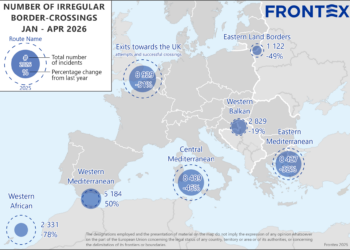
In addition to the decline in asylum applications, the European migration landscape is characterised by a marked shift towards the closure and externalisation of borders. According to Frontex data from May 2026, there has been a sharp drop in irregular entries, down by 40 per cent in the first four months of the year, due to closer cooperation with partner countries and preventive measures in countries of origin. At the same time, there has been a tightening of control measures: the EU has stepped up restrictive measures, with a 7.1 per cent increase in pushbacks at external borders and a 20.9 per cent surge in actual returns.
This firm stance has recently gained fresh political legitimacy on 15 May, when the Council of Europe—the Strasbourg-based international organisation comprising 46 member states, not to be confused with the Council of the European Union—signed a declaration reaffirming the indisputable sovereign right of states to decide on the entry of foreign nationals and to adopt “new approaches” to deter irregular migration, including the use of return hubs in third countries. A statement that reflects what has already been approved by the European Parliament on 26 March, with a regulation introducing tougher rules on returns—including the possibility of detention for up to 24 months in the event of non-cooperation—and the outsourcing of procedures to centres located outside the EU, such as the one in Albania.
Taken together, these measures suggest a strategy aimed at turning Europe into an “impenetrable fortress”, often disregarding calls for human rights—described as “dismantled” by certain parliamentary factions and recognised as “at risk” by the majority of the European Parliament—and even failing to “harness” migration flows as a useful resource for combating a European demographic decline, now regarded as a structural problem.
English version by the Translation Service of Withub