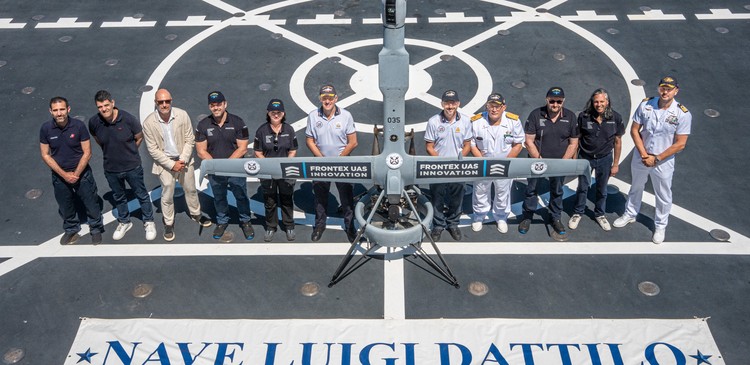
Brussels – Frontex and Italy have joined forces to trial the operation at sea of the largest drones ever used by the European Border and Coast Guard Agency. The test took place between May and July. It was a pilot project with the Italian Coastguard, under which “two vertical take-off and landing drones operated day and night from a patrol vessel (the Luigi Dattilo) in the central Mediterranean, providing the crew with a real-time view of what was happening well beyond the bridge’s line of sight”, explains Frontex. “This was the first time that drones of this class, weighing between 50 and 100 kilograms, and indeed two of them, had flown as an integral part of a vessel as part of a Frontex pilot project,” the Agency points out.
Frontex states that the aim of the trial was to ascertain whether drones and a vessel could operate as a single system, extending the vessel’s field of view and supporting the full range of Coast Guard tasks, from monitoring maritime traffic to search and rescue. The mission was a success given that, according to the Agency, one of the key findings of the trial was that the drones were not merely a temporary addition: communication antennas, ground data terminals, and control stations were installed in the vessel’s operations room, making the drones an integral part of the vessel and an operational tool in the Italian Coast Guard’s daily routine.
The results were put to the test on 8 July, when senior representatives from Frontex and the Italian Coast Guard witnessed a live demonstration on board: in a search-and-rescue simulation, one of the drones located a small rubber dinghy and helped to coordinate its recovery. “A strategy is really a dream, an idea of what you want to achieve. But when you’re on a moving ship, and you see the drone take off, carry out its task, and allow the crew to focus not on piloting the drone, but on the mission, that goes beyond anything you could have imagined,” said Aija Kalnaja, Deputy Executive Director for Capabilities at Frontex.
Over 19 days at sea, from 27 June to 15 July, the drones completed the 150 hours of flight time planned for the trial, two days before its official conclusion. At the height of the trial, the two drones remained airborne simultaneously for a total of 20 hours a day, demonstrating a range of 150 kilometres from the ship, “well beyond the range of sensors alone, with the potential for the drones to fly even further.” Throughout the operational phase, a live video feed was transmitted to a centralised display system (Common Operational Picture, COP), a single real-time representation of the situation at sea shared by the ship and the command centres on land. “Following system integration tests that began in mid-May, flight operations were gradually scaled up in three phases, with flights becoming progressively longer, more complex, more operationally significant and more exposed to difficult sea conditions,” explains Frontex.
According to Rear Admiral Luigi D’Aniello, Head of the Planning and Operations Department at the General Command of the Italian Coast Guard, “drones undoubtedly represent added value, something that can open up new possibilities: a truly innovative approach that keeps pace with technological developments and adapts to the changing nature of the challenges we face.” This is because “the international landscape has developed and changed so rapidly in recent years, and each time this brings about strategic, tactical, and operational changes across all areas of the Italian Coast Guard’s activities,” he said.
The drones were owned and operated by two specialist contractors, Global SAT as the main contractor and Shield AI as the subcontractor, which together provided a comprehensive service, from take-off to data delivery. Frontex will now carry out a comprehensive assessment of the results, but “the project has already produced a set of guidelines and lessons learnt for the integration of drones into day-to-day border and coastguard operations, and its findings will be shared with Member States and EU agencies in the autumn.” Finally, the findings will feed into Frontex’s plans to modernise surveillance across the European border and coastguard community.
English version by the Translation Service of Withub

![[Foto: Unsplash]](https://www.eunews.it/wp-content/uploads/2026/06/daniel-schludi-e1RI3wRelqM-unsplash-350x250.jpg)

![[foto: European Council]](https://www.eunews.it/wp-content/uploads/2026/03/euco-260319-120x86.jpg)