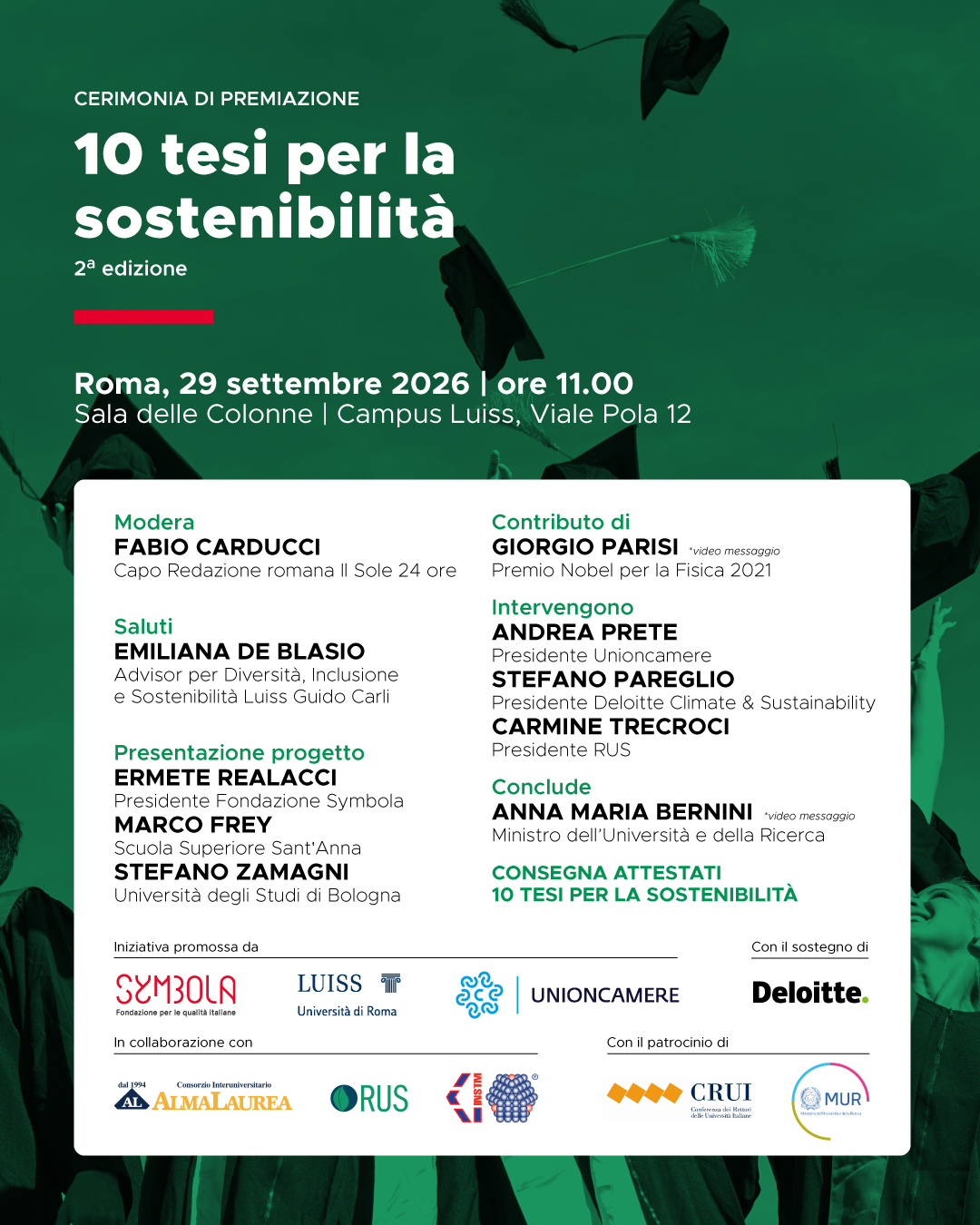
Brussels – From economics to engineering, from literature to political science, countless fields of knowledge place sustainability at the centre as the defining theme of this century, linking seemingly irreconcilable areas of study and professionals from different disciplines. This interdisciplinary approach has given rise to the second edition of “10 Theses for Sustainability”: 1,699 participants from over 80 universities across Italy. This initiative is promoted by the Symbola Foundation, Luiss Guido Carli University and Unioncamere, with the support of Deloitte Climate & Sustainability, under the patronage of the Ministry of Universities and Research and the Conference of Rectors (CRUI), in collaboration with the AlmaLaurea Inter-University Consortium, the Network of Universities for Sustainable Development (RUS), the National Inter-University Consortium for Materials Science and Technology (INSTM) and 26 other universities.
The partner universities, in addition to Luiss, are: Bocconi University in Milan, the Catholic University of the Sacred Heart, Ca’ Foscari in Venice, Federico II in Naples, La Sapienza, LUMSA, the Polytechnic University of the Marche, the Polytechnic University of Milan, the Polytechnic University of Turin, Roma Tor Vergata, Sant’Anna in Pisa, the Universities of Bari Aldo Moro, Basilicata, Brescia, Cagliari, Camerino, Ferrara, L’Aquila, Macerata, Milano-Bicocca, Padua, Parma, Perugia, Teramo, San Raffaele Online University in Rome and Universitas Mercatorum.
The Scientific Committee that selected the winners is chaired by Emiliana De Blasio (Advisor on Diversity, Inclusion and Sustainability at Luiss), Stefano Zamagni (Professor Emeritus at the University of Bologna) and Marco Frey (Professor at the S. Anna School of Advanced Studies in Pisa and Chair of the Scientific Committee of the Symbola Foundation). The theses are available on the www.symbola.net website. Of the participants, 61 per cent were women and 39 per cent were men.
The universities with the highest number of submissions are: Università Cattolica del Sacro Cuore (203 theses), University of Bologna (107 theses), La Sapienza (90 theses), followed by Padua, Turin, Rome Tor Vergata, Federico II of Naples, Ca’ Foscari in Venice, the Polytechnic University of the Marche and the Polytechnic University of Milan.
At the regional level: Lombardy (382 theses) 22.50 per cent; Lazio (270) 15.90 per cent; Emilia-Romagna (208) 12.24 per cent; Veneto (166) 9.78 per cent; Campania (115) 6.77 per cent.
The 10 winners received a prize of 2,000 euros. A further 90 honourable mentions were awarded to the non-winning theses deemed most deserving. There is also the opportunity, through Unioncamere and Deloitte, to attend company interviews to foster links with the labour market.
“The high level of participation in the ‘10 Theses’ competition demonstrates that we can tackle the challenges ahead by drawing on the clean, renewable energy of the knowledge and intellect of young people in our country,” said Ermete Realacci, president of the Symbola Foundation. “The call for entries can provide us with important insights and inspiration. It is an initiative that today recognises 10 university theses from different academic disciplines which make strong and original references to sustainability,” he added. “An opportunity to rally and empower the Italy that makes Italy. On the eve of COP31 in November, the message of the Assisi Manifesto is reaffirmed: tackling the climate crisis with courage is not only necessary, but represents a great opportunity to make our economy and our society more people-centred and, as a result, better equipped for the future,” he stressed.
“As the driving force behind an initiative that promotes environmental awareness and inclusion, Luiss is proud to demonstrate, through concrete actions, its daily commitment to responsible development,” said Emiliana De Blasio, Advisor for Diversity, Inclusion and Sustainability at Luiss. “Giving these invaluable ideas back to the community means strengthening the university’s social role, transforming sustainable values into strategic drivers for the country’s progress,” she said.
“The success of this competition demonstrates how sustainability has become a fundamental element in the education of the younger generation, cutting across every field of knowledge,” said the president of Unioncamere, Andrea Prete. “As Unioncamere, we are delighted to support an initiative that recognises the achievements and ideas of young people, while also building a tangible bridge between the world of academic research and our businesses, facilitating the entry into the labour market of the skills essential for shaping the future of the Italian economy,” he added.
“The challenge of sustainability and the fight against climate change are now a pressing concern: record-breaking heatwaves, increasingly frequent extreme events and disruptions to value chains show that climate risk is no longer a future concern, but a factor that is already affecting competitiveness, business continuity and the ability to generate value,” noted Paolo D’Aprile, CEO of Deloitte Climate & Sustainability. “It is against this backdrop that Deloitte Climate & Sustainability, a benefit corporation designed to develop innovative solutions and services, is supporting Italian businesses through this transition,” he concluded.
English version by the Translation Service of Withub