- Europe, like you've never read before -
Friday, 20 February 2026
No Result
View All Result
  • it ITA
  • en ENG
Eunews
  • Politics
  • World
  • Business
  • News
  • Defence
  • Net & Tech
  • Agrifood
  • Other sections
    • Culture
    • Diritti
    • Energy
    • Green Economy
    • Finance & Insurance
    • Industry & Markets
    • Media
    • Mobility & Logistics
    • Sports
  • Newsletter
  • European 2024
    Eunews
    • Politics
    • World
    • Business
    • News
    • Defence
    • Net & Tech
    • Agrifood
    • Other sections
      • Culture
      • Diritti
      • Energy
      • Green Economy
      • Finance & Insurance
      • Industry & Markets
      • Media
      • Mobility & Logistics
      • Sports
    No Result
    View All Result
    Eunews
    No Result
    View All Result

    Home » Politics » The “Baltic Way”: a peaceful protest that changed history 35 years ago

    The “Baltic Way”: a peaceful protest that changed history 35 years ago

    From Tallinn to Vilnius via Riga, two million people in 1989 demonstrated for independence in the largest demonstration against the Soviet regime, which would collapse shortly after

    Francesco Bortoletto</a> <a class="social twitter" href="https://twitter.com/bortoletto_f" target="_blank">bortoletto_f</a> by Francesco Bortoletto bortoletto_f
    23 August 2024
    in Politics
    Intel(R) JPEG Library, version 1,5,4,36

    Intel(R) JPEG Library, version 1,5,4,36

    Brussels – Today, the Baltic republics commemorate the historic day 35 years ago when their citizens joined in a human chain across the borders of the three states, linking their capitals, to claim independence from the Soviet Union.

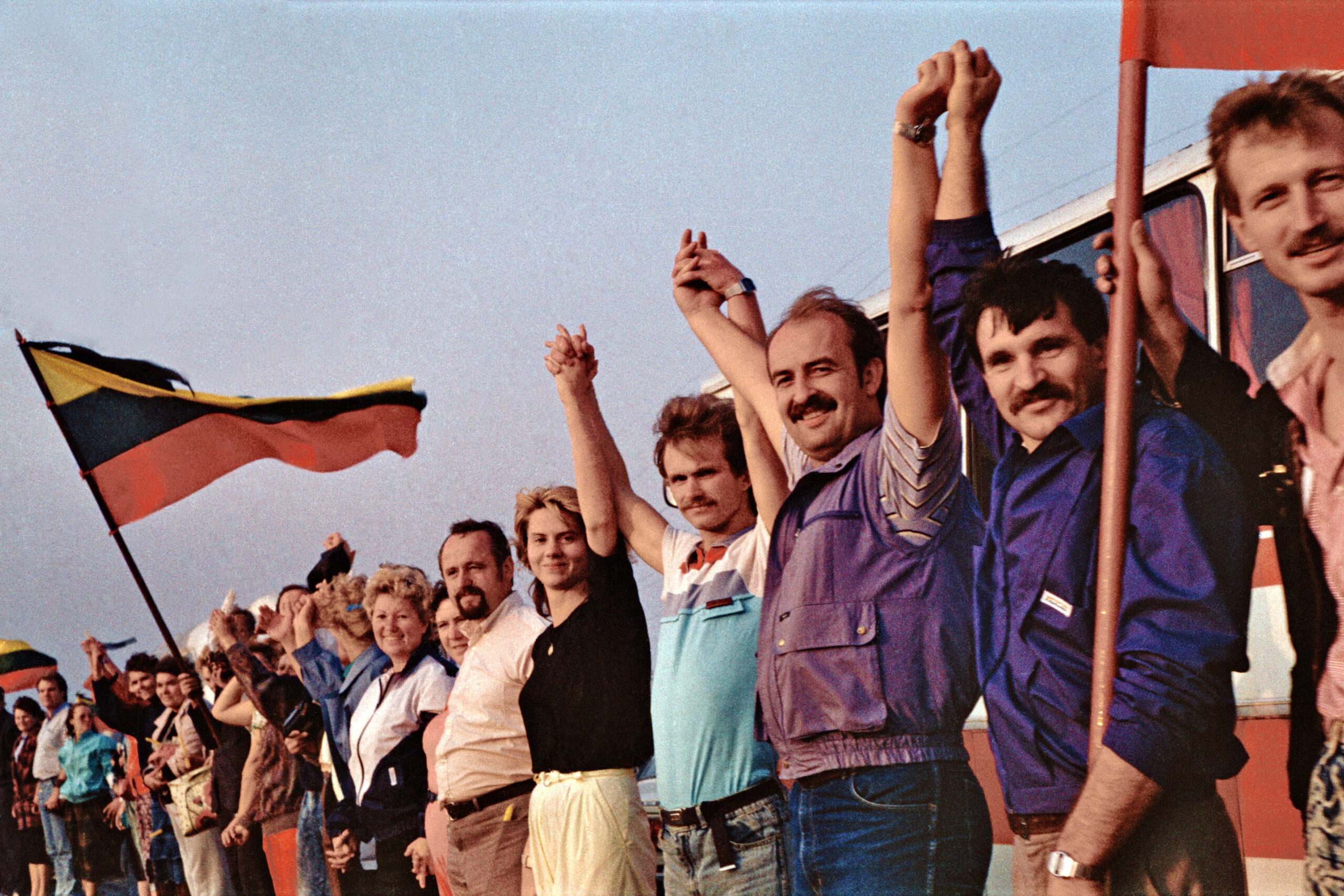
    It was August 23, 1989, a watershed year in the history of the Old Continent. What became known as the “Baltic Way” was a peaceful demonstration of powerful symbolic significance, attended by some two million people from Estonia, Latvia, and Lithuania, equal to about a quarter of the total population of the three states. Starting at Toompea Castle in Tallinn, passing through Riga and ending at Gediminas Tower in Vilnius, the non-Russian residents of the area (about one million Estonians, 700,000 Lithuanians and 500,000 Latvians) held hands, forming a chain about 670 kilometres long.

    The chain held together, in its entirety, for about a quarter of an hour at 7 p.m. Not a very long time, but enough to send a crucial message, first and foremost to Moscow: the Baltic republics—annexed by the USSR after World War II as stipulated in the clauses of the non-aggression pact between Moscow and Berlin (the infamous Molotov-Ribbentrop pact, then foreign ministers of the Stalinist empire and the Nazi Third Reich) signed precisely fifty years earlier, on August 23, 1939—wanted independence and their citizens were willing to literally put their bodies on the line to get it.​

    But also to the world, and in particular to other Central and Eastern European countries: to show that, in one of the tightest passages of the Cold War, it was possible to challenge Soviet despotism openly. In the late 1980s, the communist bloc, although weakened by the reforms of the new PCUS secretary Mikhail Gorbachev (known as perestroika), still seemed solid. The Baltic Way was one of the sparks of the unstoppable crisis that, three months later, led to the unexpected “fall” of the Berlin Wall, Die Mauer (for 28 years, the most tangible symbol of the division of Europe between East and West), and later to the dissolution of the Soviet empire.

    The long column of citizens from the three Baltic countries represented probably the most emblematic moment in that series of events known globally as the “Singing Revolution”: a phase between 1987 and 1991 when Estonians, Latvians, and Lithuanians began to sing traditional folk songs and, more importantly, their national anthems (all banned by the communist regime) as a peaceful form of political protest, in support of organized pro-democracy and pro-independence movements. The initiators of the Baltic Way were the main Baltic opposition forces: the Estonian Rahvarinne, the Latvian Tautas fronte and the Lithuanian Sajudis, who had organized the protest the previous August 12. As they chanted, dressed in traditional costumes, the protesters waved the flags adopted by their countries before the Soviet occupation while the bells of towns and villages rang festively.

    The next day, August 24, the first non-Communist government democratically elected by Poles was established in Warsaw, led by Tadeusz Mazowiecki, an activist of
    Solidarnosc
    , the Christian party that had overwhelmingly won the first free elections in the Communist bloc in June of that year. Between March and May 1990, Vilnius, Tallinn, and Riga declared their independence from the USSR, which Moscow formally recognized in September of the following year. By that time, the Soviet Union was dissolving.
    English version by the Translation Service of Withub
    Tags: baltic chainestonialatvialithuaniasoviet union

    Related Posts

    Gas serra
    Energy

    EU greenhouse gas emissions rise by 1.1 per cent in the economy of the 27 Member States

    13 February 2026
    Scienza è una cosa per donne
    Business

    Women in science and engineering in the EU rise to 7.9 million in 2024

    11 February 2026
    Lituania
    General News

    Lithuania declares “emergency” due to balloon incursions

    9 December 2025
    Lettonia
    Diritti

    Latvia will not withdraw—for now—from Istanbul Convention against violence against women

    5 November 2025
    lettonia
    Diritti

    Latvia’s President rejects bill to withdraw from the Istanbul Convention on violence against women

    4 November 2025
    Lettonia
    Diritti

    Latvia wants to withdraw from Istanbul Convention against violence against women

    31 October 2025
    map visualization
    Maros Sefcovic

    Trade, Sefcovic: “Speed up the agreement process. Act quickly on Mercosur, we lost 300 billion due to failure to implement it in 2021”

    by Giorgio Dell'Omodarme
    20 February 2026

    At the informal meeting of EU trade ministers, the European Commissioner for Trade called for the rapid ratification of the...

    dazi

    US Supreme Court rejects Trump’s tariffs: Federal law violated

    by Giulia Torbidoni
    20 February 2026

    The EU Commission: "We remain in close contact with the US Administration to obtain clarity on the measures it intends...

    Virkkunen IA

    The “AI Continent” objective: Europe tightens its schedule (and its ties with India)

    by Annachiara Magenta annacmag
    20 February 2026

    The opening of the European Legal Access Office, as well as the use of "applied" artificial intelligence to transform AI...

    I ministri della Difesa del gruppo 'E5' [

    E5 group launches cooperation on low-cost anti-drone technologies

    by Emanuele Bonini emanuelebonini
    20 February 2026

    Joint statement by the defence ministers of France, Germany, Italy, Poland, and the United Kingdom. Warsaw: "Devices that are revolutionising...

    • Director’s Point of View
    • Letters to the Editor
    • Opinions
    • About us
    • Contacts
    • Privacy Policy
    • Cookie policy

    Eunews is a registered newspaper
    Press Register of the Court of Turin n° 27


    Copyright © 2025 - WITHUB S.p.a., Via Rubens 19 - 20148 Milan
    VAT number: 10067080969 - ROC registration number n.30628
    Fully paid-up share capital 50.000,00€


    No Result
    View All Result
    • it ITA
    • en ENG
    • Politics
    • Newsletter
    • World politics
    • Business
    • General News
    • Defence & Security
    • Net & Tech
    • Agrifood
    • Altre sezioni
      • European Agenda
      • Culture
      • Diritti
      • Energy
      • Green Economy
      • Gallery
      • Finance & Insurance
      • Industry & Markets
      • Letters to the Editor
      • Media
      • Mobility & Logistics
      • News
      • Opinions
      • Sports
    • Director's Point of View
    • L’Europa come non l’avete mai ascoltata
    • Draghi Report
    • Eventi
    • Eunews Newsletter

    No Result
    View All Result
    • it ITA
    • en ENG
    • Politics
    • Newsletter
    • World politics
    • Business
    • General News
    • Defence & Security
    • Net & Tech
    • Agrifood
    • Altre sezioni
      • European Agenda
      • Culture
      • Diritti
      • Energy
      • Green Economy
      • Gallery
      • Finance & Insurance
      • Industry & Markets
      • Letters to the Editor
      • Media
      • Mobility & Logistics
      • News
      • Opinions
      • Sports
    • Director's Point of View
    • L’Europa come non l’avete mai ascoltata
    • Draghi Report
    • Eventi
    • Eunews Newsletter

    Attention