Brussels – Unable to raise its voice in the tug-of-war with Donald Trump, the European Union has identified two paths to avoid coming out badly: deepening the single market on the one hand, and the spasmodic search for new trade partnerships on the other. In Latin America and the Caribbean, Central Asia, and Australia, Brussels is trying to weave a web of free trade agreements. Yesterday (13 July), it added a new piece: the aim is to finalize a comprehensive economic partnership agreement with Indonesia by September.
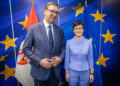
The President of the European Commission, Ursula von der Leyen, and the President of the Republic of Indonesia, Prabowo Subianto, announced it. Negotiations had been ongoing for 10 years, but the global trade war unleashed by Trump forced a decisive acceleration. If the EU risks 30 percent tariffs as of 1 August, Indonesia fared no better: in the “letter” it received from Washington, tariffs were at 32 percent for the Southeast Asian archipelago.

“In times of global challenges like these, partners must strengthen their ties,” emphasized von der Leyen on the sidelines of the political agreement reached with Subianto. The CEPA (Comprehensive Economic Partnership Agreement) will promote trade and investment between Brussels and Jakarta and will strengthen cooperation on critical raw materials, which are extensively mined on the volcanic islands of the Republic of Indonesia. “The agreement will open new markets and create more opportunities for our businesses. It will also help strengthen the supply chains of critical raw materials, essential for Europe’s clean tech and steel industry,” said the EU leader.
For the Indonesian president, the agreement “is not only about trade, it is about fairness, respect, and building a strong future together.” Indonesia, with a GDP of EUR 1.2 trillion, has rapidly become one of the largest global economies, as well as being the third largest democracy in the world and the fourth largest country by population. A giant in the region, accounting for over a third of the GDP of the Association of Southeast Asian Nations (ASEAN). However, while the EU is the fifth largest trading partner for Indonesia in terms of trade in goods and services, conversely, Jakarta is only 33rd on Brussels’ list. Last year, the EU exported EUR 9.7 billion worth of goods to Indonesia, while importing from the country amounted to EUR 17.5 billion.
Indonesia and the deforestation issue
Mainly agricultural products and raw materials arrive from Jakarta. Palm oil, coffee, cocoa, but also coal, tin, and rubber. Products that come from the rainforests of Borneo, Sumatra, and Sulawesi: what von der Leyen does not say is that Indonesia has one of the highest deforestation rates in the world, which has been steadily increasing in recent years. Since 1990, the country has lost about 25 percent of its ancient forests, and according to the NGO Global Forest Watch, from 2001 to 2024, 76 percent of tree cover loss is related to deforestation activities. Forest destruction is mainly due to mining, palm oil production, and the timber trade.
However, Indonesia was not included on the list of countries at high risk of deforestation, drawn up by Brussels as envisaged by the EUDR regulation on imported deforestation. Only Russia, Belarus, North Korea, and Myanmar are on the list. Against them, the EU will tighten import controls on products such as beef, cocoa, coffee, palm oil, rubber, soya, and wood from 30 December 2025.
English version by the Translation Service of Withub![[foto: imagoeconomica, rielaborazione Eunews]](https://www.eunews.it/wp-content/uploads/2025/07/eu-us-350x250.png)


![[foto: European Council]](https://www.eunews.it/wp-content/uploads/2025/06/euco-250626-350x250.jpg)

![Da sinistra: il presidente del Consiglio europeo, Antonio Costa; il presidente dell'Ucraina, Volodymir Zelensky: la presidente della Commissione europea, Ursula von der Leyen [Bruxelles, 18 giugno 2024. Foto: European Council]](https://www.eunews.it/wp-content/uploads/2026/06/euco_ua260618-120x86.jpg)
![[foto: Saverio De Giglio/imagoeconomica]](https://www.eunews.it/wp-content/uploads/2026/10/cpt-120x86.png)