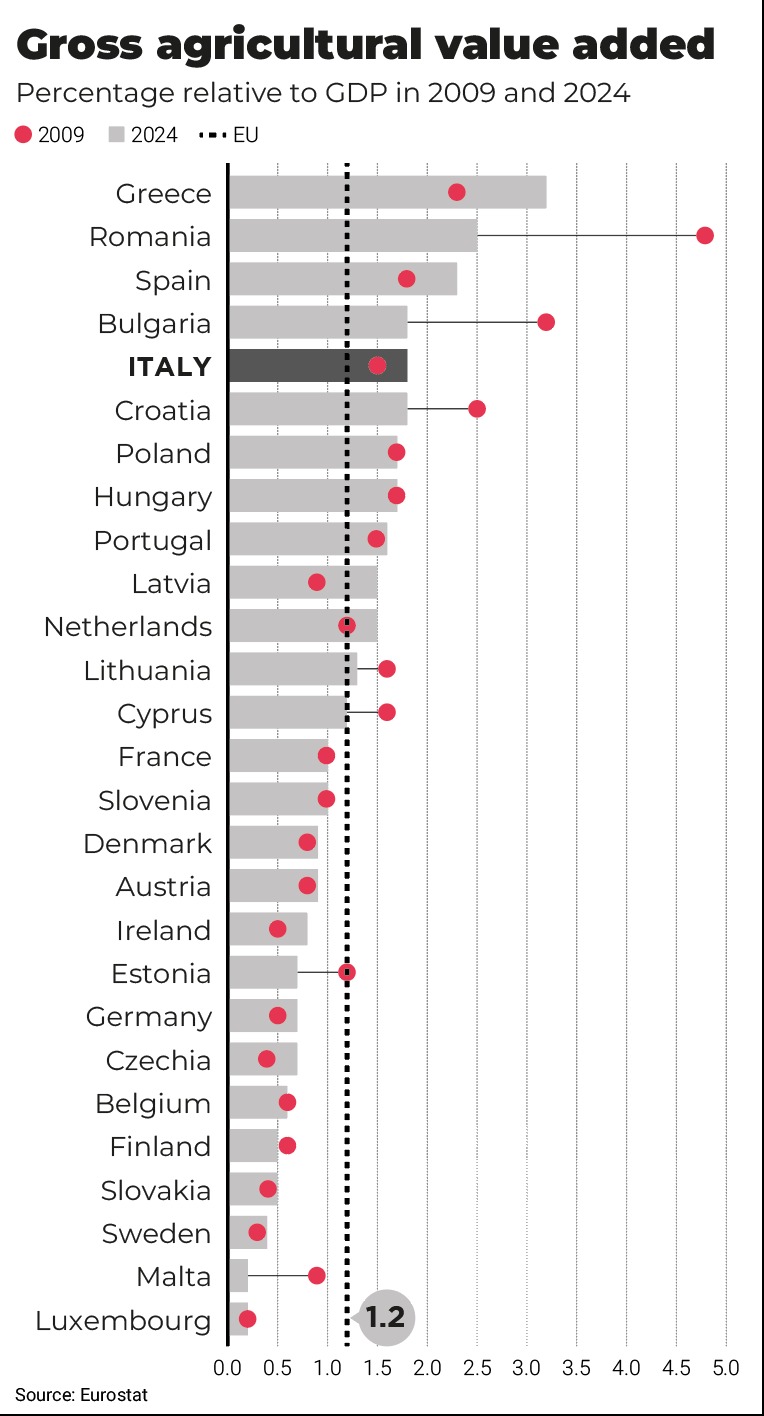
Brussels –Italy ranks fourth among European Union countries in terms of agricultural added value relative to gross domestic product (GDP), at 1.8 per cent, according to a report published by Eurostat, the statistical office of the EU, on the added value of the agricultural industry in Europe. The data refer to 2024, when the entire European agro-industrial sector accounted for an average of 1.2 per cent of the EU’s GDP, 0.1 percentage point more than in 2009.
The weight of agriculture in the respective economies varies slightly between European countries: the highest values are recorded in Greece (3.2 per cent), Romania (2.5 per cent), and Spain (2.3 per cent). The lowest are in Luxembourg and Malta, where the influence of agricultural added value accounts for 0.2 per cent of GDP. Furthermore, between 2009 and 2024, the ratio of agricultural value added to GDP grew in 15 EU countries. Greece (+0.9 pp), Latvia (+0.6 pp), and Spain (+0.5 pp) recorded the largest increases. Conversely, the relative weight of the agricultural sector declined most sharply in Romania (-2.2 pp), Bulgaria (-1.4 pp), Malta, and Croatia (both down 0.7 pp).
Italy ranks fourth in Europe, tied with Bulgaria and Croatia, with a value corresponding to 1.8 per cent of Italian GDP. In 2024, Italy held the EU record for agricultural added value, contributing 17.4 per cent to the European total. Among Italy’s top products are grapes, with a 34.2 per cent share of total European production, as well as fruit, berries, and nuts (excluding citrus), with 22.2 per cent of the total. The absolute leader is buffalo milk, which accounts for 98% of total EU production and is mainly used for cheese production.
In the fisheries sector, Italy remains one of the four countries that account for two-thirds of the EU’s total aquaculture production, preceded by Greece, France, and Spain, and has the largest fishing fleet in the Union in terms of engine power and number of vessels.

![Il ministro dei Trasporti, Matteo Salvini [Bruxelles, 5 dicembre 2024. Foto: Emanuele Bonini per Eunews]](https://www.eunews.it/wp-content/uploads/2024/12/salvini241205-350x250.jpeg)





![Il ministro dei Trasporti, Matteo Salvini [Bruxelles, 5 dicembre 2024. Foto: Emanuele Bonini per Eunews]](https://www.eunews.it/wp-content/uploads/2024/12/salvini241205-120x86.jpeg)