- Europe, like you've never read before -
Tuesday, 16 June 2026
No Result
View All Result
  • it ITA
  • en ENG
Eunews
  • Politics
  • World
  • Business
  • News
  • Defence
  • Health
  • Agrifood
  • Other sections
    • Culture
    • Diritti
    • Energy
    • Green Economy
    • Finance & Insurance
    • Industry & Markets
    • Media
    • Mobility & Logistics
    • Net & Tech
    • Sports
  • Newsletter
  • European 2024
    Eunews
    • Politics
    • World
    • Business
    • News
    • Defence
    • Health
    • Agrifood
    • Other sections
      • Culture
      • Diritti
      • Energy
      • Green Economy
      • Finance & Insurance
      • Industry & Markets
      • Media
      • Mobility & Logistics
      • Net & Tech
      • Sports
    No Result
    View All Result
    Eunews
    No Result
    View All Result

    Home » World politics » Russian soldiers entering the EU: eight countries warn Costa and von der Leyen that they must not be allowed to enter

    Russian soldiers entering the EU: eight countries warn Costa and von der Leyen that they must not be allowed to enter

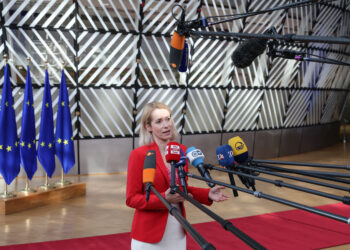
    Estonia’s foreign minister, Margus Tsahkna, claims to have “information suggesting that many people would like to come to Europe once the war has ended”

    Giorgio Dell'Omodarme by Giorgio Dell'Omodarme
    13 March 2026
    in World politics

    Brussels – Eastern Europe and the Scandinavian countries are increasingly concerned that Russian soldiers who have fought – or are still fighting – in Moscow’s war of aggression against Ukraine might set foot on European soil. This fear has been put in writing by the eight leaders of Estonia, Latvia, Lithuania, Germany, Poland, Romania, Finland, and Sweden, in a letter sent today (13 March) to the President of the European Commission, Ursula von der Leyen, and the President of the European Council, Antonio Costa. Some governments have received information suggesting that, aat the latest by the end of the war, many Russian soldiers intend to enter the EU. In the text, the leaders describe the potential entry of Russian combatants or former combatants into the Schengen area as “one of the most serious risks to the EU’s internal security arising from the war in Ukraine,” and stress the need to address the issue and organise a coordinated European response “as early as in the conclusions of the forthcoming European Council on 19 and 20 March.” 

    As the signatories explain, “anyone who has taken part in the war as part of the aggressor state’s armed forces poses a threat” that could manifest itself in the form of “violent crimes, organised criminal networks, extremist movements, or hostile activities within the broader context of Russia’s hybrid operations against the EU.” Further worrying the EU’s eastern flank is the fact that, to compensate for losses at the front, Moscow has progressively increased the recruitment of inmates serving time for violent crimes. According to the letter sent to the EU leadership in Brussels, there are “more than 180,000 previously convicted criminals who have been recruited from Russian prisons to be sent to the front.” And, as rotations progress, “it is likely that the number of individuals with recent experience of violent combat seeking to travel abroad will increase significantly.” 

    Today’s document follows months in which concerns among the major Eastern European countries on this issue have gradually grown. As reported by the German newspaper Die Welt, at a meeting of EU foreign ministers in late January, Estonia’s foreign minister, Margus Tsahkna, stated that he was in possession of “information suggesting that many Russian soldiers would like to come to Europe following a possible end to the war.” It is no coincidence that the first capital to introduce a regulation to ban the entry of 260 Russian soldiers at the beginning of the year was Tallinn, followed by Lithuania, which just yesterday tabled a similar bill.

     For the countries on the eastern flank, however, national measures are not enough: “given the freedom of movement guaranteed by Schengen, the consequences of any entry can be serious for the security of each individual Member State and of the Union as a whole.” For this reason, the authors of the letter are calling for a Community-wide response to these risks, starting as early as the next European Council. In addition to existing instruments – such as “the refusal of visas and residence permits and the imposition of long-term entry bans across the Schengen area” – the signatories refer to the new strategy on visa policy launched by the Commission in January, which opened the door to “further restrictive measures in cases of serious deterioration in relations with a specific third country, with particular reference to the category of ‘former and current combatants of an aggressor state’.”

    It seems – or perhaps it is – a passage written specifically with Russia in mind, and at the very same meeting in late January reported by Die Welt, there were reportedly discussions about using it to establish a European regulation similar to the one already approved by Estonia and currently under discussion in Lithuania. According to several European diplomats, however, there are numerous obstacles. Chief among these is the fact that the power to grant or deny visas remains in the hands of individual governments, and the difficulty of proving whether a soldier has actually fought in Ukraine if the latter provides false information. 

    All these issues have been postponed – perhaps – until 19 and 20 March.

    English version by the Translation Service of Withub
    Tags: estoniaeuropean councilrussiaschengen areasoldatiukrainevisas

    Related Posts

    La presidente della Commissione europea, Ursula Von der Leyen, e il presidente del Consiglio Europeo, Antonio Costa durante la conferenza stampa del G7 ad Evian, in Francia. Crediti: Commissione europea
    World politics

    The trade deficit with China, the wars in Ukraine and the Middle East: the EU reiterates its priorities at the G7 summit in Evian

    15 June 2026
    La sala riunioni del consiglio di associazione UE-Egitto [Lussemburgo, 15 giugno 2026. Foto: European Council]
    World politics

    The EU is seeking Egypt’s cooperation against Russia, while Cairo is looking to attract investment

    15 June 2026
    World politics

    While awaiting the 21st package, the EU imposes further sanctions on Russia

    15 June 2026
    Preparazione della foto di famiglia all'ultimo Summit del G7, nel giugno 2025, ad Alberta, in Canada. Source: EU Council
    Business

    Macroeconomic imbalances, Ukraine, and the Middle East: the key issues at the G7 Summit in Evian

    12 June 2026
    [Foto: Unsplash]
    Net & Tech

    The EU and Brazil have signed a Digital Partnership

    12 June 2026
    Parlamento europeo di Strasburgo, lavori in corso [Foto: Imagoeconomica]
    Politics

    European Parliament plenary in Strasbourg: repatriation, US tariffs and much more – Gaza absent

    12 June 2026
    map visualization
    La presidente della Commissione europea, Ursula Von der Leyen, e il presidente del Consiglio Europeo, Antonio Costa durante la conferenza stampa del G7 ad Evian, in Francia. Crediti: Commissione europea

    The trade deficit with China, the wars in Ukraine and the Middle East: the EU reiterates its priorities at the G7 summit in Evian

    by Iolanda Cuomo
    15 June 2026

    Von der Leyen: “Our main objective is to tackle the structural challenges facing the global economy, but also to focus...

    Source: Photo by Sergio Oliverio via Imagoeconomica

    Compensation for three-hour delays: Council and Parliament update rules on air passenger rights

    by Giulia Torbidoni
    15 June 2026

    Key features include a three-hour delay threshold for claiming a refund; clear instructions for passengers on how to claim from...

    Source: Imagoeconomica

    The review of tobacco products is mobilising the EU: over 80,000 responses sent to the European Commission

    by Annachiara Magenta annacmag
    15 June 2026

    The review of EU regulations has sparked a clash between industry, trade associations, and the public health sector, amid accusations...

    La sala riunioni del consiglio di associazione UE-Egitto [Lussemburgo, 15 giugno 2026. Foto: European Council]

    The EU is seeking Egypt’s cooperation against Russia, while Cairo is looking to attract investment

    by Emanuele Bonini emanuelebonini
    15 June 2026

    The 11th Association Council meeting between the two sides took place in Luxembourg. Kallas called for tougher measures against Moscow’s...

    • Director’s Point of View
    • Opinions
    • About us
    • Contacts
    • Privacy Policy
    • Cookie policy

    Eunews is a registered newspaper
    Press Register of the Court of Turin n° 27


    Copyright © 2025 - WITHUB S.p.a., Via Rubens 19 - 20148 Milan
    VAT number: 10067080969 - ROC registration number n.30628
    Fully paid-up share capital 50.000,00€


    No Result
    View All Result
    • it ITA
    • en ENG
    • Politics
    • Newsletter
    • World politics
    • Business
    • General News
    • Defence & Security
    • Health
    • Agrifood
    • Altre sezioni
      • Culture
      • Diritti
      • Energy
      • Green Economy
      • Gallery
      • Finance & Insurance
      • Industry & Markets
      • Media
      • Mobility & Logistics
      • Net & Tech
      • News
      • Opinions
      • Sports
    • Director’s Point of View
    • Draghi Report
    • Eunews Newsletter

    No Result
    View All Result
    • it ITA
    • en ENG
    • Politics
    • Newsletter
    • World politics
    • Business
    • General News
    • Defence & Security
    • Health
    • Agrifood
    • Altre sezioni
      • Culture
      • Diritti
      • Energy
      • Green Economy
      • Gallery
      • Finance & Insurance
      • Industry & Markets
      • Media
      • Mobility & Logistics
      • Net & Tech
      • News
      • Opinions
      • Sports
    • Director’s Point of View
    • Draghi Report
    • Eunews Newsletter

    Attention