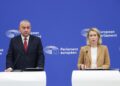
Brussels – For years, Russia reportedly received detailed reports on key meetings between European Union foreign ministers. And the country “spying” is said to be the very one that has for years been the subject of doubts and fears about excessive alignment with the Kremlin: Hungary under Viktor Orbán, the country’s prime minister since 2010. The news started to spread on Saturday (21 March), when the US daily, Washington Post reported the suspicions of several EU security officials, according to whom “during breaks in EU Council meetings, the Hungarian government’s foreign minister, Peter Szijjártó, is said to have made regular phone calls to his Russian counterpart, Sergey Lavrov, with “live reports on what’s been discussed.” According to one of the officials interviewed, “through such calls, every single EU meeting for years has basically had Moscow behind the table.” While the EU Council limited itself to a “no comment” on the matter, the European Commission – when questioned today (23 March) on the matter – did not deny the US newspaper’s reports and, through its spokesperson Arianna Podestà, described the news as “a cause for great concern,” calling on Budapest to “provide clarification.”
The Hungarian government’s ties – and in particular those of Szijjártó – with the Kremlin are well known. Since the start of the Russian invasion of Ukraine, the foreign minister and Orbán’s right-hand man has travelled to Moscow 16 times, most recently on 4 March, when he met directly with President Vladimir Putin. The news itself regarding the transmission of sensitive information over the phone was met with little surprise by some prominent figures within the EU. Yesterday (22 March), the Polish Prime Minister, Donald Tusk, wrote su X that what the Washington Post revealed “shouldn’t come as a surprise to anyone. We’ve had our suspicions about that for a long time. That’s one reason why I take the floor only when strictly necessary and say just as much as necessary.” He was echoed by Gabrielius Landsbergis, Lithuania’s Foreign Minister from 2020 to 2024, who said he had been warned of the existence of a privileged channel between Szijjártó and Lavrov as early as the beginning of 2024. “That is why my counterparts and I limited the sharing of sensitive information when Szijjártó was present,” he added, specifically recalling the attempt to “keep the Hungarian delegates at a distance” during the NATO summit held in Vilnius in 2023. According to some EU officials interviewed by Politico, this was so widely known in the corridors of Brussels that the very aura of suspicion surrounding Hungary was said to be one of the main reasons why it was recently decided to “conduct most diplomatic talks between EU states in smaller formats, such as the E3 (Germany, France, the UK), the E4 (France, Germany, the UK, and Poland) or the Weimar Alliance (Germany, France, and Poland).”
Budapest’s defence strategy is to shift the focus to the fact that Szijjártó’s telephone conversations were allegedly intercepted by foreign intelligence services. “The interception of a government minister’s conversations is a serious attack on Hungary, which is why I have instructed the Minister of Justice to launch a thorough investigation immediately,” wrote su X Orbán’s government spokesperson, Zoltán Kovács. The Minister for European Affairs, János Bóka, went further, directly dismissing the allegations as “fake news spread as a desperate reaction to the momentum gained by Fidesz (Orbán’s party, ed.) in the election campaign.”
The scandal, in fact, has erupted at a very delicate time for Hungary: parliamentary elections are due to be held on 12 April and – for the first time in 15 years – Orbán will be standing for election with the polls suggesting he is the underdog. As expected, the leader of the Respect and Freedom Party and his main rival, Péter Magyar, immediately seized the opportunity presented by the “Szijjártó affair.” At a rally held over the weekend, Magyar described the Foreign Minister’s behaviour as “a true case of betrayal of the motherland,” adding that “this man has betrayed not only Hungary, but the whole of Europe.”
In an election campaign already quite heated, new revelations in the same Washington Post report could further heighten tensions. According to the US newspaper, Russian intelligence (SVR) is said to have proposed a plan to the Budapest government to strengthen Orbán’s position in the final days before the vote. Among the strategies contained in the plan, known as The Gamechanger, is reportedly the staging of an assassination attempt against the prime minister. “Such an incident will shift the perception of the campaign out of the rational realm of socioeconomic questions into an emotional one, where the key themes will become state security and the stability and defense of the political system,” reads the document published by the Washington Post.
On this point too, the Orbán government has declined to comment when asked by the American newspaper.
English version by the Translation Service of Withub

![[credits: Dietmar Rabich / Wikimedia Commons / “Münster, Stadtweinhaus, Beflaggung Ukraine und EU -- 2022 -- 0219” / CC BY-SA 4.0]](https://www.eunews.it/wp-content/uploads/2026/03/ue-ucraina-350x250.jpg)