![[fonte foto: CEPS. Elaborazione: Eunews]](https://www.eunews.it/wp-content/uploads/2021/01/recessione-1.png)
Brussels – By the end of 2026, the war in Iran and its impact on energy supplies and prices will cost the eurozone a third of a percentage point of GDP. The European Central Bank, in its economic bulletin, is beginning to grapple with the conflict triggered by the United States and Israel, confirming the fears already expressed by the European Commission: Brussels feared growth would be 0.4 percentage points lower, while now Frankfurt has put 0.3 percentage points lower in black and white.
The ECB notes that the war in the Middle East “is disrupting commodity markets and weighing on real incomes and confidence.” This has led to a “downward revision” of consumption and investment in the baseline scenario of the projections, particularly for 2026. This scenario forecasts annual real GDP growth of 0.9 per cent in 2026, 1.3 per cent in 2027, and 1.4 per cent in 2028. ” Compared with the December 2025 projections, GDP growth has been revised down by 0.3 percentage points for 2026 and by 0.1 percentage points for 2027, on account of the escalating war in the Middle East, while for 2028 it is unchanged.”
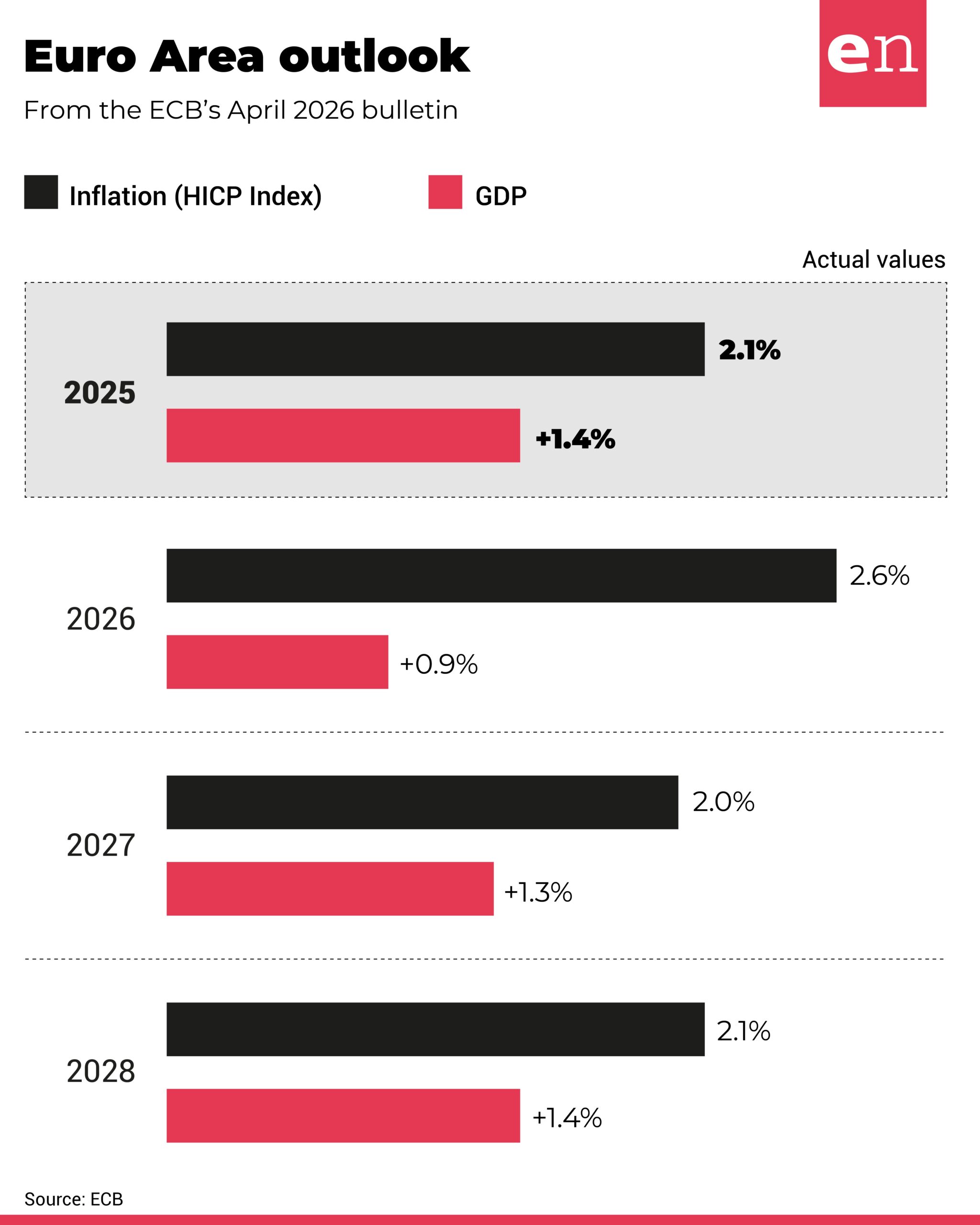
The economic picture is thus beginning to take shape in the wake of the conflict in Iran, which is set to significantly affect the cost of living. “The increase in energy prices caused by the war in the Middle East will drive inflation above 2% in the near term,” as already demonstrated by Eurostat’s preliminary data for March (+0.6 percentage points compared to February). On this trajectory, the ECB warns, “inflation is projected to increase sharply to 3.1 per cent in the second quarter of 2026, driven by a surge in energy inflation as a result of the war, and then to decline in the third quarter to 2.8 per cent following declines in energy commodity prices as embedded in futures prices.”
https://www.eunews.it/en/2026/03/25/iran-ecb-set-to-raise-interest-rates/
Against this backdrop, the European Central Bank is beginning to monitor public finances. Rising costs and a slowdown in growth are driving up public spending. Whether driven by stimulus or support measures, the euro area’s public debt-to-GDP ratio is on an upward trend, rising from 87.5 per cent to 89.5 per cent between 2025 and 2028. Also in this case, the figure has been “revised upwards, reflecting higher cumulative primary deficits and less favourable interest rate-growth differentials.”
With the war in Iran eating into growth and imposing new costs, it is becoming even more imperative to keep spending under control. “In the current geopolitical environment, governments should prioritise sustainable public finances, strategic investment, and growth-enhancing structural reforms. Unlocking the full potential of the Single Market remains crucial,” according to the ECB bulletin. With this in mind, “Any fiscal responses to the energy price shock triggered by the war in the Middle East should be temporary, targeted, and tailored.” This emphasis sounds like a warning to Prime Minister Giorgia Meloni and her government, who intend to extend the existing cut in fuel excise duties until 30 April.
English version by the Translation Service of Withub
![Il commissario per l'Energia, Dan Jorgensen [Bruxelles, 31 marzo 2026. Foto: European Council]](https://www.eunews.it/wp-content/uploads/2026/03/jorgensen-260331-350x250.jpg)
![La video riunione dell'Eurogruppo [27 marzo 2026. Foto: European Council]](https://www.eunews.it/wp-content/uploads/2026/03/eurogruppo-260327-350x250.jpg)