Brussels – “It is an extremely difficult negotiation” regarding the European Union’s next multiannual financial framework (MFF 2028–2034). The Prime Minister, Giorgia Meloni, is one of the first leaders to summarise the discussions between EU heads of state and government on the subject at the informal European Council summit in Nicosia. She spoke to reporters even before the traditional final press conference by the Presidents of the European Commission and the European Council, and so it fell to the Italian Prime Minister to report that “their positions are very far apart” and that more time and further meetings will be needed to reach an agreement, which is, in any case, difficult to foresee at the moment.
Too much money: the frugal camp closes ranks
The so-called “frugal” countries—those that would prefer a budget with fewer resources—are not changing their minds. On the contrary, they insist, with the Prime Minister of the Netherlands, Rob Jetten, leading the front of those who want to spend less on running the EU and funding its programmes. “There are many countries which, like us, are calling for a leaner budget,” he states on the sidelines of the proceedings, before warning: “We are creating a broad front.” This group includes the Netherlands, the Scandinavian countries (Denmark, Sweden and Finland) and Ireland. But Austria and Germany also believe that the almost €2 trillion for the MFF 2028–2034 proposed by the European Commission is too high.
https://www.eunews.it/en/2025/10/10/opposition-increases-as-ecofin-scuttles-eu-budget-2028-2034-proposal/
In this context, the European Parliament’s position complicates the negotiations even further. At the committee level, a 200 billion increase has been approved, and the plenary is likely to confirm this position next week. The President of the Parliament, Roberta Metsola, is, moreover, clear in telling the heads of state and government that “what we need now is a budget fit for purpose.” This means more money, to be found partly through new own resources as an alternative to national contributions, on which there currently seems to be little prospect.
Italy’s priorities
“We are looking for new resources to fund new priorities, and objectively speaking, there aren’t that many; we are struggling to find them,” admits Giorgia Meloni, who, in negotiations that are already shaping up to be an uphill struggle, has set out the Italian government’s “red lines”. “One of these concerns cohesion funds and the Common Agricultural Policy,” which are considered insufficient and also poorly distributed. “We agree on our defence as well as on competitiveness, but these things go hand in hand.” Because, as the Prime Minister emphasises, “it is pointless to focus on our defence if we do not also focus on our food security, and it is pointless to build competitiveness if we do not understand that cohesion—that is, putting all regions in a position to compete on a level playing field—is the precondition for any form of competitiveness”.
Another Italian priority concerns the Competitiveness Fund and how it is used. “We must support the transformation of traditional industry and our long-established supply chains, without forgetting small and medium-sized enterprises,” which are as important for “Made in Italy” as they are for the European Union, given that SMEs account for 99 per cent of the twelve-star industrial and productive fabric.
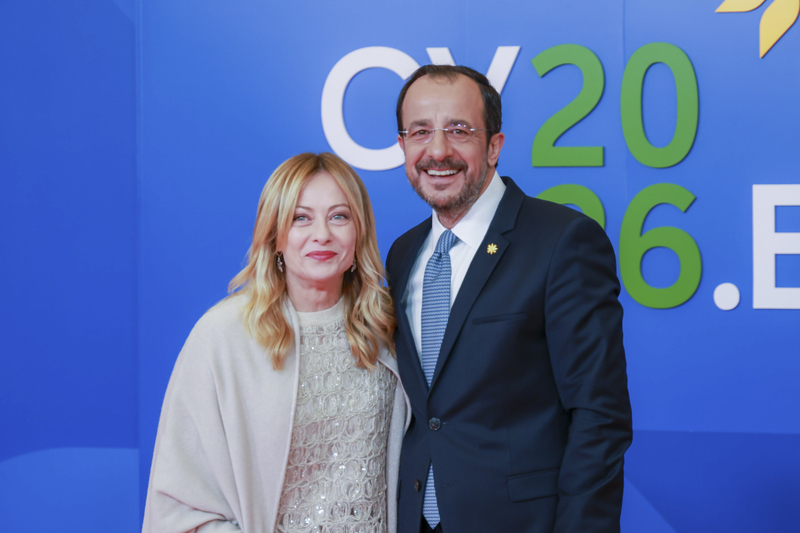
Finally, Meloni criticises: “I think a signal needs to be sent regarding administrative expenditure: we cannot propose renovating the European Council’s headquarters at a cost of 800 million euros; this is something Italy cannot afford.” The EU must learn to economise at a time that calls for sacrifices and difficult choices.
The Baltic states (Estonia, Latvia, and Lithuania), together with Poland, want to ensure that, whatever happens during the negotiations, adequate resources are allocated to defence. This view was expressed by Latvian Prime Minister Evika Silina. “We share a border with Russia,” she argues, and this is not merely a geographical fact. “As you can imagine, I am focused on the eastern flank,” confides Polish Prime Minister Donald Tusk.
“More work” will therefore be needed, admits the President of the European Council, Antonio Costa, who remains convinced, however, that the debate has been useful given the feedback received. The issue will be back on the leaders’ agenda at the European Council summit on 18 and 19 June. The Cypriot Presidency of the Council will have to present a compromise proposal with the new figures by that date, a process that is far from a foregone conclusion, prompting Costa to wish “good luck” to Nikos Christodoulides, President of Cyprus, the country holding the EU Council rotating presidency. “We are ready to undertake this difficult task“, says the Cypriot, who is taking up the challenge.
Committee of the Regions on a war footing
Behind the scenes lies a challenge within the challenge: regions determined to pressure their respective central governments. With the European Council currently deliberating on own resources and the total size of the seven-year budget, Poland’s Minister for Regional Policy, Jan Szyszko, has announced that he is working, alongside representatives from 16 other EU Member States, to draw up “a common position on the EU’s new investment policy” starting from the non-paper circulated to partners, with the aim of securing “greater resources for investment, the protection of European businesses, and strong local authorities.” This is a political counterproposal that rejects the framework for the forthcoming seven-year budget and reignites the clash between the Committee of the Regions and the European Commission.
.
English version by the Translation Service of Withub



![Il ministro dei Trasporti, Matteo Salvini [Bruxelles, 5 dicembre 2024. Foto: Emanuele Bonini per Eunews]](https://www.eunews.it/wp-content/uploads/2024/12/salvini241205-120x86.jpeg)