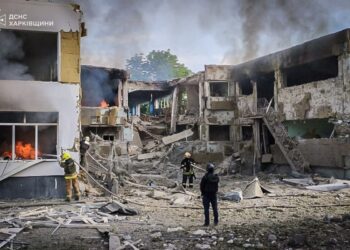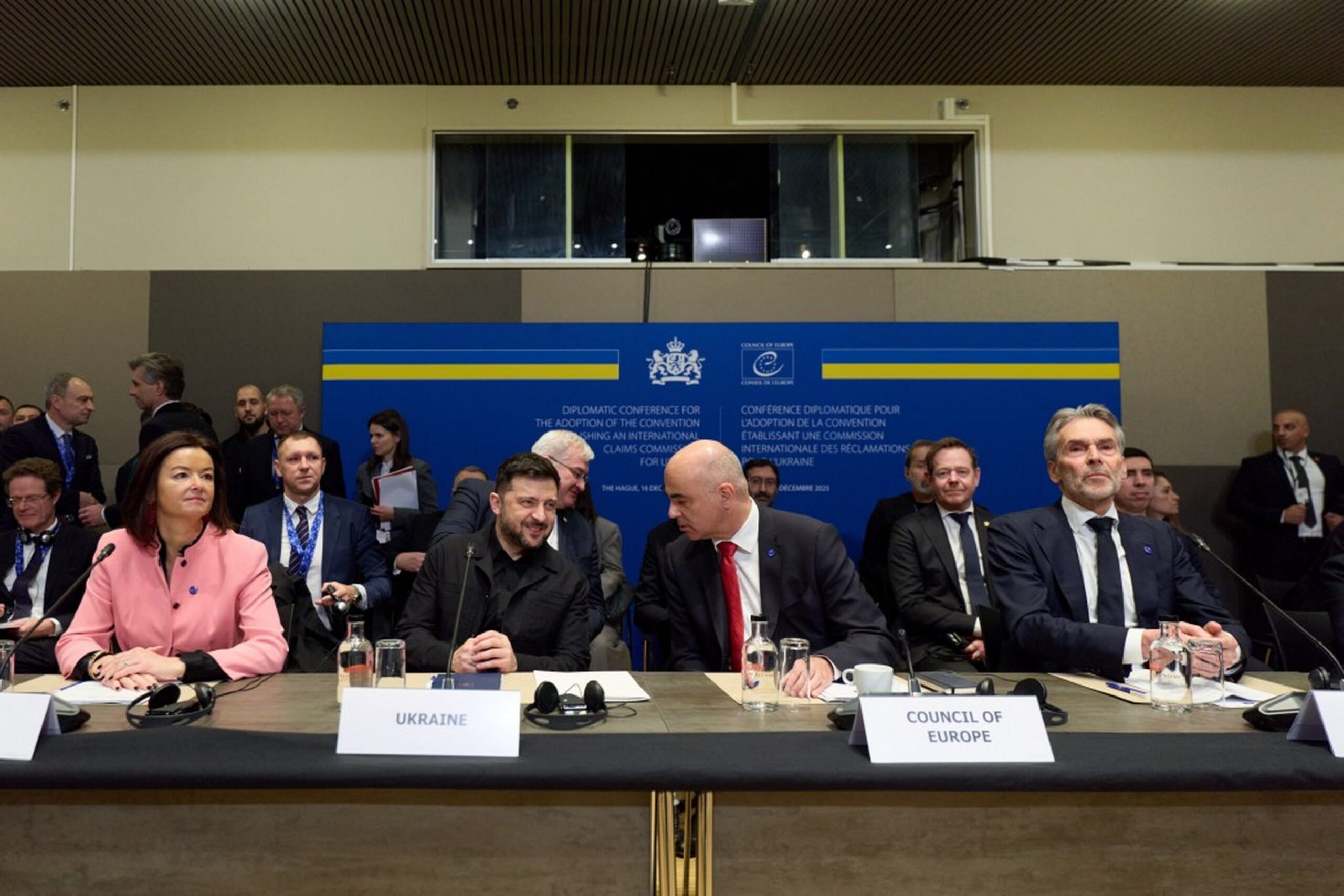

Brussels – Twenty-four hours after what the Ukrainian Foreign Ministry described as “one of the deadliest Russian attacks since the start of the war,” with 24 people killed in a bombing of an apartment block in central Kyiv, the Council of Europe announced today (15 May) that it has completed a new institutional step towards the creation of the Special Tribunal for the crime of aggression against Ukraine.
During the annual meeting of the foreign ministers of the 46 member states in Chisinau (Moldova), the organisation that brings together the leading European countries to promote the values of democracy and the rule of law, approved the resolution establishing the Enlarged Partial Agreement on the Steering Committee of the Special Tribunal. This body will be responsible for supervising the activities of the future judicial body and, above all, securing the necessary funding to ensure its operational capacity. To this end, the funds will be made available by the states that officially ratify their accession to the Committee.
“The Special Tribunal represents justice and hope,” said the Secretary General of the Council of Europe, Alain Berset, adding that “the time for Russia to be held to account for its aggression is fast approaching.” He was echoed by Kyiv’s Deputy Prime Minister and Foreign Minister, Andrii Sybiha, who stated that “The moral foundation of Europe and the world will only be restored when the crime of aggression against Ukraine is punished.”
What is the Special Tribunal
The Special Tribunal for the Crime of Aggression against Ukraine is an institution, established within the framework of the Council of Europe, whose aim is to investigate, prosecute, and try those primarily responsible for the war unleashed by Moscow against Kyiv. The target, therefore, is a major one: the political and military leadership of the Russian Federation, starting with President Vladimir Putin.
Discussions regarding the creation of such a body began just a few months after the start of the war, to address legal loopholes that would have prevented the International Criminal Court (ICC) from charging those responsible for the conflict with the crime of aggression. There is one very simple reason for this: Russia’s failure to ratify the Rome Statute, the ICC’s founding document.
While the Statute provides that third-state citizens may also be prosecuted for war crimes, crimes against humanity, and genocide, the crime of aggression is governed by much stricter rules. For the Court to be able to launch an investigation in this regard, the perpetrator of the crime must be a national of a State Party or, if the suspect is a national of a country not party to the ICC, authorisation to proceed must come directly from the United Nations Security Council (UNSC). This second scenario was also immediately deemed unlikely in the case of the war in Ukraine, given Moscow’s veto power over any decision taken within the UNSC.
To overcome these legal obstacles, a group of experts from Ukraine, the European Commission, the Council of Europe, and dozens of partner states has been working for around three years to establish an ad hoc tribunal, modelled along the lines of those set up in the 1990s for the War in the former Yugoslavia and for the Genocide in Rwanda. The first milestone was reached on 25 June, when, in Strasbourg, the Ukrainian President, Volodymyr Zelensky, and the Secretary General of the Council of Europe, Alain Berset, signed the bilateral agreement officially establishing this body.
The signing of today’s agreement on the establishment of the Steering Committee marks the next step required to make the Tribunal fully operational.
Next steps: from ratification by the States to the start of preparatory work
Of the 46 member states of the Council of Europe, 36 (plus the EU) voted in favour of the resolution adopted today. While there are some notable absences (EU countries such as Bulgaria, Hungary, Malta, and Slovakia, and non-EU countries such as Albania, Armenia, Azerbaijan, Serbia, and Turkey), on the other hand, two countries that are not members of the Strasbourg-based organisation also voted in favour: Australia and Costa Rica.
For the Steering Committee to be effectively established, official ratification by individual national governments will be required, and Berset expressed the hope that this would take place “as soon as possible.” In a message addressed to those who withdrew today, Moldova’s Foreign Minister, Mihai Popsoi, also pointed out that “to ensure the widest possible legitimacy for the Special Tribunal, it is important that other states also accede to the expanded partial agreement.”
Once the ratification process is complete, the preparatory group for the tribunal’s establishment will be able to begin its work. In accordance with the agreement reached by the EU and the Council of Europe on 24 January, the group will establish the institutional, logistical, and organisational framework for the new body, laying the foundations for the election of judges and the prosecutor, and drafting procedural rules.
The issue of immunity for Putin and his loyalists
Behind the widespread optimism with which EU leaders (and others) have welcomed today’s decision lie doubts about the project’s actual feasibility. While the ad hoc tribunal solution may overcome the regulatory gaps in the Rome Statute, there is a risk that it may nevertheless run up against another key principle of international law: immunity for heads of state and government while performing their official duties. Given the “scant” turnover of government that characterises the Russian political system, it is likely that adherence to this principle will significantly delay, or entirely compromise, the start of proceedings against Putin and his loyalists.
Despite this, the plan remains to press ahead. This was made clear, on the sidelines of today’s meeting, by the Dutch Foreign Minister, Tom Berendsen, who stated that “those responsible for the terrible crimes committed against Ukraine must be held to account” and “even if this will not happen overnight, this does not prevent us from doing everything possible.” These words carry double the weight for Kyiv, as The Hague is the leading candidate to host the Tribunal’s offices.
During the meeting in Chisinau, the Council of Europe also discussed a further initiative to ensure full accountability for the crimes Russia committed: the creation of an International Claims Commission for Ukraine. Welcoming the “broad support” from member states, the Strasbourg-based institution hopes to see “further accessions to ensure the rapid establishment of a compensation mechanism” for all victims of the attacks launched by the Kremlin during more than four years of war.
English version by the Translation Service of Withub
![Il ministro degli Esteri ucraino, Andriy Sybiha, con l'Alta rappresentante per la politica estera e di sicurezza dell'UE, Kaja Kallas [Bruxelles, 11 maggio 2026. Foto: European Council]](https://www.eunews.it/wp-content/uploads/2026/05/fac-ua-350x250.jpg)