
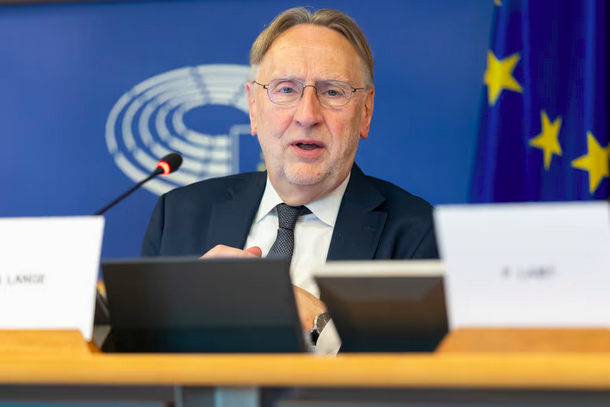
Brussels – The European Union and the United States have finally reached a definitive agreement on tariffs — assuming US President Donald Trump doesn’t change his mind. The European Parliament and the Council of the EU reached the interinstitutional agreement needed to implement the joint statement agreed on 21 August 2025. Bernd Lange (S&D), Chair of the European Parliament’s Committee on International Trade and rapporteur for the dossier, is delighted: “This agreement is an important step towards greater predictability in transatlantic trade relations,” he said at the conclusion of negotiations that wrapped up overnight. But that’s not all. “This regulation becomes part of the EU’s toolkit to improve EU-US relations but also responds to pressure.”
Indeed, the pressure. Trump had urged the EU to reach a deal by 4 July or risk tariffs above the agreed 15 per cent. The White House occupant’s interventions were unwelcome and poorly received. The comments by Michael Damianos, Minister for Commerce and Industry of Cyprus, the country currently holding the rotating presidency of the Council of the EU, are no coincidence: “Today, the European Union is honouring its commitments. We are and will remain a reliable and trustworthy partner in global trade.”
The tariff agreement: two regulations, two deadlines
The EU-US tariff agreement at the heart of the deal between the European Parliament and the Council of the EU concerns two separate measures: a first regulation, the main one, removes the remaining customs duties on US industrial goods and grants preferential access to the European market, including through tariff quotas and reduced tariffs for certain non-sensitive agricultural products and seafood ‘made in the USA’; a second regulation, on the other hand, focuses on extending the suspension of tariffs on imports of lobster, both in its natural state and as a processed product.
Under the specific “sunset clause,” the main regulation on industrial and agri-food imports will expire on 31 December 2029. Before that date, the European Commission will conduct a comprehensive assessment of its trade effects on EU industry, agriculture, and small and medium-sized enterprises, as well as on trade patterns with third countries. The Commission may submit a legislative proposal to extend the regulation’s duration.
As regards the second proposal on lobsters, Parliament and the Council have reached an agreement on Parliament’s proposal to extend the zero-duty import of lobsters for five years, until 31 July 2030. This extension will apply retroactively from 1 August 2025.
European safeguard mechanism and suspension clause
The steel and aluminium dispute, and the EU’s response
The EU does not trust Trump
“We need safety nets with the United States, because there is currently a great deal of unpredictability in our relations with the US,” Lange said during the press conference called to present the details of the agreement. The chair of the European Parliament’s Committee on International Trade confirms that the EU does not trust the US administration and its president, who is “totally unpredictable.”
So much so that Lange continues, “we need clear suspension clauses in the event of a breach of the Scotland agreements” by the US.
Lange also has something else to say, and it concerns significant differences with the other side of the Atlantic: today, Europe is more democratic than the United States. “We have done our work in a democratic manner, rather than having a single person make all the decisions.”