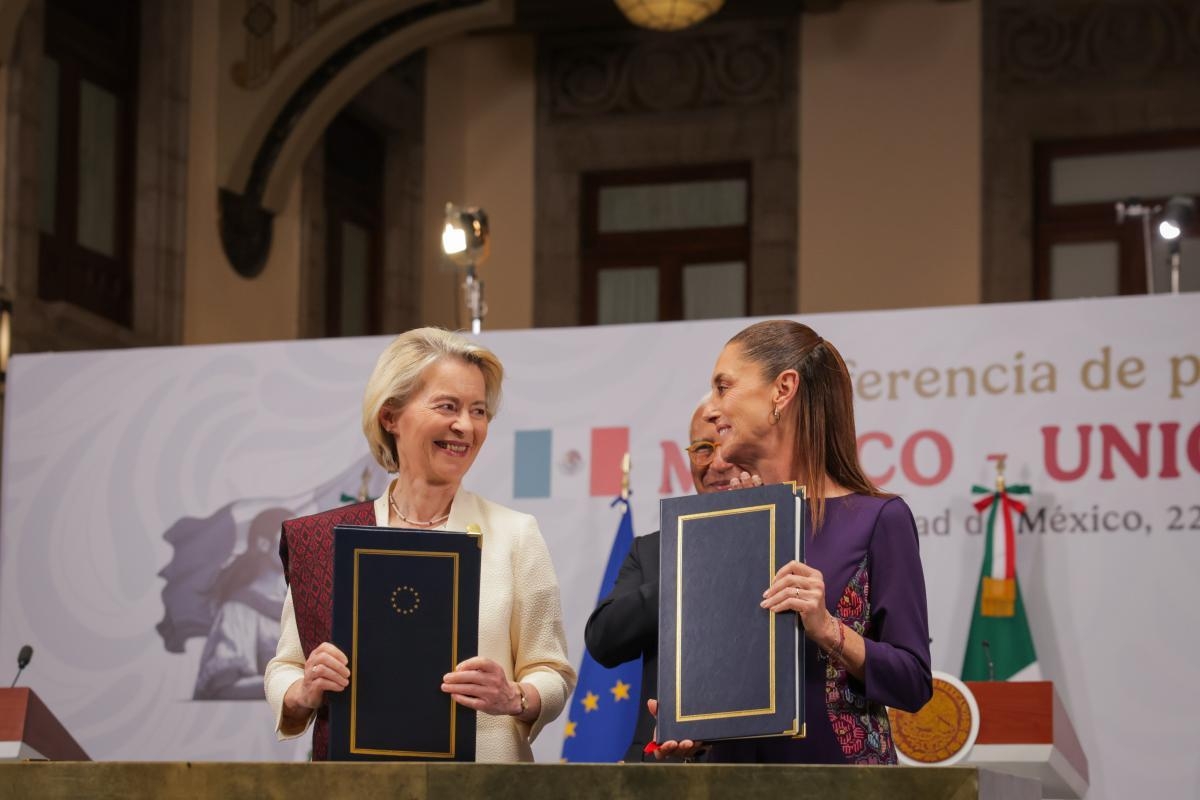

Brussels – The European Union and Mexico have officially signed two agreements designed to radically overhaul their economic and political partnership: the Modernised Global Agreement (MGA) and the Interim Trade Agreement (iTA). The two documents were signed today (22 May) during the 8th EU-Mexico Summit, currently taking place in the capital of the Central American country, and the significance of the event was underscored by the large delegation that travelled from Brussels to meet the country’s president, Claudia Sheinbaum: in addition to the President of the European Commission, Ursula von der Leyen, and the President of the European Council, Antonio Costa, the delegation also included the High Representative for EU Foreign Policy, Kaja Kallas, and the Commissioner for Trade, Maroš Šefčovič. They all flew to the country south of the United States of America to pursue and reaffirm—this time almost visibly under the nose of President Donald Trump—the EU’s policy of alliances and trade agreements, which has been strengthened precisely by the tariffs and trade restrictions pursued by the White House occupant.
“The modernised agreements signed today—commented von der Leyen immediately afterwards—set out the vision for the future shared by the EU and Mexico and will bring benefits to both sides.” In addition to “boosting trade and investment”, according to the President of the European Commission, the new agreements will enable cooperation to be expanded across a wide range of policy areas: “Together we will shape a better future for our citizens and for the planet, finding common ground in the defence of global institutions, the promotion of sustainable growth, and the protection of human rights and gender equality,” she explained.
Today’s signing—authorised by an EU Council decision on 11 May—marks a further step towards the official entry into force of the two agreements: the trade agreement will require only final approval from the Parliament and the Council, while the Comprehensive Agreement—as it does not fall within the exclusive competence of the Union—will also need to be ratified by the individual Member States and the Mexican government.
The trade agreement
The provisions on trade form the core of the MGA, to the extent that they have been incorporated into a separate text, the iTA, to speed up their entry into force without the need for approval from individual European capitals.
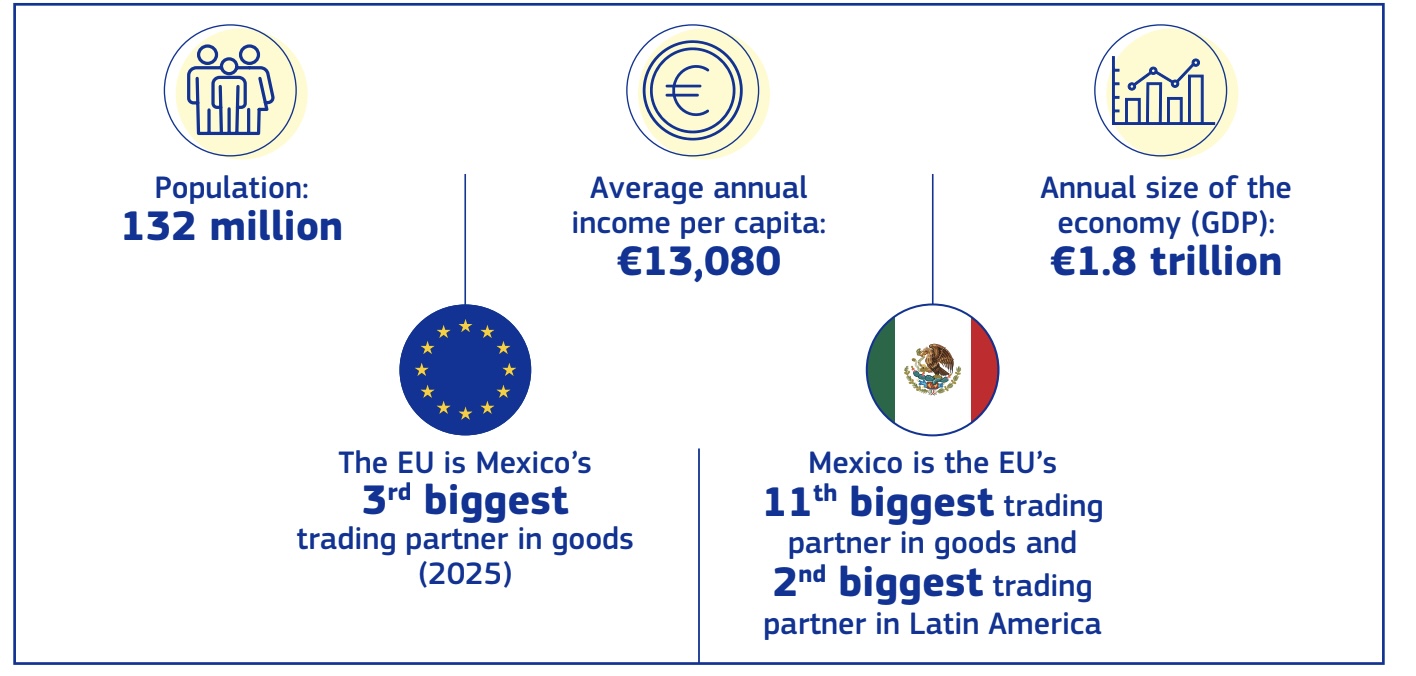
The main aim of the agreement is to further liberalise the flow of goods and services between the two sides of the Atlantic and to facilitate investment opportunities in each other’s economies by upholding the EU’s commitments to Mexico under the Global Gateway strategy. After all, we are talking about a country that is one of the EU’s main trading partners, with total trade exceeding €100 billion in 2025. “Over the last 25 years, trade in goods between us has quadrupled, with over 43,000 European companies exporting to Mexico and more than 11,000 companies operating directly in the country,” Commissioner Šefčovič noted.
The main measure to achieve this massive liberalisation is the elimination of the remaining customs tariffs on certain European exports. The agri-food sector is expected to benefit in particular, as Mexican tariffs remain very high: 20 per cent on pasta, the same rate on cheese and chocolate, and as much as 45 per cent on eggs and pork products. The so-called “non-tariff barriers” will also be removed, such as the quantitative limits imposed by Mexico on exports of certain products from Europe.
The benefits that the agreement is expected to bring to EU food and wine producers do not end there. In line with the provisions of other free trade agreements recently signed by Brussels—such as the one with Australia—protection will be guaranteed for hundreds of European geographical indications, safeguarding the presence of distinctive regional products on the Mexican market: whilst the old agreement from 2000 included around a hundred spirits designations, the new rules will increase this number to 232 and extend protection mechanisms to a further 336 wines, beers and food products. Among the protected brands are Prosciutto di Parma, Speck del Tirolo, Roquefort cheese and Spanish Rioja wine.
In addition to the food industry, the laissez-faire principle underpinning the agreement will also be extended to other sectors, such as mechanical engineering, electronics, pharmaceuticals and the automotive industry. In the latter case, provision has been made for the inclusion of a specific “Motor Vehicles Annex” to facilitate the export of car components manufactured in the EU to Mexico.
Finally, the agreement aims to strengthen cooperation between the EU and Mexico in the crucial sector of critical raw materials. In order to break free from dependence on China in this area, Brussels is seeking to diversify its supply sources, and Mexico represents, quite literally, a goldmine of opportunities in this regard: it is the EU’s main supplier of calcium fluoride (a mineral of fundamental importance for the production of steel and electric batteries) and exports significant quantities of copper and molybdenum. In light of this, the agreement includes provisions to make the supply chain “cheaper, more stable and more predictable,” such as the ban on so-called dual pricing: EU companies will have the right to purchase these strategic materials at the same price paid by local competitors.
Beyond the economy: the geopolitical dimension of the agreement
The EU-Mexico agreement signed today has, as its name suggests, a “global” scope, extending beyond the economic sphere alone to encompass the entire geopolitical dimension of relations between the Union and the Latin American country. In an international context characterised by uncertainty, instability, and the crumbling of historic alliances, Europe is looking for new partners who might be more dependable and whose worldviews align more closely with Brussels’ perspective. To this end, the strengthening of trade ties with third countries is increasingly being used as a tool for geopolitical influence.
This was explained by the President of the European Council, Antonio Costa, during a speech delivered yesterday (21 May) to the Mexican Senate. “My hope is that most nations will choose cooperation rather than rupture and isolation and that dialogue will prevail between partners who believe in stability and respect for international law,” he said, before emphasising that “this is certainly the unequivocal will of the EU and the strategy we are implementing, promoting agreements and deepening alliances with all our partners.”
In line with the vision set out by the former Portuguese Prime Minister, the agreement with Mexico also aims to strengthen political cooperation. To this end, the text includes legally binding commitments to align the two sides of the Atlantic on issues such as environmental protection, human rights, justice, and social cohesion.
Particular emphasis was placed on gender equality and its link to the economy, with the signing of a joint declaration reaffirming the shared commitment to promoting women’s economic empowerment and rights. Furthermore, President von der Leyen announced an investment of over 4 million pesos to support the empowerment of indigenous women in Mexico.
English version by the Translation Service of Withub![Ursula von der Leyen alla plenaria di Strasburgo, 20 maggio [Foto: EC - Audiovisual Service]](https://www.eunews.it/wp-content/uploads/2026/05/P-069763_00-01_02-HIGH-732475-350x250.jpg)