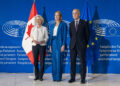
![Il primo ministro dell'Ungheria, Péter Magyar, e la presidente della Commissione europea, Ursula von der Leyen [Bruxelles, 29 maggio 2026. Foto: Xavier Lejeune/EC - Audiovisual Service ]](https://www.eunews.it/wp-content/uploads/2026/05/vdl-magyar.jpg)

Brussels – The new Hungary, that of Prime Minister Péter Magyar, has made significant progress in the fight against corruption, the defence of fundamental rights, and the rule of law, and for this reason the European Commission is releasing €16.4 billion in EU funds comprising guarantees (€12.9 billion) and loans (€3.5 billion) that had been frozen due to a lack of reforms. Specifically, Budapest is being granted €10 billion from the NextGenerationEU post-pandemic recovery programme, €4.2 billion from the Cohesion Fund, and €2.2 billion under the academic freedom programme, essentially funds from the Erasmus programme.
These are “rewards” for measures already underway, and commitments that the Hungarian Prime Minister has negotiated directly with the European Commission. It is a matter of fulfilling the commitments set out in the reform plan that Budapest and Brussels have been working on since the very first day after the election victory. Hungary is expected to present its proposed revision of the Recovery Plan (NRRP) as early as next week and will have until 31 August to complete the agreed objectives. The political shift that has turned the press conference into a trial for the defeated prime minister, Viktor Orbán, and a rally for the new head of government.
The President of the European Commission, Ursula von der Leyen, kicked off this remarkable show: “12 April will remain etched in our memories for a long time,” she began, referring to the elections that have shifted the balance of power, the majority and the key players. “On that day, the Hungarian people took their future into their own hands. They made a clear choice. They chose Europe. And they chose democracy.” Words that paint Orbán as a Eurosceptic and undemocratic, as indeed certified by the European Parliament.
https://www.eunews.it/en/2026/04/14/magyar-vonderleyen-eufunds-unblocking/
At this point, it is Magyar who takes to the podium in the Commission’s press room to launch a new election campaign. He spends 10 minutes attacking his opponents—who, incidentally, have already been defeated—and accusing them of all manner of things. “Orbán and his friends have lied to the Hungarian people about the European Union and the reasons behind the blocking of these funds, which was not ideological but motivated by corruption.” He takes issue with his predecessor for “having used the power of veto for the sheer pleasure of using it,” with the result that in the end “Orbán was isolated, he had no friends” and, at the European Council, “he had to be politely asked to go and have a coffee so that the others could make a decision.” A reference to what happened regarding Ukraine, but the accusations do not end there, because the campaign-driven delegitimisation also touches on the issue of immigration.
“I don’t know if you’re aware of this here in Brussels, but during his time in office, Orbán released 2,200 human traffickers from prison on the pretext of overcrowding.” Magyar reveals this anecdote to highlight the contradictory and untrustworthy nature of his predecessor, who exploited fears about asylum seekers only to release people who enrich themselves by trafficking in human beings. It is another moment in the trial of Orbán, held within the EU institutions for an event that is highly irregular.
Magyr’s entire tirade is delivered in his own language, after he himself announces that it is important to address the Hungarian people. One might imagine he intends to emphasise just how important the political agreement reached with the EU is because, as he stresses, the €16.4 billion are “resources that businesses, services, and families deserve.” Instead, he says something else and glosses over the fact that of these €16.4 billion, the NextGenerationEU portion requires the approval of Ecofin, and so €10 billion is proposed to be released, but it hasn’t actually been released yet. He does, however, say one thing: “The polls indicate that if we were to vote again, we would win more seats than we currently hold.” He adds that it only took his new government “three or four weeks” to get the funds that Brussels had kept frozen for some time. “I’ve said this from the start: if Hungary accepts anti-corruption measures, if we set up the asset recovery office, if we increase the powers of the integrity authority, and if we accept rules against nepotism, then I think this money will come to Hungary. That’s all we had to do,” he claims.
The chapter on Ukraine and EU accession. Here, von der Leyen reiterates that accession is a “merit-based” process and that the dialogue with Budapest and Kyiv’s path to accession are not linked. “There is no link between the ongoing talks and the funds released” to Hungary “and Ukraine, because NextGenerationEU and cohesion policy do not concern the accession process,” she explains. The President of the European Commission, however, confirms that Kyiv has done everything necessary to secure the green light. “Our position is very clear: Ukraine and Moldova have met all the necessary conditions to open the “fundamentals” cluster, the first one,” she notes, “and therefore there is no reason to delay the process.” The issue will be on the agenda at the meeting of heads of state and government: “We will discuss it at the European Council summit in June,” she reveals.
English version by the Translation Service of Withub