Brussels – Moving forward with “full political, financial, economic, humanitarian, military and diplomatic support for Ukraine and its people.” The Heads of State and Government reaffirm and renew the European Union’s stance to date in the war between Moscow and Kyiv. They are doing so as a group of 27, as announced and called for, at the end of the first day of the European Council summit, which was marked by promises of a further enlargement of the twelve-star club, with Ukraine as a future Member State: “The European Council looks forward to the opening of the other clusters, in line with the merit-based approach.” This is the key passage from the conclusions adopted by the leaders of the EU countries: while not going into detail on deadlines, there is a willingness to move forward with the accession process.
According to EU sources, the general view is that “all negotiation chapters should be opened as soon as possible.” This intention, not officially stated but conveyed through informal channels, gives renewed impetus to European support for Ukraine, alongside a willingness to make a genuine diplomatic effort aimed at achieving that “just and lasting” peace which is reiterated as the prerequisite for the future, in which Ukraine must in any case be defined territorially in accordance with “internationally recognised borders.” This means that Moscow will have to return all territories seized by force, including Crimea.
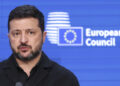
The leaders confirm that they are working towards a diplomatic solution, because when the time comes in the forthcoming negotiations, “Europe has a key role to play in a future solution and is ready to defend its interests.” The leaders are clear on this point, and are responding to explicit requests from the Ukrainian president, Volodymyr Zelensky. The same sources reveal that it was he who asked the 27 member states to “take a more active role” in the diplomatic arena. This means that the EU is seen as a credible and reliable partner and, above all, a key player in post-conflict management.
https://www.eunews.it/en/2026/06/01/ukraine-eu-and-european-aid-exceeds-e200-billion/
In this regard, the
contacts with Russia initiated by the office of the President of the European Council, Antonio Costa, are in line with these requests and reflect this spirit. Costa reiterated to European leaders and Zelensky that no negotiations are underway, nor have any “substantive” discussions begun, but that this process currently serves to lay the groundwork for the time when it comes to defend the interests of the Euro-Ukrainian bloc.
Meanwhile, the EU has decided to continue putting pressure on Russia, and a unanimous decision has been taken to extend the sanctions imposed on Russia for a further year, with all heads of state and government calling on their sherpas and relevant ministers to work towards “the swift adoption of the 21st package of sanctions” currently being finalised by the EU. Furthermore, in line with the approach to isolate Moscow internationally, the conclusions formalise the principle that “until there is a just and lasting peace in Ukraine, Russia’s participation in international sporting and cultural events should not be normalised.“
Finally, there is a warning to the international community, which is veiled for some, explicit for others. “The European Council urges all countries to
immediately cease any assistance to Russia in its war of aggression against Ukraine, whether direct or indirect, and notably through the provision of dual-use goods and components.
” The conclusions expressly mention, in this regard, Belarus, Iran, and North Korea, “among others.” Who these “others” are is left to the reader’s interpretation. It is the EU that is afraid to speak out openly and publicly against China, given the difficulties in the bilateral balance of power, and also against India, which continues to buy oil from Gazprom. It is the same old Europe that raises its voice against the weakest and lowers it before the strongest. The first day of the European Council essentially confirms the EU’s true nature today.
The commitments of the 27 do not end here. “
The European Union remains committed to supporting Ukraine’s repair, recovery and reconstruction, in coordination with international partners.” In this context, the European Council “looks forward” to the Ukraine Recovery Conference on 25 and 26 June in Gdańsk, where discussions on new contributions will begin.


![Il presidente del Consiglio europeo, Antonio Costa, e il presidente ucraino, Volodymr Zelensky [Bruxelles, 18 giugno 2026. Foto: European Council]](https://www.eunews.it/wp-content/uploads/2026/06/euco_zelensky-260618.jpg)
![Da sinistra: il presidente del Consiglio europeo, Antonio Costa; il presidente dell'Ucraina, Volodymir Zelensky: la presidente della Commissione europea, Ursula von der Leyen [Bruxelles, 18 giugno 2024. Foto: European Council]](https://www.eunews.it/wp-content/uploads/2026/06/euco_ua260618-350x250.jpg)

![Da sinistra: il presidente del Consiglio europeo, Antonio Costa; il presidente dell'Ucraina, Volodymir Zelensky: la presidente della Commissione europea, Ursula von der Leyen [Bruxelles, 18 giugno 2024. Foto: European Council]](https://www.eunews.it/wp-content/uploads/2026/06/euco_ua260618-120x86.jpg)
![[foto: Saverio De Giglio/imagoeconomica]](https://www.eunews.it/wp-content/uploads/2026/10/cpt-120x86.png)