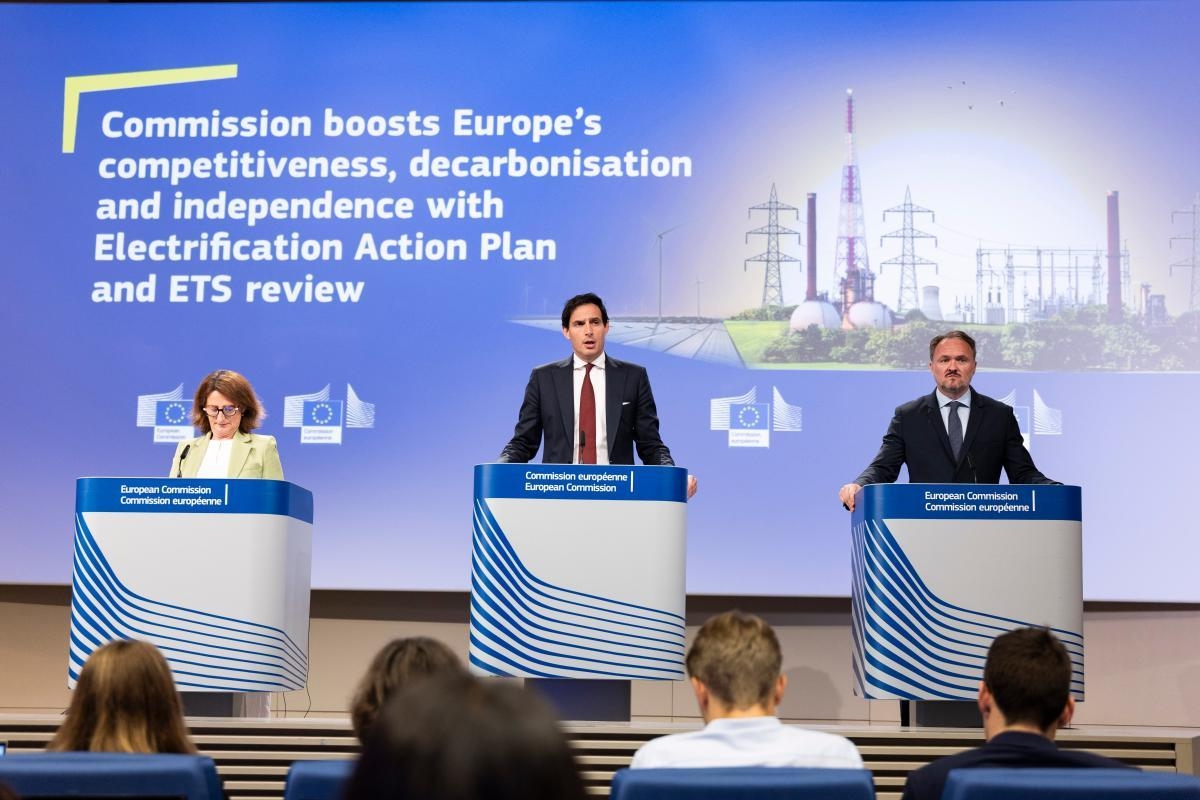

Brussels – It was clear that this was a hot-button issue: the press conference was over an hour and a half late, and materials for journalists were only handed out once the meeting had already begun. But when the three commissioners finally took the floor, the message was clear: “The era of fossil fuels has come to an end,” declared Energy Commissioner Dan Jørgensen, flanked by Climate Commissioner Wopke Hoekstra and Executive Vice-President Teresa Ribera. On the table is the new European plan to transform the Union into the first “electrified continent”. The core of the strategy is simple in its ambition and complex in its implementation: to gradually shift the European economy away from fossil fuels towards clean electricity. The aim is to achieve 46 per cent electrification by 2040, reducing fossil fuel imports by up to €260 billion a year. This is not just a climate issue, but also an economic and geopolitical one. As Ursula von der Leyen emphasised, “the best way to reduce Europe’s dependence on fossil fuels is to power our economy with electricity from clean, domestic sources.”
The plan: electricity at the heart of it all
The package presented by the Commission follows two parallel tracks: on the one hand, an action plan for electrification, and on the other, the review of the ETS, the European carbon market. Two instruments designed to work together. The electrification plan focuses on reducing the price gap between electricity and fossil fuels, particularly gas, and on incentivising the adoption of cleaner, electricity-based technologies. In practical terms, electrification means replacing direct fossil fuel consumption with electricity generated from renewable sources. Electric cars instead of combustion engines, heat pumps instead of gas boilers, and industrial processes powered by electricity rather than coal or oil. According to the Berlaymont Building, the benefits are already tangible: “Driving an electric car can reduce costs by up to 78 per cent, while switching to a heat pump can cut your heating bill by up to 60 per cent.”
Yet the obstacles remain significant. Today, electricity often costs up to three times as much as gas, grid connections take years to complete, and many technologies are struggling to reach commercial scale. The plan aims precisely to bridge this gap by addressing prices, infrastructure, and incentives. Key measures include allowing Member States to reduce electricity charges and taxes, particularly for energy-intensive industries, and the wider roll-out of smart metres to improve energy efficiency. The aim is to create a “level playing field between electricity and gas,” according to the press release, thereby removing one of the main obstacles to the transition.
Therefore, by 2030, Member States should take measures to ensure that electricity costs no more than 2.5 times the price of gas for households and no more than twice the price for industry. Furthermore, the European Commission will assess an electrification target for 2040 leading to an indicative target of 46 per cent electrification of final energy consumption, double the current share of 23 per cent, which has remained unchanged over the last ten years. According to calculations, achieving this target could reduce the EU’s fossil fuel import bill by €260 billion a year by 2040.
Furthermore, the plan aims to accelerate the uptake of electric vehicles, develop charging infrastructure, support social leasing schemes for low- and middle-income households, and step up the electrification of heavy goods and maritime transport. With regard to buildings, measures include doubling the number of heat pump installations by 2030 compared with 2025, new funding instruments for energy-efficient refurbishments and a possible European mechanism for the clean heating market.
ETS moves closer to industry: less rigidity, more investment
The second pillar is the reform of the ETS, the European Emissions Trading Scheme. A long-awaited and controversial review that the Climate Commissioner had already begun outlining in May, highlighting the most sensitive issues. At the heart of the reform is greater flexibility in the climate targets for 2040: the emissions cap will be reduced more gradually, with a linear reduction rate of 3.7 per cent between 2031 and 2035 and 1.7 per cent between 2036 and 2040. This decision reflects the desire to balance climate ambition with industrial competitiveness. “The proposal brings together three key objectives: climate action, competitiveness, and independence,” explained Hoekstra. However, this slowing of the trajectory risks coming into conflict with Europe’s increasingly stringent climate targets, while meeting the demands of the continent’s industries.
A further key element of the ETS revision is the increase in free allowances for industry, which will continue beyond 2030 but will be more closely linked to investments in decarbonisation. The aim is to prevent so-called “carbon leakage” and to support European reindustrialisation. “Contributions from industry should go back to industry,” states the Commission’s press release.
At the same time, the system is a major driver of investment. Since its inception, “the ETS has already generated over 270 billion euros,” noted Hoekstra. The aim now is to scale up: the Industrial Decarbonisation Bank is being launched, with €100 billion earmarked to support the transition. An initial phase, the ETS Investment Booster, will be operational from 2028, with around €30 billion in funding. Member States will also be required to allocate at least 50 per cent of ETS revenues to decarbonisation investments, totalling an estimated figure of over 100 billion by 2030.
Not just industry, but also aviation and shipping
The reform also broadens the scope of the carbon market. Rules for aviation and maritime transport will be tightened, with the ETS being extended to international flights of up to 5,000 km and to new categories of ships. As regards the extension to aviation for flights of up to 5,000 km, the measure (calculated based on the distance from the airport of arrival) includes stopovers in the Middle East but excludes the United States and China. For the maritime sector, new ports are being added to the anti-evasion list for transhipment, and the ETS is being extended to ships emitting between 400 and 5,000 gross tonnes.
The gradual inclusion of municipal waste incineration is also envisaged. For municipal incinerators, inclusion will be phased in from 2031 to 2034, with a possible national opt-out until 2035 if two of the following three conditions are met: an equivalent national carbon tax; compliance with recycling targets; compliance with the landfill target.
Another significant development is the introduction of international credits up to 2 per cent, which will enable funding for decarbonisation projects outside Europe, providing greater flexibility, particularly during the most challenging years of the transition, between 2036 and 2040.
Electrification depends on the grids
However, there is one essential prerequisite for electrification: the grids. Without the expansion and modernisation of the electricity infrastructure, the entire plan risks being held back. The Commission insists on the need to “speed up connection times and make better use of existing capacity.” The issue is also social and economic. The transition promises to create hundreds of thousands of jobs, but requires investment in skills and training. “Europe’s competitiveness will be based on clean energy, not on imported fossil fuels,” said Teresa Ribera.
The plan’s credibility hinges on striking a balance between climate ambition, energy security and support for industry. The political message, however, has already been set out. “Choose green electrons, home-grown and cheaper than black molecules, which are imported and expensive,” summarised Jørgensen. A choice which, in Brussels’ view, can no longer be postponed. “Let’s get it going,” concluded von der Leyen: not just a slogan, but Europe’s strategic direction for the coming decades. One question, however, remains unanswered: will it really be possible to steer the EU towards extensive electrification while, in the name of competitiveness, the 2040 climate targets for industry are being relaxed?
English version by the Translation Service of Withub
![[Foto: Unsplash]](https://www.eunews.it/wp-content/uploads/2026/06/andreas-gucklhorn-Ilpf2eUPpUE-unsplash-350x250.jpg)