
We live in a world of autocracies and monopolies.
The promise, a generation ago, was that opening markets would open societies too. Instead, we got tighter monopolies, a public square quietly bought out from under us, and platforms that answer to shareholders and governments somewhere else rather than to the citizens who fill them every day.
Somewhere along the way, Europe opened its economies before it finished opening its societies – and the oldest political technology in history, the tribe, came back dressed as the future: borders hardening not to protect people but to sort them, fear repackaged as belonging.
This is why Eumans exists: not another party competing for the next electoral cycle, but a movement built to reclaim the open society, this time in full.
What do we actually mean by “open society”…
A century ago, the philosopher Henri Bergson drew a distinction that still holds: a closed society, bound by instinct, custom, and a single approved destiny, against an open one, built on correction, pluralism, and a loyalty wider than the tribe.
Karl Popper turned that insight into the central question of political philosophy. Since no one holds the final truth, he argued, societies can only advance by trial, error, and the freedom to correct course. For this reason, he reframed politics away from “who should rule?” toward how we build institutions able to correct, replace, and hold rulers accountable, without violence.
George Soros, his student, staked real institutions on that same bet: that pluralism, the rule of law, and a vigorous civil society will always outlast unaccountable power. It is no accident that “open society” has itself become a target for some of the governments it was written against: a sign of how much is still at stake in it.
Our own working definition follows from theirs. An open society is one organised to prevent political, economic, and algorithmic power from concentrating and closing itself off from challenge.
… and what we envision as “open source democracy”?
That principle is not only political. It is also architectural. In a world that is getting more and more digital, as Lawrence Lessig put it, code is law, and architecture is politics. The platforms, algorithms, and digital infrastructures we live inside function as a kind of constitution, whether or not we ever voted on them.
Software culture already has a name for the two ways such systems get built. On the one hand, the Cathedral, where a hierarchy hands down a finished, unquestionable product. On the other, the Bazaar, where a decentralised community builds it in the open, correcting it in public as it goes. The Cathedral is the closed society in miniature. The Bazaar is the open one.
What is true of code is equally true of institutions: they are never simply found, they are always made, by people. Which means they can always be remade, by people.
This is why Eumans has long argued for making the EU itself open-source, that is, an institution whose “source” citizens can access and amend, not just observe from a distance. And that argument is being tested on two fronts right now.
The first is institutional. Closed societies are satisfied by legality alone. An election was held, a form was correctly filled in. Open societies demand something thicker: the substantive protections of minority rights, judicial independence, and a free press. Especially when they are inconvenient to those in power.
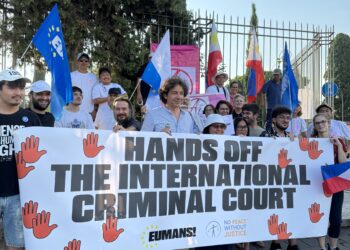
That is precisely what is at stake when the International Criminal Court is sanctioned by Washington and Moscow alike, as Eumans and No Peace Without Justice have been denouncing in Brussels. This is not a simple diplomatic disagreement. On the contrary, it represents an attack on the substance of the rule of law itself, the same substance that governments in the US, Russia, and many other countries are trying to hollow out from the inside.
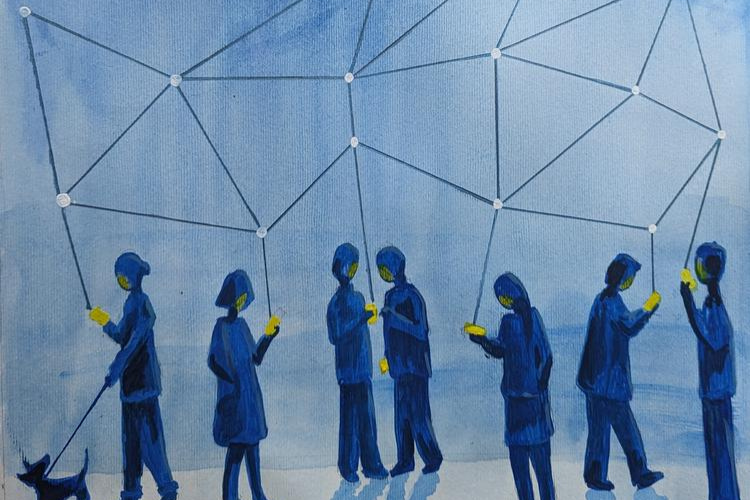
The second front is technological. The sociologist Pierre Bourdieu described how societies sort insiders from outsiders through mechanisms of distinction. We see algorithmic echo chambers as the same tribalism, rebranded for the attention economy, optimised not for truth but for engagement.
Left unchecked, this produces a kind of digital techno-feudalism. A handful of platforms decides what a continent sees, fears, and blames. Yet, they are answerable to nobody, nor even to representatives anyone can vote out. The alternative is not to reject technology. We are aware of how relevant contemporary platforms can be to mobilise activists and build communities beyond local and national borders.
However, the most popular social networks are far from being neutral. Their algorithms are built for profit, so when it comes to democracy and public services, we must build them differently. This is why we advocate for open-source, human-centred, and scrutinisable systems, including civic artificial intelligence, designed to serve public deliberation rather than harvest outrage.
Eumans’ method: participation across borders
Eumans works both fronts through one method: direct participation that does not stop at a border. Our societies are mobile, plural, and increasingly run through a genuinely European, digital public sphere. Participation can no longer be confined to the old Westphalian logic of one citizen, one nation, one vote cast only at home.
That openness has to be a vehicle for inclusion, it must hold for internationals and migrants as much as for anyone born within a given border, across every intersection of gender, class, origin, and ability that traditional politics still leaves out.
It is also why we back citizens’ assemblies chosen by lot, standing alongside elected office rather than beneath it. The political theorist Hélène Landemore calls this the answer a twenty-first-century democracy owes to a political class grown too entrenched, and we agree. It is the same principle behind our ICC campaign, our push for civic AI, and our case for a substantive rule of law. Different fronts, one open democracy.
An open society, in the end, is not something granted from above. With Lessig, we believe politics is, first and foremost, “the process by which we reason about how things ought to be.” Citizens who can only watch that process are subjects to another sovereign. Citizens who can access it, question it, and help rewrite it are something else entirely, are prosumers of democracy, producing the institutions they also live inside.
That is the society Eumans is building, one campaign, one border crossed, at a time. Join us.