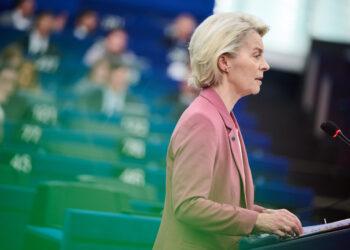
Brussels – Legitimising the Taliban regime to get rid of asylum seekers and migrants, both legal and, above all, irregular. The European Union has for some time now been pursuing a policy of direct dialogue with Afghanistan’s new government, but at the express wish of the Member States. The Commissioner for Immigration, Magnus Brunner, wishes to set the record straight and refute criticism and accusations. He takes advantage of a parliamentary question submitted by representatives of the Greens, the Liberals (RE) and the Radical Left (The Left) to clarify what has happened.
The European Commission and its External Action Service (the EEAS, headed by the High Representative for Foreign Affairs and Security Policy of the EU, Kaja Kallas) are reportedly organising an official meeting in Brussels with a delegation from the Taliban government to discuss the repatriation of Afghan migrants. This is the reason for the criticism of the EU executive. Brunner does not deny this; on the contrary, he confirms it. “The Commission was asked by 20 Member States and Schengen-associated countries in a letter signed by their Ministers in October 2025, to coordinate contacts on returns with the de facto authorities, to ensure a coherent European approach.”
In short, if the EU has formal and official contacts with the Taliban regime, it is because that is what the capitals have requested and wanted. Specifically, these are Austria, Belgium, Bulgaria, Cyprus, Estonia, Finland, Germany, Greece, Ireland, Italy, Lithuania, Luxembourg, Malta, the Netherlands, Poland, the Czech Republic, Slovakia, Sweden, Hungary, and Norway. These are practically all the governments that failed to support Spain in its handling of the Ceuta migration crisis.
While rejecting the accusations and criticism, Brunner shifts all responsibility onto national governments – all those that, in the name of repatriation, have sought to open a channel of dialogue with the Taliban regime. This is because, he explains, the signatories of the letter believe that “returns to Afghanistan need to be addressed in a comprehensive and coordinated manner, bearing in mind the challenges arising from the acute humanitarian and human rights situation in Afghanistan.” Hence, the request for assistance from the EU executive to provide support and act as a coordinating body. In any case, the Commissioner for Migration and Home Affairs continues, the “focus is on the return of persons posing a threat to public order or national security.”
As part of this initiative, Brunner goes on to admit, “the Commission and Sweden, on behalf of interested Member States, co-chaired a technical-level meeting with representatives of the de facto authorities of Afghanistan responsible for return and readmission, following technical-level discussions in Kabul, in January 2026.” This, he goes on to clarify, “does not constitute nor imply recognition.” However, de facto, it does.
English version by the Translation Service of Withub