

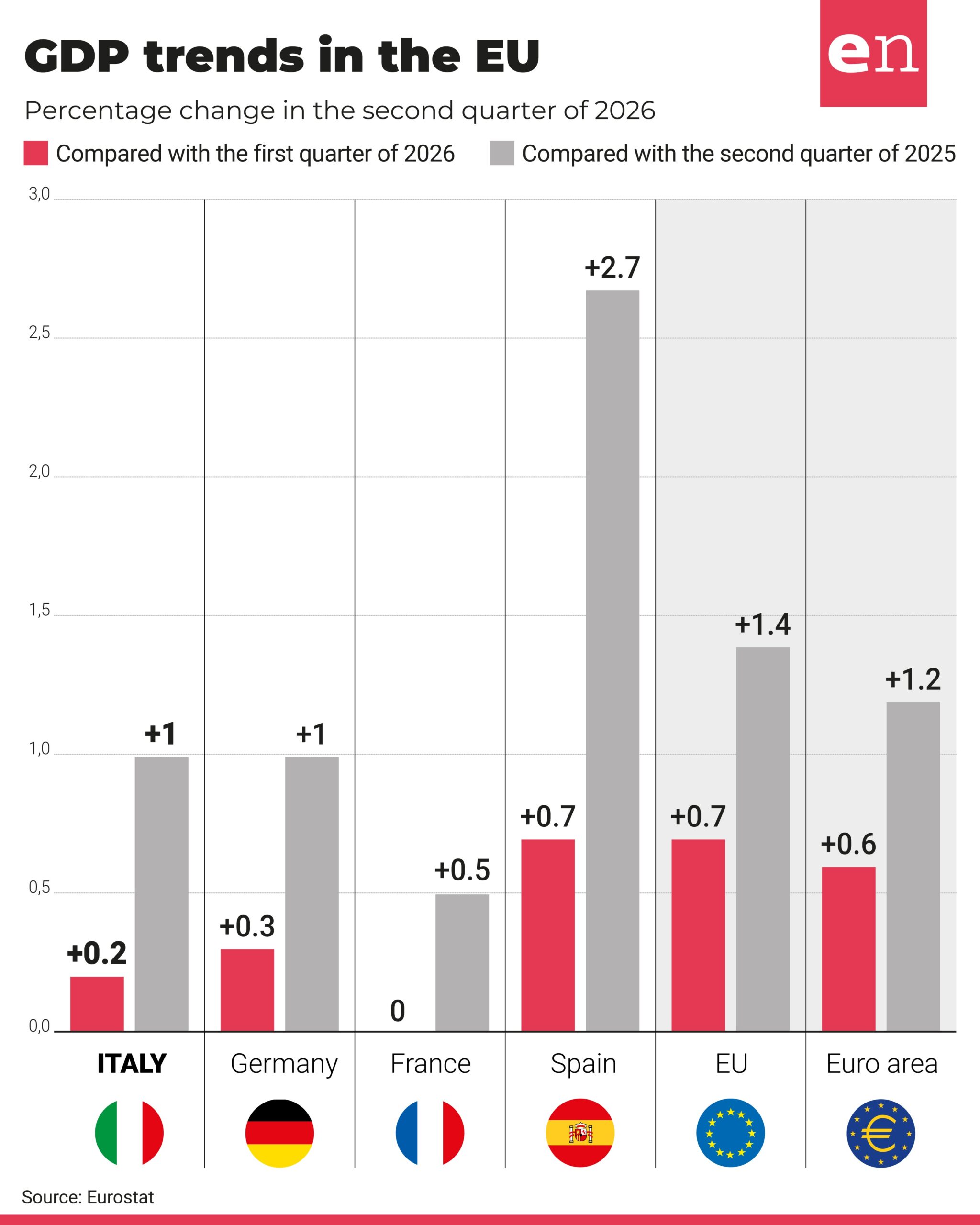
Brussels – GDP and employment are rising in the eurozone. According to Eurostat, the European Union’s statistical office, in the second quarter of 2026, seasonally adjusted GDP – the economic figure adjusted for periodic fluctuations linked to seasonal factors – increased by 0.6 per cent in the eurozone and by 0.7 per cent in the EU, compared with the previous quarter. In the first three months of 2026, the figure remained stable in the eurozone, whilst it rose by 0.1 per cent in the EU.
Compared with the same quarter of the previous year, it grew by 1.2 per cent in the euro area and by 1.4 per cent in the EU. During the same period, US GDP rose by 0.4 per cent from the previous quarter and by 2.1 per cent from the same quarter of the previous year. Looking at individual Member States, Ireland (+10.2 per cent) recorded the highest increase, followed by Slovenia (+1.8 per cent) and Lithuania (+1.7 per cent). Austria (-0.1 per cent) was the only country to record a decline, whilst Italy saw a slight increase of 0.2 per cent.
Looking at the individual expenditure items, household final consumption expenditure contributed positively to GDP growth in both the euro area and the EU (+0.2 percentage points in each). As regards final consumption expenditure by general government, Eurostat notes a “negligible” increase. The data also show that, for gross fixed capital formation, the estimate is negligible for the euro area but positive for the EU (+0.1 percentage points). Changes in inventories – which indicate the difference in value between goods held in stock at the beginning and end of an accounting period – show a decrease in both the euro area and the EU (-0.5 percentage points for both). The balance between exports and imports was positive for both samples, with an increase of 0.9 percentage points in the euro area and 0.8 percentage points in the EU.
Based on seasonally adjusted data – statistical figures adjusted for seasonal fluctuations – Eurostat estimates that 221.4 million people were in employment in the EU in the second quarter of the year, of whom 176.4 million were in the eurozone, representing an increase of 0.1 per cent for both. In the first quarter of 2026, employment rose by 0.1 per cent in the euro area and remained stable in the EU. Compared with the same quarter of the previous year, employment rose by 0.5 per cent in the euro area and by 0.4 per cent in the EU.
Finally, in the second quarter of 2026, hours worked rose by 0.1 per cent in both the euro area and the EU. Compared with the same quarter of the previous year, hours worked rose by 0.7 per cent in the euro area and by 0.8 per cent in the EU. In the second quarter of 2026, Portugal (+1.0 per cent), the Czech Republic and Malta (both +0.9 per cent) stood out for the largest increases in employment in terms of the number of people in work. The sharpest declines were recorded in Finland (-0.8 per cent) and Greece (-0.4 per cent). Italy recorded an increase of 0.3 per cent.
English version by the Translation Service of Withub






![Il ministro dei Trasporti, Matteo Salvini [Bruxelles, 5 dicembre 2024. Foto: Emanuele Bonini per Eunews]](https://www.eunews.it/wp-content/uploads/2024/12/salvini241205-120x86.jpeg)