Brussels – More than one in two adults in the European Union is overweight and around one in six is obese, according to figures published today (4 September) by Eurostat, the EU’s statistical office, for 2025. 16.3 per cent of the EU population aged 18 and over have a body mass index (BMI) of 30 or above, whilst a further 35.4 per cent fall into the pre-obesity category, with a BMI between 25 and just under 30. Overall, therefore, 51.7 per cent of European adults are overweight.
Compared with 2019, the figures also show a deterioration: the proportion of obese adults has risen from 15.3 per cent to 16.3 per cent, an increase of one percentage point over six years. However, there are very marked differences between Member States.
The country with the highest proportion of obese people is Malta, where 26.6 per cent of adults fall into this category. It is followed by Latvia, with 24.6 per cent, and Finland, with 23.2 per cent. At the other end of the scale is Italy, which, with an obesity rate of 7 per cent, has the lowest figure in the entire EU. After Italy come Greece at 12.8 per cent and Romania at 12.9 per cent.
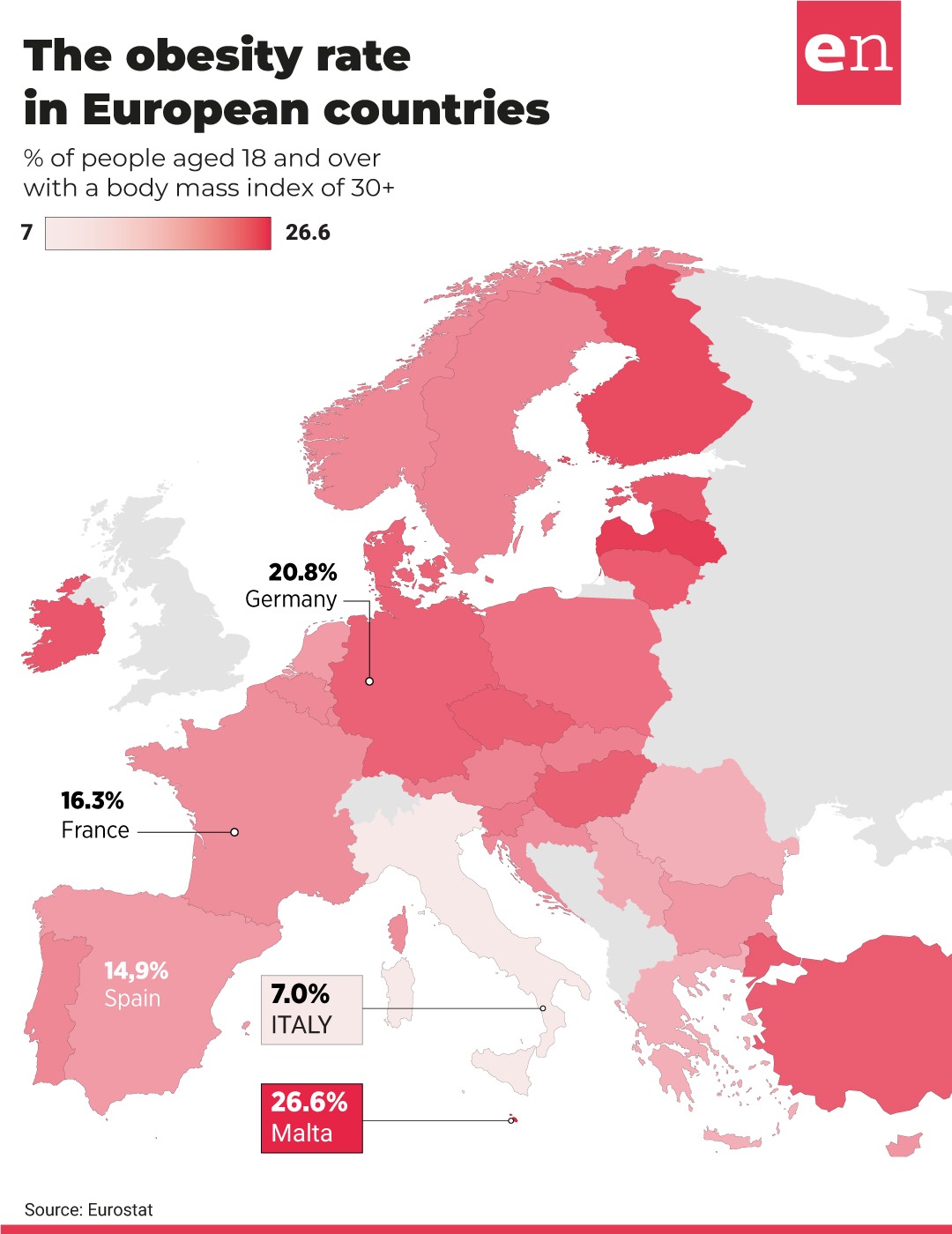
The figure for Italy is therefore 9.3 percentage points below the European average and represents just over a quarter of the figure recorded in Malta. Even when considering overweight as a whole, Italy ranks at the bottom of the ranking: in 2025, the proportion of overweight Italian adults stood at 37.7 per cent, compared with the EU average of 51.7 per cent.
Gender plays a role in the prevalence of obesity across Europe. Across the EU as a whole, in 2025, 17.4 per cent of men were obese compared with 15.3 per cent of women. The difference is even greater when considering the pre-obesity category: 41.9 per cent of men fell into this category, compared with 29.3 per cent of women. Conversely, women were more frequently underweight: 2.9 per cent compared with 1 per cent of men.
The issue is in the spotlight at the Commission. On the occasion of World Obesity Day, the Commissioner for Climate Action, Wopke Hoekstra, stated in the European Parliament in Strasbourg that obesity figures in the European Union “are very worrying.” The data presented leaves no room for interpretation: “More than half of adults are overweight, whilst 30 per cent of the child population is overweight or obese,” he stated. Hoekstra pointed out that “childhood obesity leads to chronic diseases, with truly serious socio-economic consequences for society and our healthcare systems” and that, to tackle these problems, it is necessary to “start with prevention,” by promoting “a healthy lifestyle and habits from the outset, such as a balanced diet and regular physical activity,” which play a “pivotal role” in preventing obesity.
To achieve this objective, “we need to persuade consumers to make the right choices by providing information on food products” and “this work will continue with the development of tools and possible financial incentives for companies to make their products healthier,” Hoekstra explained to the European Parliament, speaking on behalf of the Commissioner for Health, Olivér Várhelyi.
English version by the Translation Service of Withub



![[Copyright: European Union]](https://www.eunews.it/wp-content/uploads/2026/10/euco-261015-120x86.png)