- Europe, like you've never read before -
Monday, 23 November 2026
No Result
View All Result
  • en ENG
  • it ITA
Eunews
  • Politics
  • World
  • Business
  • News
  • Defence
  • Health
  • Agrifood
  • Other sections
    • Culture
    • Rights
    • Energy
    • Green Economy
    • Finance & Insurance
    • Industry & Markets
    • Media
    • Mobility & Logistics
    • Net & Tech
    • Sports
  • Eunews Newsletter
  • European 2024
    Eunews
    • Politics
    • World
    • Business
    • News
    • Defence
    • Health
    • Agrifood
    • Other sections
      • Culture
      • Rights
      • Energy
      • Green Economy
      • Finance & Insurance
      • Industry & Markets
      • Media
      • Mobility & Logistics
      • Net & Tech
      • Sports
    No Result
    View All Result
    Eunews
    No Result
    View All Result

    Home » Defence & Security » Weekend Round-Up War in Ukraine Brief — Europe

    Weekend Round-Up War in Ukraine Brief — Europe

    Russia continues launching ballistic missiles that Ukraine has few reliable methods of defeating without Patriot

    Antonia Williams by Antonia Williams
    21 September 2026
    in Defence & Security
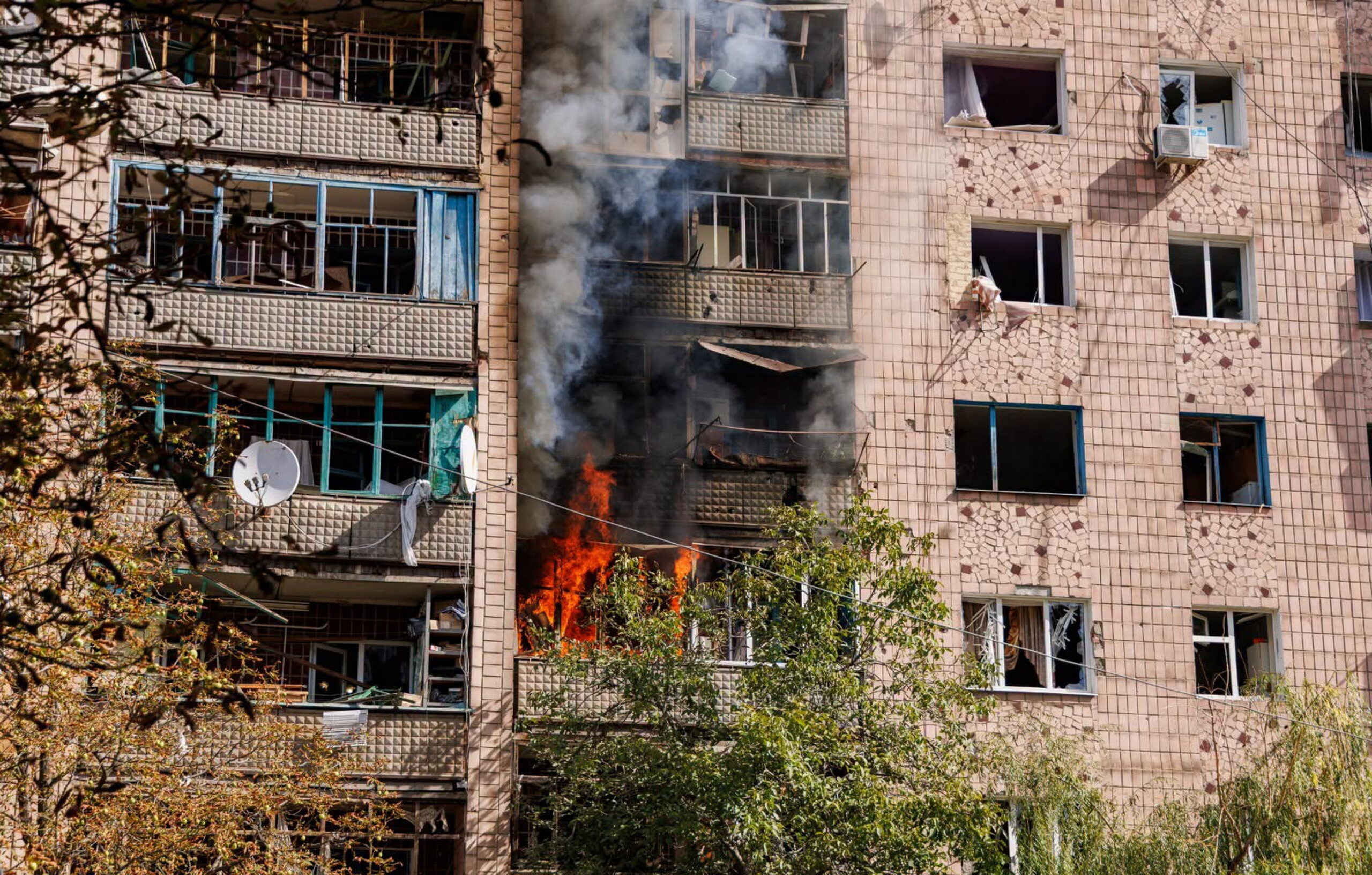
    The aftermath of a Russian drone attack on Kyiv on 9 September 2026 (Imagoeconomica)

    The aftermath of a Russian drone attack on Kyiv on 9 September 2026 (Imagoeconomica)

    21 September 2026

    This weekend, the long-range conflict intensified.

    Ukraine launched its largest drone attack yet on Russia, with Russian authorities reporting more than 1,600 drones intercepted since Saturday. Hundreds headed towards the capital, damaging Moscow’s oil refinery, as the Kremlin concluded the third and final day of parliamentary elections.

    Kyiv says the operation also involved an unusually broad range of domestically produced long-range weapons. At the same time, Russia continues attacking Ukrainian cities and industry, with strikes reportedly forcing plants responsible for roughly 90% of Ukraine’s steel production to stop operating.

    The pattern on both sides is becoming clearer: the targets are not simply military forces, but the industrial systems that allow those forces to keep fighting.

    The Big Story: Ukraine shifts its deep-strike tactics

    The scale of Ukraine’s attack was significant.

    Moscow Mayor Sergei Sobyanin said more than 1,600 drones had been intercepted since Saturday, including 450 heading towards the capital. Russian authorities said three people were killed.

    But what flew alongside the drones may matter more.

    In a statement, President Volodymyr Zelenskyy said Ukraine used a broad range of domestically produced long-range weapons, including FP-1, RZ-100, MICH-2000, Palyanytsia, Vendetta, Liutyi, Bars, Flamingo, Sichen and Pelican. The Kapotnya refinery in Moscow was among the facilities damaged.

    The attack points towards an important evolution in Ukraine’s deep-strike campaign.

    Until now, Kyiv has relied heavily on large waves of long-range drones. It now appears to be moving towards mixed strike packages: combining different weapons in the same operation rather than relying overwhelmingly on one type.

    That matters because different weapons present different interception problems.

    Large numbers of relatively slow drones can consume the attention and resources of Russian air defences, while other weapons approach with different speeds, trajectories and signatures.

    Air-defence systems have limited radars, launchers, interceptors, and reaction time.

    The goal is now to make attacks more complex, not just to overwhelm defences with numbers.

    There is still some confusion about Pelican. Early reports said it was Ukraine’s new FP-7 ballistic missile, but later Ukrainian sources said the Pelican used in this attack was an aircraft-type drone. Zelenskyy confirmed it was used but did not say exactly what kind of weapon it was.

    This uncertainty does not affect the overall importance of the attack.

    Ukraine is no longer simply trying to put more weapons into Russian airspace. It is trying to give Russian air defence more problems to solve at once.

    The industrial war becomes explicit

    Some of Russia’s most important attacks this week may not have hit military targets.

    The Financial Times reported that Russian strikes have reportedly halted Ukraine’s three principal steelworks, including after two ballistic-missile strikes against the Zaporizhzhia plant. Together, the facilities produced roughly 90% of Ukraine’s steel.

    Steel supports construction, infrastructure and manufacturing. Oil performs a similarly fundamental role for Russia.

    Ukraine is targeting Russian refineries and supply facilities, while Russia is hitting Ukrainian steel plants, transport systems, and energy sites.

    Ukrainian news agency RBC-Ukraine estimates that Russia lost 4 per cent of oil refining capacity after the latest attack on Moscow. That remains a Ukrainian assessment, but it points towards the real objective of the refinery campaign.

    Ukraine does not need to destroy Russia’s refining industry permanently. It needs to keep enough capacity under repair at any given moment to create sustained pressure on fuel supplies, logistics and revenues.

    The important metric is therefore becoming downtime, not explosions.

    So, is the logic becoming symmetrical? Attack the system that sustains the army, not simply the army itself.

    A refinery hundreds of kilometres inside Russia or a steel plant far behind Ukrainian lines can therefore matter to the war almost as much as individual positions at the front.

    The Patriot problem remains

    Ukraine’s growing offensive capability does not change its defensive problem.

    Kyiv has seen a surge in Russian attacks, which its air defences have struggled to repel amid ammunition shortages. In response, the US on Friday approved a potential $2.68 billion air-defence sale to Ukraine, covering missiles, launchers, counter-drone radars and associated equipment.

    But approval is not availability.

    Last month, AP reported that US Patriot inventories in Europe had been described as “beyond critical” following heavy use during the war in Iran.

    That makes the central constraint industrial as much as financial.

    Europe can provide money. Washington can approve sales. Ukraine can request missiles. But none immediately creates additional interceptors.

    There are signs that Washington is beginning to tackle the production bottleneck further down the supply chain. Last week, Northrop Grumman qualified its own solid rocket motor for the PAC-3 MSE and is preparing to become a second source alongside the existing supplier.

    That matters because expanding final assembly achieves little if additional missiles still depend on the same constrained suppliers underneath it.

    Production does.

    Russia continues launching ballistic missiles that Ukraine has few reliable methods of defeating without Patriot.

    The question is no longer simply whether Ukraine’s allies are willing to buy more interceptors, but whether enough physically exist — and how quickly industry can manufacture more.

    English version by the Translation Service of Withub

    Tags: briefukraine

    Related Posts

    Il presidente ucraino, Volodymyr Zelensky, e il premier irlandese Micheál Martin alla riunione della Comunità politica europea. 12 Novembre 2026. Source: Imagoeconomica
    Defence & Security

    Weekend Round-Up War in Ukraine Brief – Europe

    16 November 2026
    Il presidente russo, Vladimir Putin, al tavolo con Steve Witkoff, inviato speciale USA, Jared Kushner, imprenditore e consulente politico. 12 Novembre 2026. Source: Imagoeconomica
    Opinions

    Why Does Moscow Believe It Has Leverage?

    16 November 2026
    The Patriot Shortage and Ukraine's Freyja Ambitions. Source: Imagoeconomica
    Defence & Security

    The Patriot Shortage and Ukraine’s Freyja Ambitions – Part II

    12 November 2026
    A Russian raid in late September 2026 on one of the buildings of the Academy of Sciences. Source: Imagoeconomica
    Defence & Security

    Weekend Round-Up War in Ukraine Brief – Europe

    2 November 2026
    Pipeline. Photo de Wolfgang Weisersur Unsplash
    Energy

    One in three Europeans backs Russian gas, but only after the war ends, Polling Europe Euroscope data show

    27 October 2026
    Stoyan Tchoukanov Tabe Media. Source: EESC
    Agrifood

    INTERVIEW/ Stoyan Tchoukanov (EESC): “Global coordination is needed to strengthen food security”

    20 October 2026
    map visualization
    Crediti: Thomas Schaefer via Unsplash

    Italy urges the EU to provide greater protection for geographical indications (GIs) against unfair US practices

    by Iolanda Cuomo
    23 November 2026

    In support of Rome’s request, Austria, Bulgaria, the Czech Republic, Cyprus, France, Greece, Hungary, Poland, Portugal, Slovenia, and Spain

    Il primo ministro belga Bart De Wever. Foto d'archivio, conferenza stampa

    Belgium at a standstill over the budget and paralysed by protests against austerity. The King: “Reach an agreement”

    by Redazione eunewsit
    23 November 2026

    Between 50,000 and 70,000 people in the streets, cancelled flights and reduced public transport services

    Bandiera di The Base, organizzazione terroristica di estrema destra fondata da Rinaldo Nazzaro [foto: John Banks Trent/imagoeconomica]

    Rinaldo Nazzaro, founder of neo-nazi group The Base, active across Europe, added to terrorism blacklist

    by Emanuele Bonini emanuelebonini
    23 November 2026

    The Council of the EU imposes sanctions on the founder of the far-right organisation for white supremacy and violence aimed...

    SIBEG AZIENDA INDUSTRIA BEVANDE IMBOTTIGLIAMENTO IMBOTTIGLIAMENTI COCA COLA STABILIMENTO BOTTIGLIA BOTTIGLIE FABBRICA

    Coca-Cola Europacific Partners may have breached competition rules: the Commission launches a formal probe

    by Emanuele Bonini emanuelebonini
    23 November 2026

    According to the European Commission, the European bottler that distributes drinks under the ‘The Coca-Cola Company’ brand is alleged to...

    • Director’s Point of View
    • Opinions
    • About us
    • Contacts
    • Privacy Policy
    • Cookie policy

    Eunews is a registered newspaper
    Press Register of the Court of Turin n° 27

    Copyright © 2025 - WITHUB S.p.a., Via Savona 127/B, 20144 Milano
    VAT number: 10067080969 - ROC registration number n.30628
    Fully paid-up share capital 50.000,00€


    No Result
    View All Result
    • en ENG
    • it ITA
    • Politics
    • Newsletter
    • World politics
    • Business
    • General News
    • Defence & Security
    • Health
    • Agrifood
    • Altre sezioni
      • Culture
      • Rights
      • Energy
      • Green Economy
      • Gallery
      • Finance & Insurance
      • Industry & Markets
      • Media
      • Mobility & Logistics
      • Net & Tech
      • News
      • Opinions
      • Sports
    • Director’s Point of View
    • Draghi Report
    • Eunews Newsletter

    Attention