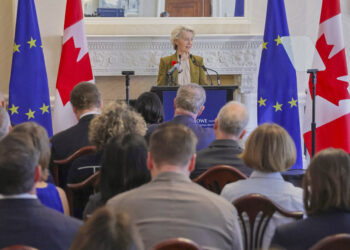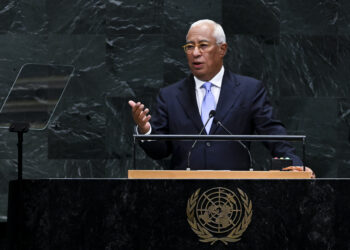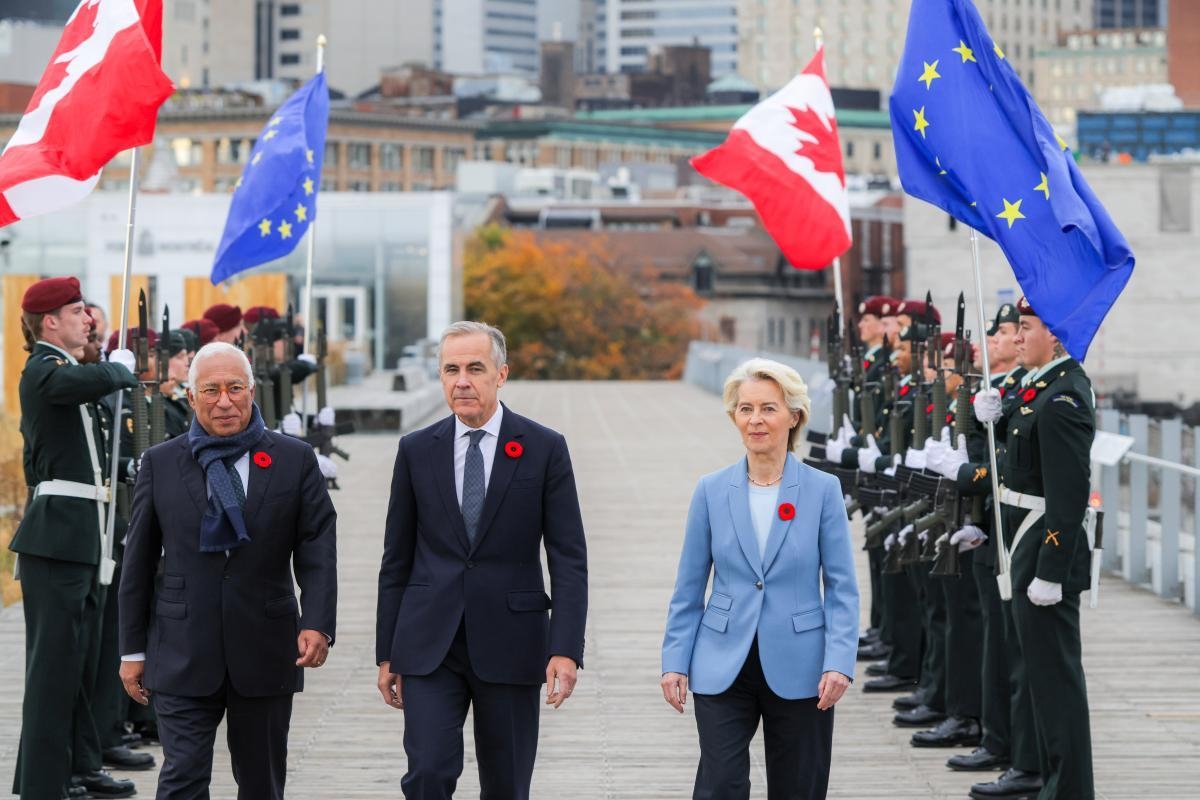
Brussels – Canada cannot be part of the European Union; geography and the ocean prevent this under the Treaties. But something new can be created, which could make the North American country a partner that is just “one step away from accession.” This is the political essence of the Montréal summit held yesterday and today (29 and 30 October) between the European Union and Canada. The two sides cannot yet formally record the designation of Ottawa as an “associated member” of the EU-27 – which consequently does not appear in the final Joint Statement of the summit. However, not only is the issue by no means off the table, but it has emerged from the meeting with greater clarity. And it is only a matter of time. Canadian Prime Minister Mark Carney made this very clear at the press conference following the summit with the Presidents of the European Commission and the European Council, Ursula von der Leyen and António Costa. “We are working to establish the deepest possible partnership – without going as far as full membership, given our geographical location. Canada will become the European Union’s first associate member,” he stated.
The path to achieving this entirely new goal is clearly defined. “Over the coming months, we will set out in detail the substance, scope, and remit of this new form” of partnership, in which “the President and I will meet regularly to monitor progress,” explains Carney. “In March, we will bring together the College of European Commissioners and our federal government here in Canada to take this work forward,” he continues. Furthermore, “I have accepted President Costa’s invitation to attend the European Council meetings in June; by that date, we aim to conclude the ongoing negotiations and discussions,” Carney explains. For the Prime Minister, and for the people of Europe and Canada, this means “greater opportunities, greater economic accessibility and, yes, stronger sovereignty.”
In the text of the declaration, the leaders state: “We will work to define, by the 2027 EU–Canada summit, the concept of an ever closer partnership between Canada and the EU –
short of full membership itself
–
to reflect, through this even closer association, our common endeavour and cooperation towards our shared goals of prosperity, economic security and strategic autonomy.”
But the leaders’ remarks at the press conference reveal something more. “Our relationship is so special that we want to create something new: to go beyond a simple association, coming within a hair’s breadth of full EU membership,” Costa explains. “Ours will be the closest, deepest, and most unique association of its kind. We will achieve this through a more intensive commitment at the highest political levels, identifying shared priorities and coordinating our responses to common challenges. It is a path we have already begun to tread,” continues the Prime Minister, recalling Carney’s participation in several EU and European Political Community meetings.
The first to speak of Canada as an associate member of the EU in her State of the Union address in September, von der Leyen describes the concept of an associate member as “uncharted territory.” But she tries to provide a little more detail. “The idea is simple: an association without membership,” replacing “the concept of ‘membership’ with a shared ambition and vision,” she explains. In other words, “we can establish a strong partnership that comes much closer to membership than we have done in the past,” with three objectives: “Greater opportunities for our citizens, greater prosperity on both sides of the Atlantic, and greater security for all of us.” To achieve this, von der Leyen identifies three pillars: “policies, programmes, and governance,” defining a greater number of policies “jointly”; ensuring Canada’s “more comprehensive” participation in EU programmes; and, finally, bringing the institutions closer together. She emphasised: “This is a partnership not against anyone else, but for our shared strength.”
Amid the vagueness of the wording and the political work that lies ahead for the EU and Canada, one thing is clear in the meantime: Ottawa’s inclusion in the “Made in Europe” concept, that is, the “European preference” for public procurement in strategic sectors, starting with steel, cement, aluminium, the automotive industry, and net-zero emission technologies. “The Industrial Accelerator Act has been proposed by the Commission ‘so as to include all countries with which we have a free trade agreement’, he notes, referring to the proposal launched in March to accelerate the decarbonisation of European industry. With Canada, ‘we have CETA, so Canada would automatically be included, of course’, she observes.
Montréal, however, looks towards Washington in the distance. According to the President of the European Commission, “Canada is, without a doubt, the most European country outside Europe” and what unites the two sides “goes far beyond geography.” These words were directed at Carney, but also at Donald Trump, just a few days before the mid-term elections. “What matters today is not a country’s location on the map, but what it is willing to build together with us and the values it represents in a world characterised by strong headwinds at a geopolitical level,” says the President, alluding to the path of estrangement taken by the US partner. For her, these are winds that “will not stop blowing” because they represent “a permanent change.” Therefore, “the time has come to act with confidence and foresight to build a new future” and “this is precisely what makes today’s summit so unique and so historic.”
Finally, a reassurance that the future will put to the test. According to von der Leyen, there is “broad support” and “a shared ambition” amongst EU Member States to bring Canada closer to the Union, and there is also “a large majority in favour” of the project within the “European Parliament.” The coming months will reveal whether a Union preoccupied with the upcoming election year and mired in the struggles and divisions involved in agreeing a common budget for the 2028–2034 seven-year period and restructuring itself with a view to future enlargement to include other members, will be able to forge a new relationship with Canada as well.
English version by the Translation Service of Withub