Brussels – Austria, Germany, Denmark, Greece, and the Netherlands officially begin negotiations with Rwanda to establish the first joint return centre outside the European Union. The aim of the five governments is to reach an agreement with Kigali and have the facility up and running by 2027, transferring to it third-country nationals who no longer have the right to remain in the EU and who cannot be returned to their countries of origin. The promoters describe the project as “a turning point” in the management of irregular migration, and it forms part of a broader shift in the European approach to return policies.
The announcement came from Vienna, on the sidelines of the Conference on migration, during a press conference attended by the Austrian Chancellor Christian Stocker, the Danish Prime Minister, Mette Frederiksen, and representatives of the governments involved. “We have achieved a truly historic paradigm shift in migration policy,” said Stocker, who believes the centre should help to ensure that return obligations are “effectively enforced” and to ease the pressure on European reception systems. “If people who have no right to reside in the European Union cannot be removed, the entire asylum system is rendered meaningless. And we will not allow that,” he added.
Socialist leader Frederiksen agrees, having championed a political agenda that has been in the works for several years. “Some of us have been working towards this goal for eight or nine years, and we are finally ready to take more concrete steps,” said the Danish Prime Minister, referring to a necessary shift to “undermine the business model of human traffickers and regain control of our borders.”
Frederiksen also explicitly referred to the collaboration with Rome: the changes promoted by the five governments, she said, had been carried out “together with a large majority of European nations and, in particular, in close collaboration with Italy.” This was a reference to the stance of Giorgia Meloni’s government, which has long advocated the need to develop forms of cooperation with third countries to manage migration procedures and repatriations, and with whom Fredriksen has long agreed on the need to step up repatriation.
For the German Minister of the Interior, Alexander Dobrindt, the project marks the transition from drawing up the rules to implementing them. “We have laid the legal foundations and are now moving on to the implementation phase,” he said in Vienna, referring to the new European regulation on returns, which opens up the possibility of establishing centres in third countries. Dobrindt clarified that talks with Rwanda are the most advanced and rejected comparisons with the controversial British plan, which was subsequently abandoned: “What the United Kingdom intended to do was to transfer asylum procedures to third countries.” The European proposal, he emphasised, concerns instead people whose applications have been definitively rejected and who have no right to remain in the EU.
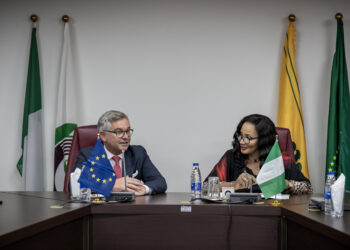
Kigali has indicated its willingness to take part in the initiative. Rwanda’s Minister of the Interior, Vincent Biruta, has given assurances that the country will offer a “second chance” to those resettled, who will be able to choose whether to return voluntarily to their country of origin, integrate into Rwandan society, or move to another destination where they have the right to reside. “Rwanda is ready to participate in innovative solutions to migration challenges, offering a safe and dignified alternative,” he said, referring to the collaboration already underway with the United Nations High Commissioner for Refugees (UNHCR) and the International Organisation for Migration (IOM).
The European Commission welcomed the initiative, confirming that it “had closely followed the preparatory work” of the five Member States. During the daily briefing in Brussels, the spokesperson for the European Commission, Markus Lammert, has mentioned that the work had been carried out with particular attention to “respect for human rights and close cooperation with United Nations agencies.” On the economic front, Brussels has made it clear that “in principle, it is the responsibility of the Member States to fund the return hubs.” Any European support for accompanying measures, the spokesperson added, will have to be assessed “on a case-by-case basis,” based on specific requests from the governments concerned.
However, a number of operational aspects remain to be defined: the arrangements for managing the facility, the legal safeguards, the independent monitoring system, and the necessary resources. According to the organisers, the centre is initially expected to accommodate around one hundred people – men and women who have exhausted all avenues of appeal against the rejection of their asylum claims and who cannot be returned to their country of origin. Minors will be excluded from the scheme. The governments assure that the facility will be open, with no deprivation of liberty or barbed wire, and that the stay will last a few months, during which language courses and vocational training will be offered.
Expressing concern in the European Parliament is Mélissa Camara (Greens), who stated that “the agreement announced between Rwanda and five European countries is a pact of shame, a grave moral failure” because “the repatriation centres represent one of the most striking symbols of the dehumanisation of migration policies.” Camara recalled having “visited the centre in Gjadër, Albania, where people are not called by name but identified by numbers, where they do not know what day or time it is, and where suicide attempts are regularly reported.” In this case, “the signatory EU Member States have crossed yet another shameful moral line, by entering into an agreement with an authoritarian regime, guilty of human rights violations and implicated in crimes far beyond its own borders,” observed the French MEP from Les Écologistes. “Under this agreement, people will be deported thousands of kilometres away from the European Union, with no guarantee that their rights will be respected,” she concluded, vowing to continue fighting “against these centres of shame and for the dignity of every human being.”
English version by the Translation Service of Withub