- Europe, like you've never read before -
Friday, 24 April 2026
No Result
View All Result
  • it ITA
  • en ENG
Eunews
  • Politics
  • World
  • Business
  • News
  • Defence
  • Health
  • Agrifood
  • Other sections
    • Culture
    • Diritti
    • Energy
    • Green Economy
    • Finance & Insurance
    • Industry & Markets
    • Media
    • Mobility & Logistics
    • Net & Tech
    • Sports
  • Newsletter
  • European 2024
    Eunews
    • Politics
    • World
    • Business
    • News
    • Defence
    • Health
    • Agrifood
    • Other sections
      • Culture
      • Diritti
      • Energy
      • Green Economy
      • Finance & Insurance
      • Industry & Markets
      • Media
      • Mobility & Logistics
      • Net & Tech
      • Sports
    No Result
    View All Result
    Eunews
    No Result
    View All Result

    Home » World politics » Brussels commits €35 billion to Kiev, funded by profits from frozen Russian assets

    Brussels commits €35 billion to Kiev, funded by profits from frozen Russian assets

    On her trip to the Ukrainian capital, the chairwoman of the EU executive announced that the Union is committed to using proceeds from the Russian Central Bank's immobilized funds to support the finances of the attacked country

    Francesco Bortoletto</a> <a class="social twitter" href="https://twitter.com/bortoletto_f" target="_blank">bortoletto_f</a> by Francesco Bortoletto bortoletto_f
    20 September 2024
    in World politics
    Foto: EC - Audiovisual Service

    Foto: EC - Audiovisual Service

    Brussels – European Commission President Ursula von der Leyen met with Ukrainian leader Volodymyr Zelensky in Kyiv for the eighth time since the Russian invasion began. She told him that the EU would soon write a maxi check for the attacked country that, as per agreements made last summer in the G7 context, will be financed by the extra profits generated by immobilised Russian assets. The exact amount is not yet finalised, but it could be as high as €35 billion. However, the risk remains that Hungary could jeopardise the entire plan.

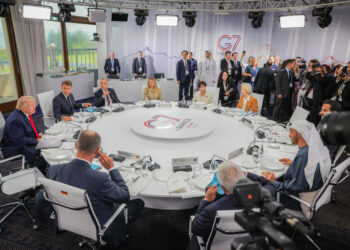
    During a joint press conference with Volodymyr Zelensky at the end of their bilateral meeting, the head of the EU executive announced on Friday (Sept. 20) that “the Commission has adopted proposals that will allow the EU to lend €35 billion” as part of last summer G7 partners’ pledge to provide Ukraine with $50 billion (about €45 billion) to bolster state coffers, financing the disbursement with proceeds generated by Russian assets tied up in the West.

    Speaking alongside the Ukrainian president, von der Leyen returned to the three-point “winter plan” (worth €160 million) she had set out Thursday (Sept. 19): the priority for the EU is to support Kyiv’s energy system by repairing the damage caused by Russian attacks, connecting the Ukrainian grid to the European one and stabilising the country’s energy production. Moreover, it added the heavy lifting, namely these €35 billion that should arrive as quickly as possible in Ukrainian coffers.

    In reality, €35 billion is the upper limit that the EU can provide to Ukraine under the G7 plan, but it is not certain that the actual disbursement will amount to that figure. The exact amount will be decided later, probably by the end of October, when the other Western partners have also defined the size of their contribution. In short, the total €45 billion could be provided in different proportions—not necessarily 35 from Brussels and the remaining 10 from the other organisation members.

    The agreements made last summer at the G7 level originally envisaged an equal contribution from the EU and the United States of $20 billion each (just under €18 billion), with Canada, Japan, and the UK putting in the rest. But Washington had then slowed down the whole process, citing doubts about the willingness of EU member states to periodically renew the sanctions that, in practice, effectively keep the assets of the Russian Central Bank immobilised—and thus form the legal foundation on which the whole plan is based. Specifically, the fear centres on Viktor Orbán’s Hungary. Since the Twenty-Seven must reach unanimity in the Council to renew the sanctions regime against Moscow, there is a risk that Budapest will spoil the game.

    The EU Commission’s idea is to set up a special mechanism, which should be called the Ukraine loan cooperation mechanism, to channel between €2.5 and €3 billion in revenue to Kyiv’s coffers annually (assets frozen in European jurisdictions are estimated at around €200 billion). This mechanism would thus complement the European Peace Facility (EPF), which currently finances most of the disbursements incurred by member states, and indeed should end up covering (at least in intentions) 95 per cent of the loans disbursed to Ukraine, based on the principle that “Russia must pay for the destruction it causes,” as von der Leyen herself has often reiterated.

    Technically, this money is not earmarked for any specific area of expenditure but will be available to the Ukrainian government in full. That is, a way by which Brussels seeks to increase the fiscal space agibility for Kyiv, whose expenditures to cope with Russian aggression continue to rise. The creation of this special fund—which will ultimately be guaranteed by the EU budget and will become operational in 2025—will have to be approved by the end of the current fiscal year under an ordinary legislative procedure by the EU Parliament and the Council, which deliberates on this point by qualified majority and can thus bypass a possible Hungarian veto.

    On the other hand, Budapest’s “no” vote may halt the sanctions regime imposed by the Twenty-seven against the Russian Federation, which is renewed every six months. Now, to limit the risk that a single member state could undermine the entire lending mechanism, the Commission has proposed to extend to 36 months the periodicity with which the Council decides on the renewal of the freeze on immobilised Russian assets. With this move (which is not to be understood as a “decoupling” of the freeze from the rest of the sanctions, as clarified by EU executive officials), the restrictive measures would continue to be renewed every six months while the immobilisation of Moscow’s central bank funds would be effectively locked in for three years at a time. For this proposal to be accepted, however, the governments of the Twenty-Seven would need to accept it unanimously—which may not be so obvious.

    English version by the Translation Service of Withub

    Tags: g7loanukraine

    Related Posts

    ucraina
    Energy

    EU ambassadors approve a €90 billion loan for Kyiv and sanctions against Moscow. Zelenskyy: “A positive sign”

    22 April 2026
    FASTNED  AZIENDA ENERGIA STAZIONE DI RICARICA RICARICHE ELETTRICHE ELETTRICA COLONNINA SPARKALLIANCE SPARK ALLIANCE ALBERI SOLARI PANNELLO SOLARE  PANNELLI AUTO AUTOMOBILE AUTOMOBILI COLONNINA
    Mobility & Logistics

    Environmentalists claim: “The car industry is opposing EU CO2 targets. It will cost us an extra 74 billion”

    14 April 2026
    RAFAEL DIFENCE SYSTEM AZIENDA INDUSTRIA BELLICA SETTORE DIFESA PRODUZIONE ARMI RAZZO RAZZI MISSILE MISSILI
    Briefs

    Defence: EU Council approves SAFE loans for France and the Czech Republic

    10 April 2026
    Un sito di estrazione di grafite in Quebec, visitato dal vicepresidente esecutivo della Commissione europea, Stéphane Séjourné, responsabile della strategia industriale,
    Business

    ECB warns Chinese rare earth export restrictions could weigh on production and inflation

    3 April 2026
    La vicepresidente della BEI, Gelsomina Vigliotti, e l’Amministratore Delegato di Eni, Claudio Descalzi [foto: European Investment Bank]
    Briefs

    EIB, ENI agree on 500 million euro financing for biofuel production in Italy

    1 April 2026
    Green Economy

    EU makes its first amendment to the ETS; boosts reserve allowances to counter energy market volatility

    1 April 2026
    map visualization
    Marta Kos

    Ukraine’s EU accession gains momentum as Kos says “integration is increasingly essential”

    by Annachiara Magenta annacmag
    24 April 2026

    Thanks to the release of the 90 billion euro loan to Kyiv and the approval of the 20th package of...

    Informal Meeting of Heads of State or Government of the EU

    EU signs inter‑institutional deal in Cyprus to implement competitiveness agenda

    by Emanuele Bonini emanuelebonini
    24 April 2026

    The informal summit of heads of state and government sees the signing of the EU Commission-Parliament-Council declaration on the roadmap...

    Il vertice informale dei capi di Stato e di governo dell'UE [Nicosia, 23 aprile 2026. Foto: European Council]

    Italy, Belgium reject Commission’s energy agenda; Costa urges faster transition

    by Emanuele Bonini emanuelebonini
    24 April 2026

    At the informal European Council summit, Meloni and De Wever opposed von der Leyen’s measures. The President of the European...

    Ucraina Allargamento Ue

    Enlargement: EU leaders attempt to launch Ukraine’s accession process

    by Emanuele Bonini emanuelebonini
    23 April 2026

    The Presidents of the European Commission and the European Council would like to open the first chapters of negotiations on...

    • Director’s Point of View
    • Opinions
    • About us
    • Contacts
    • Privacy Policy
    • Cookie policy

    Eunews is a registered newspaper
    Press Register of the Court of Turin n° 27


    Copyright © 2025 - WITHUB S.p.a., Via Rubens 19 - 20148 Milan
    VAT number: 10067080969 - ROC registration number n.30628
    Fully paid-up share capital 50.000,00€


    No Result
    View All Result
    • it ITA
    • en ENG
    • Politics
    • Newsletter
    • World politics
    • Business
    • General News
    • Defence & Security
    • Health
    • Agrifood
    • Altre sezioni
      • Culture
      • Diritti
      • Energy
      • Green Economy
      • Gallery
      • Finance & Insurance
      • Industry & Markets
      • Media
      • Mobility & Logistics
      • Net & Tech
      • News
      • Opinions
      • Sports
    • Director’s Point of View
    • Draghi Report
    • Eunews Newsletter

    No Result
    View All Result
    • it ITA
    • en ENG
    • Politics
    • Newsletter
    • World politics
    • Business
    • General News
    • Defence & Security
    • Health
    • Agrifood
    • Altre sezioni
      • Culture
      • Diritti
      • Energy
      • Green Economy
      • Gallery
      • Finance & Insurance
      • Industry & Markets
      • Media
      • Mobility & Logistics
      • Net & Tech
      • News
      • Opinions
      • Sports
    • Director’s Point of View
    • Draghi Report
    • Eunews Newsletter

    Attention