




Brussels – The European Union stands firmly by Moldova in its resistance to Russia’s assertiveness and on its path to membership. Or at least that is the message delivered by Emmanuel Macron, Friedrich Merz, and Donald Tusk to Maia Sandu, the President of the Republic. The visit, on the occasion of Chisinau’s 34th anniversary of independence, comes a month before legislative elections that are expected to be highly tense due to fears of interference from the Kremlin.
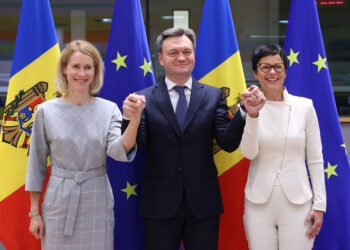
French President Emmanuel Macron offered Paris’s “determined support” to Moldova on its path to EU membership, warning about Russian “lies” during a visit to the capital alongside German Chancellor Friedrich Merz and Polish Prime Minister Donald Tusk. The three European leaders, representatives of the so-called Weimar Triangle, travelled to Moldova today (27 August) to demonstrate Brussels’ closeness in this delicate historical phase.
The hostess, pro-European President Maia Sandu, welcomed the trio with full honours, stressing that the presence of the leaders “shows not only your support for Moldova, but also that the European project continues and that we are part of it.” “There is no alternative to Europe,” the president punctuated, at a time when “our independence, our sovereignty, and our peace are being tested perhaps more than ever.”
So glad to welcome our dear friends @EmmanuelMacron, @donaldtusk, @_FriedrichMerz — honoured to celebrate Moldova’s Independence Day together. pic.twitter.com/QTvA0WZMJG
– Maia Sandu (@sandumaiamd) August 27, 2025
The choice of date is far from random. The political symbolism evokes the past while also resonating with the present and the immediate future of the small yet strategically important Balkan country. On 27 August 1991, Chisinau declared its independence from the Soviet Union, three days after Kyiv.
In the present context, today’s visit should be read in the regional context of increasing geopolitical volatility, exacerbated by Russia’s aggression against Ukraine. In a month’s time, on 28 September, voters will be called to the polls to renew Moldova’s single-chamber parliament, in a crucial vote that will also mark the country’s geopolitical trajectory for the coming years. The fear, in Chisinau as in Brussels, is that the Kremlin will unleash another campaign of electoral interference.
This already happened last November, when Sandu won a second term by a handful of votes, and the pro-Russian ultra-nationalist Călin Georgescu won the first round of the Romanian presidential elections by surprise, plunging Bucharest into a deep political and institutional crisis. The worst nightmare would be a similar development to what happened in Georgia, which slipped (again) into Moscow’s orbit following the October rigged elections.
“The Kremlin propaganda tells us that the Europeans want to prolong the war and that the EU oppresses peoples: these are lies,” Macron said. “Unlike Russia, the EU does not threaten anyone and respects everyone’s sovereignty,” he added, speaking at the joint press conference alongside his Moldovan counterpart.

Sandu has been sounding the alarm for some time about the risk of “an unprecedented electoral interference” at the next ballot box. As of today, pre-election polls give her centre-right Party of Action and Solidarity (PAS) a lead with around 39 per cent of the vote, while the pro-Russian Socialist Party (PSRM) is around 15 per cent. In the 2021 elections, PAS had obtained just under 53 per cent.
Moreover, Moscow can resort to various weapons in its extensive hybrid warfare arsenal: not only disinformation and
electoral interference, but also the instrumentalisation of energy flows, for instance. A technique already tried and tested precisely in the Moldovan separatist region of Transnistria, which was left without electricity last winter, to put pressure on Chisinau.
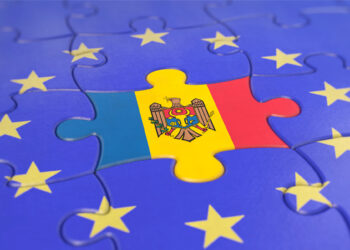
Finally, the European leaders’ trip to Chisinau was also aimed at reaffirming the Twenty-Seven’s commitment to welcoming the Balkan nation into the twelve-star club in the near future, perhaps within a few years. “The EU door is open for Moldova,” Merz said, adding that Berlin would “do everything possible to open the first chapter of negotiations in the autumn.”
The country has been an official candidate since June 2022, but accession negotiations started two years later, running in parallel with those of Ukraine. Despite the progress made by the Balkan state,
recognised on several occasions by EU leaders, none of the 35 negotiating chapters to bring Moldovan laws into line with the acquis communautaire is currently open. In recent weeks, there has even been speculation about an uncoupling of Moldova’s and Ukraine’s applications for membership, given that Viktor Orbán’s Hungary continues to stand in the way of the latter. In the corridors of Brussels, the opening of the first cluster for Chisinau shortly is taken into consideration, before the elections, to allow Sandu—who has made EU membership, considered “irreversible”, a central pillar of his political platform—to take the lead in the polls. However, this could be a politically risky move, potentially souring relations with Kyiv at a time when international diplomacy appears to be groping in the dark, with no end to the war with Russia in sight. The Ukrainians themselves say they are confident that Donald Trump‘s intercession with the Magyar premier can break the impasse.




![La video riunione dell'Eurogruppo [27 marzo 2026. Foto: European Council]](https://www.eunews.it/wp-content/uploads/2026/03/eurogruppo-260327-120x86.jpg)
