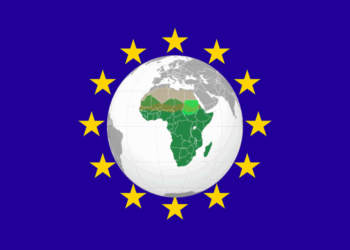
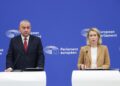
Brussels – At the table were more than seventy leaders, usually divided by the strip of the Mediterranean Sea. The heads of state and government of the European Union and the African Union (an entity that brings together the 55 countries of Africa) met in Luanda, the capital of Angola. The event celebrated 25 years of partnership between the two entities and focused on EU funding for African development. “In a world of trade conflicts, a closer partnership between us starts with trade,” said European Commission President Ursula von der Leyen.
The summit is not an easy one; between the two continents, there are centuries of colonisation, difficult to forget. That is why Europe comes to the table, trying hard to present itself as a friend rather than a usurper. “We want Africa and Europe to be partners by choice,” recalls von der Leyen. Mahmoud Ali Youssouf, President of the African Union Commission, responds on the subject: “It is no longer time to be just suppliers of raw materials.”
The Global Gateway to Africa
The European proposal revolves around the Global Gateway 150 billion investment package. Von der Leyen is already celebrating its early successes: “When we launched it, we aimed to invest €150 billion in Africa by 2027. So far, we have already mobilised over €120 billion.” The objectives would be to accelerate the green and the digital transitions, in addition to promoting sustainable growth in health and education—concrete investments aimed at promoting growth in a continent facing enormous structural problems.
The Mineral Railway
The most controversial strategic project is the modernisation of the 1,300-kilometre railway that runs through Zambia, the Democratic Republic of Congo, and Angola to the port of Lobito. The infrastructure would be essential for the European supply of strategic raw materials, one of the main objectives of European leaders. European Commissioner for Development Jozef Síkela had already taken the lead on the issue, having announced a fortnight ago the use of over €200 million to support Zambia’s industrial growth.
The main focus of the package was the restyling of the railway to Lobito (as of today, trains run at a maximum speed of 45 kilometres per hour). The idea is a noble one. Remodelling this infrastructure would spur development in the surrounding areas. The risk, however, is the construction of a cathedral in the desert, useful only to European interests.
However, the historical and symbolic aspects are not to be overlooked. The construction dates back to the end of the 19th century and the early 20th century. At that time, the colonial governments of Belgium and Portugal built the
Benguela Railway, linking the mining areas of Katanga (today the Democratic Republic of Congo) to the port of Lobito, in Angola.
Von der Leyen is aware of this, and when talking about the subject, she uses tact: “You all know about this ambitious project to bring essential minerals from Zambia and the Democratic Republic of Congo to global markets. But there is much more. With the launch of the corridor, we have also started to collaborate with farmers right here in Angola,” recalling how, in the end, it is always a win-win process. “European companies have provided training,” she continues, “they have helped local companies to align to European standards and expand their export capacity.”

China is the power to be challenged
However, in discussions about détente between Africa and Europe, the elephant in the room is not mentioned: China. Angola, host of the summit, for example, is Beijing’s main debtor in Africa. The former Portuguese colony has to repay some 46 billion dollars. Chinese investments do not only touch the western part of the Continent. In recent years, Beijing’s money has spanned the continent from north to south, focusing on financing strategic resources geared towards access to critical minerals, infrastructure projects, as well as direct loans to states. China, with an unblemished past in the region, has become the leading player in the area over the years.
While the United States has been busy burning bridges, China has been building them.
52 out of 54 countries in Africa now trade more with China than the United States.
pic.twitter.com/p4GLnAVJs5– Jostein Hauge (@haugejostein)
April 3, 2025
The Union’s Chances
The Union has no choice but to play the territorial proximity card, since, as von der Leyen recalled, “Europe is already by far your largest trading partner. One third of Africa’s total trade is with Europe, and Africa exports more than twice as much to Europe as it does to China.” In short, the challenge has begun. The gap to be bridged, however, is still wide. We will begin to understand more when the summit between the leaders of the two continents concludes.
English version by the Translation Service of Withub