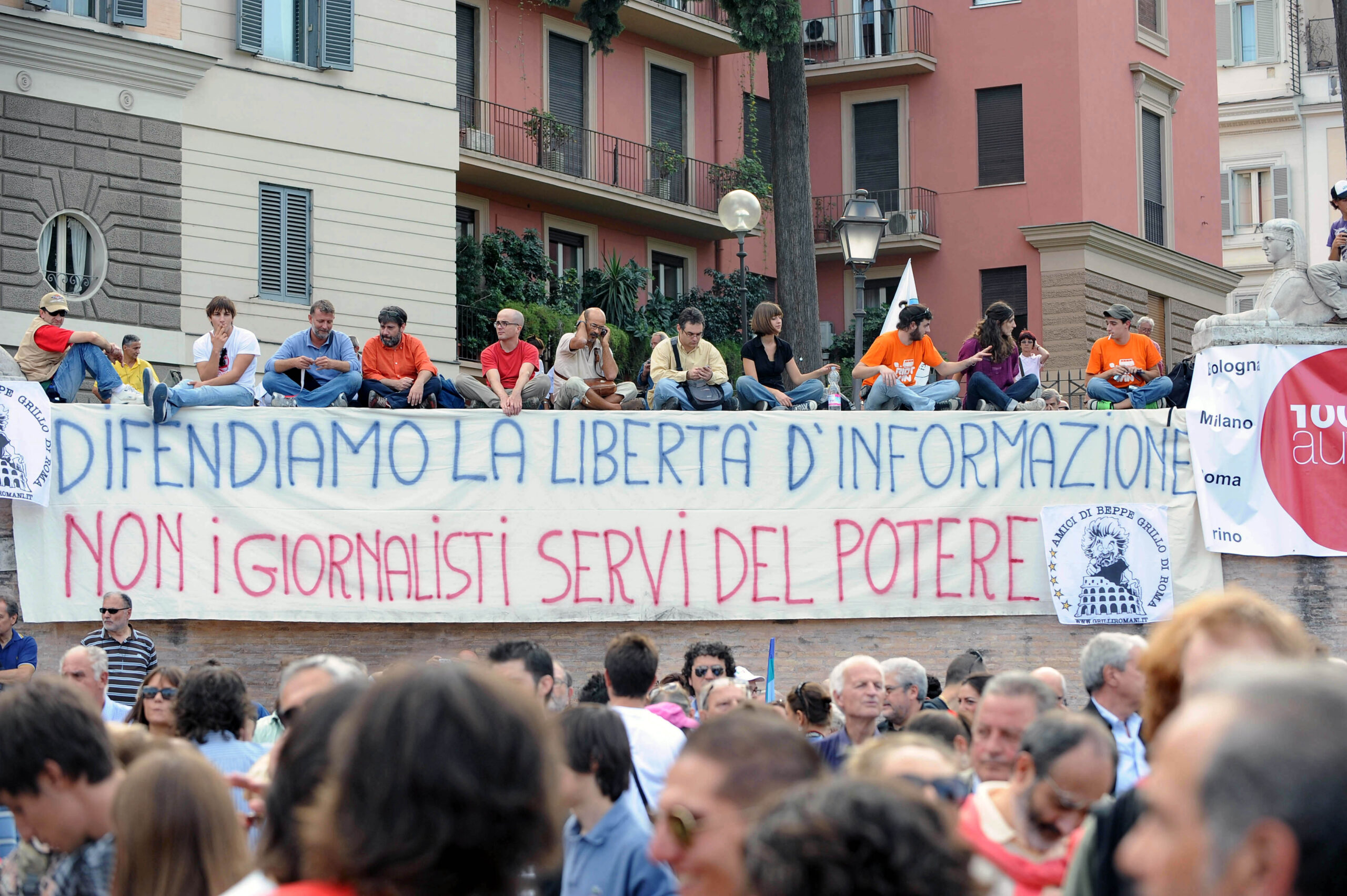
Brussels – This is not a good time for information, which is suffering from “an increasingly hostile environment for journalism in Europe.” This is the complaint made by the Council of Europe in its annual report published today (3 March), which describes a worrying situation: “In 2025, press freedom continued to be under constant pressure in Europe, due to legal threats, physical attacks and intimidation, attempts to seize media outlets, and transnational repression.”
According to the figures, in 2025, the partners of the Council of Europe’s platform for the promotion of journalism and the safety of journalists published 344 reports of serious threats to media freedom, a significant increase (+29 per cent) compared to 2024, when 266 were recorded. The countries with the highest number of reports were Russia (50), Turkey (49), Georgia (35), Serbia (35), and Ukraine (27). In general, accurately documenting news events is becoming increasingly difficult, as “across Europe, during protests, journalists have often been physically attacked by the police, politicians, and demonstrators”.
Italy is no exception to the general trend and indeed adapts to the moment and the context. Thus, the country earns passages and mentions within the document. Italy is cited as an example of state control. RAI is not named, but it is stated that “the countries with the highest rates of risk of political interference in public media are Hungary, Malta, and Turkey, followed by Slovakia, Bosnia and Herzegovina, Italy, Croatia, Poland, Greece, Serbia, and Romania.”
https://www.eunews.it/en/2024/09/23/media-freedom-fresh-tensions-between-italy-and-the-eu/
The concerns raised by the Council of Europe, a non-EU institution, echo those already raised by the European Commission three years ago, confirming that the situation regarding the independence of state television and freedom of information has still not been resolved.
On the subject of political interference, the Council of Europe cannot fail to denounce the case of political espionage against newspapers critical of the current Italian government. “In June 2025, two Italian journalists, Francesco Cancellato, editor-in-chief of Fanpage, and Ciro Pellegrino, head of the Naples editorial office, were targeted by Graphite spyware, developed by the Israeli company Paragon Solutions,” the report reads. A third journalist chose to remain anonymous.” Investigations confirmed that the spyware was targeting critical journalists and members of civil society.”
The case is significant considering that “to date, national investigations have been unsuccessful and no one has been held responsible“. In this context, “the slow response of the authorities has prompted the president of the Italian National Press Federation (FNSI), Vittorio Di Trapani, to denounce ‘unacceptable inaction,’ leading the FNSI and the National Order of Journalists to file a criminal complaint with the Public Prosecutor’s Office in Rome.
For Giorgia Meloni’s Italy, the criticism does not end there. Among the various elements of pressure on the journalistic environment, the free press and information, the Council of Europe also includes “decisions on public service funding delayed for months in France and Italy, despite their well-established public service media systems.”
Italy, therefore, demonstrates a problem with respect for the fundamentals of democracy and the rule of law. Attacks come from many sides: “Cases of dismissals, such as in Serbia, Italy and Switzerland, have highlighted threats to the independence of journalists not only because of external pressure, but also because of their own hierarchy and owners. “A striking example of this occurred on 27 October, when “the Italian news agency Agenzia Nova dismissed its Brussels correspondent, Gabriele Nunziati, for asking a question deemed ‘inappropriate’ to the chief spokesperson of the European Commission.”
English version by the Translation Service of Withub