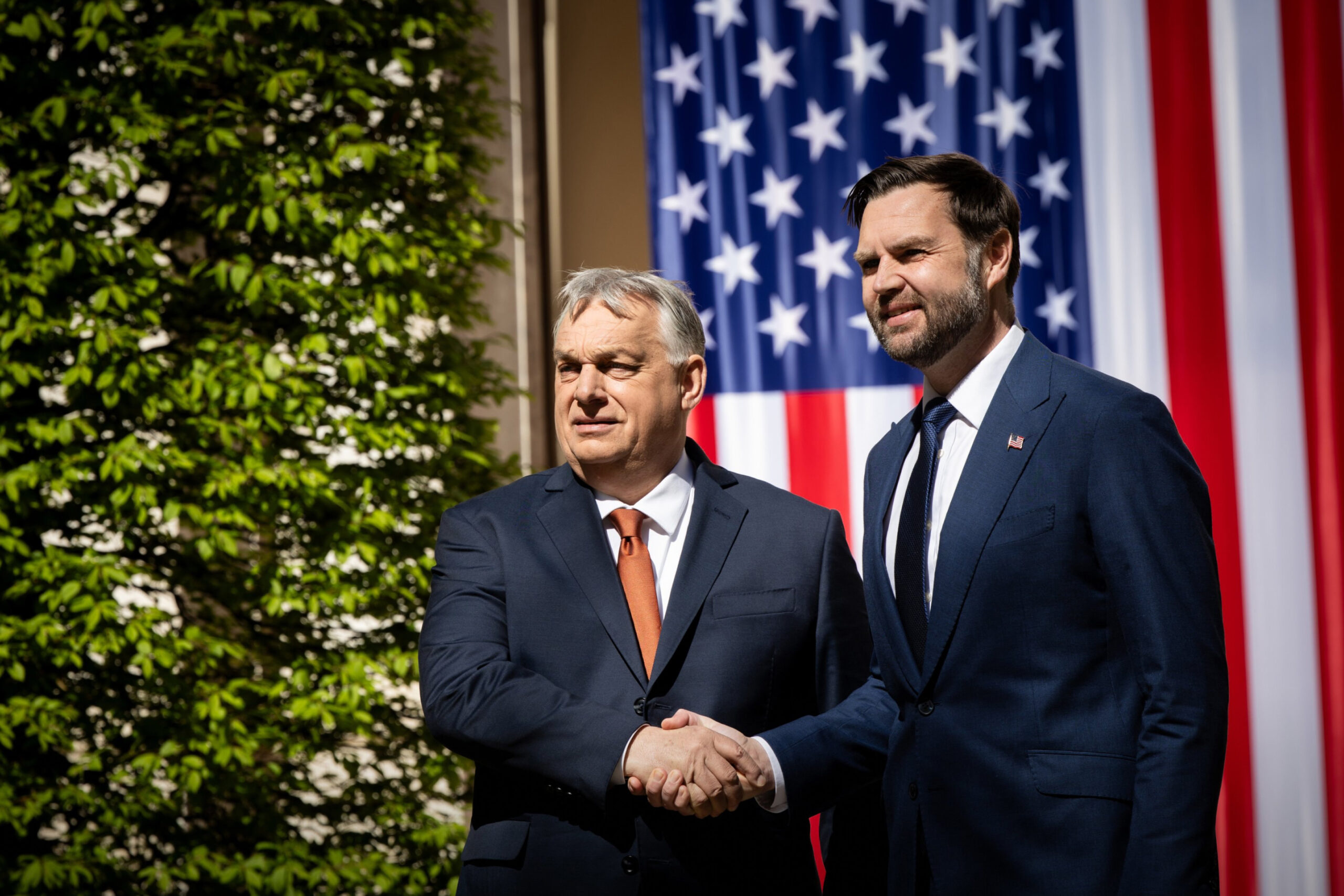
Brussels – With the polls showing him trailing, the Hungarian Prime Minister, Viktor Orbán, is attempting to make up ground ahead of the parliamentary elections on Sunday, 12 April, by capitalising on his close relationship with Donald Trump’s United States. The deputy to the tycoon, J.D. Vance, landed in Budapest yesterday morning (7 April) and took part in two separate events alongside the Hungarian leader: first, a press conference at the Government Palace, and subsequently a rally to mark “Hungarian-American Friendship Day”. Despite repeatedly stating that he did not wish to interfere in the electoral process, instead accusing “European Union bureaucrats” of doing so, Vance clearly reiterated the US government’s support for the outgoing prime minister and re-election candidate, urging his “Hungarian friends” to go out and vote “and stand with Viktor Orbán because he is on your side.”
The frontal attack on the EU—the leitmotif of the entire visit by the White House’s number two—began immediately, with Vance’s opening remarks at the press briefing held at the Prime Minister’s offices. “I certainly don’t expect the Hungarian people to listen to the Vice-President of the United States,” he said, “but I wanted to send a signal to everyone, particularly the bureaucrats in Brussels, who have done everything to keep the Hungarian people in check because they don’t like their leader, who has effectively sided with his people.” Vance described the European attitude towards Budapest as “one of the worst examples of foreign interference in elections I have ever seen, something truly shameful.” He added: “I will not tell the Hungarian people how to vote and I encourage the bureaucrats in Brussels to do the same”.
When asked about this, the European Commission responded to Vance’s comments through a spokesperson, noting that “elections are a choice that rests solely with the citizens: together, the Commission and the Member States are building a stronger and more independent Europe.” The Berlaymont building particularly emphasised the commitment, set out in the Digital Services Act, to mitigate the risks of online disinformation and protect European democracies: “In Europe, elections are not a choice made by Big Tech and their algorithms,” explained the spokesperson.
Incidentally, just seconds after accusing the EU of electoral interference, Vance issued the very call to vote that he had said he wanted to avoid, addressing Hungarian voters and urging them to vote not on the basis of “who is pro- or anti-European, or who is pro- or anti-American, but on the basis of who stands up for the Hungarian people.”
Orbán has also been showered with praise for his stance on the Russian-Ukrainian conflict. “The two leaders who have done the most to try to stop this destructive conflict are Trump and Orbán. They have done so through diplomacy, speaking with the parties, trying to understand what Ukrainians and Russians need to bring the war to an end,” said Vance. “Viktor has been better than anyone else at helping us understand what the Ukrainians need and what the Russians need to achieve peace; that is why President Trump asked him about the Budapest summit,” he added, referring to Hungary’s intention—reiterated again yesterday by Orbán himself—to host a summit between Washington and Moscow for peace, if and when that moment arrives.
According to Vance, the Hungarian Prime Minister was also “the only European leader with sound judgement on the issue of energy security and independence” within the European Union. In a further attack on Brussels, Vance remarked that “it is amusing to see prime ministers and leaders in some Western European capitals talking about the energy crisis, when they should have followed Viktor Orbán’s policies in Hungary. Had they done so, the energy crisis they are currently experiencing would have been far less severe.” Endorsing the repeated calls by the Hungarian leader on not cutting off Russian gas and oil supplies, Vance described the EU’s decision to phase out energy supplies from Moscow as “the seeds of the current conflict” which were sown “well before the fighting began.” For the US Vice-President, “it was a huge mistake then and it is obviously a huge mistake now,” he added.
In the late afternoon, when Orbán and Vance moved to a venue in eastern Budapest to take part in the celebrations for US-Hungarian Friendship Day, President Trump’s direct endorsement also arrived. “Orbán is doing a great job: he hasn’t allowed anyone to storm your country and invade it as others have done, ruining their nations,” stated The Donald
via a live telephone intervention, adding that “if I didn’t think he was doing a good job, I wouldn’t be making a call like this. We are with you all the way.” The Hungarian leader returned the praise: “Donald Trump put an end to the power of the global progressive elite and wrote about how harmful progressive liberalism was when it was not allowed to do so, unleashing forces that had been silenced. With his re-election, relations between the United States and Hungary have entered a golden age,” he noted.
It was the Prime Minister himself who was given the task of closing the rally with a call for the “Reconquista of Europe“, which must begin “right here in Hungary” and “bring new patriotic governments to power.” And “after Washington,” Orbán declared, “Brussels will also change, transforming it from the headquarters of the progressives into a stronghold of the patriots.”
English version by the Translation Service of Withub


![Da sinistra: il presidente del Consiglio europeo, Antonio Costa; il presidente dell'Ucraina, Volodymir Zelensky: la presidente della Commissione europea, Ursula von der Leyen [Bruxelles, 18 giugno 2024. Foto: European Council]](https://www.eunews.it/wp-content/uploads/2026/06/euco_ua260618-120x86.jpg)
![[foto: Saverio De Giglio/imagoeconomica]](https://www.eunews.it/wp-content/uploads/2026/10/cpt-120x86.png)