



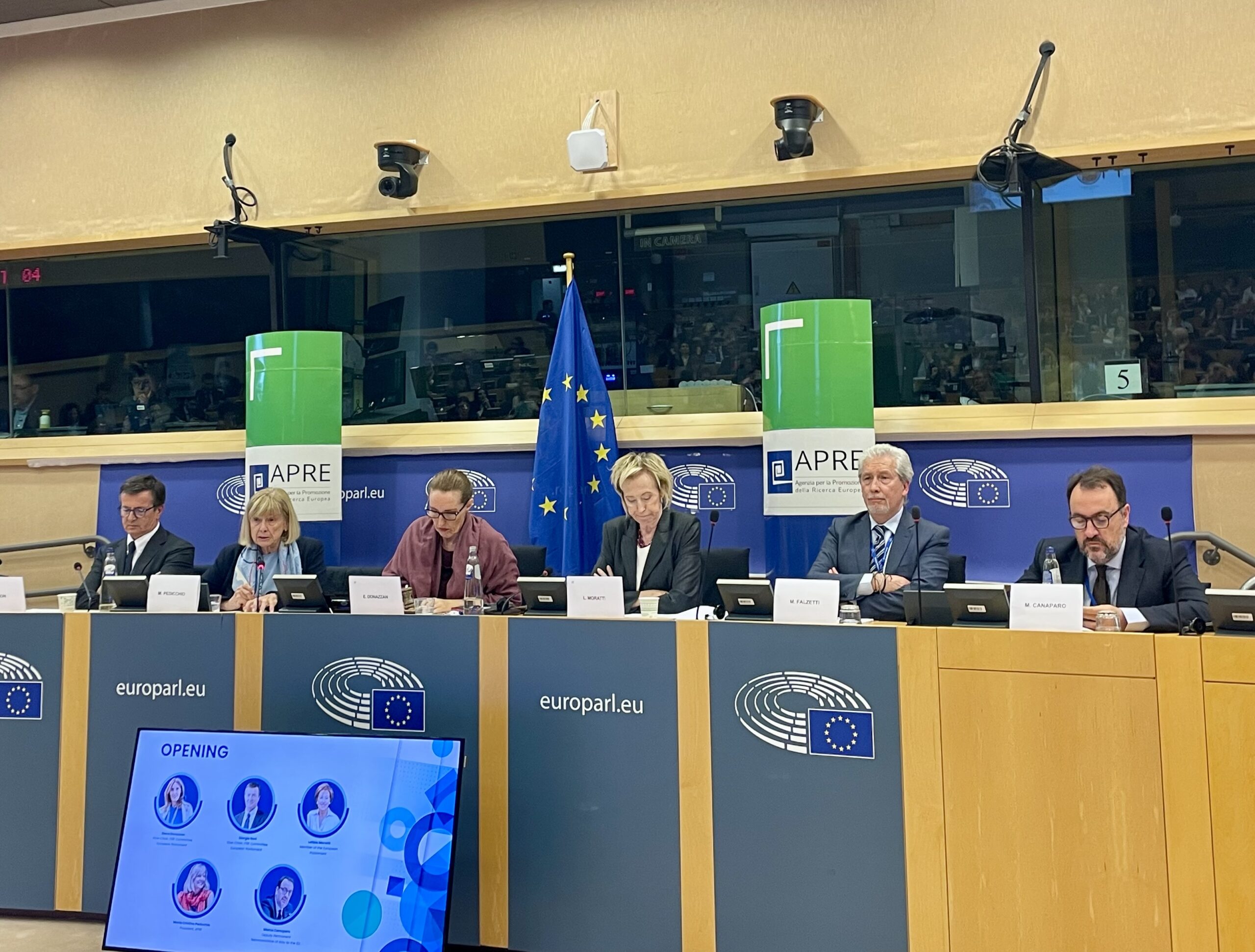
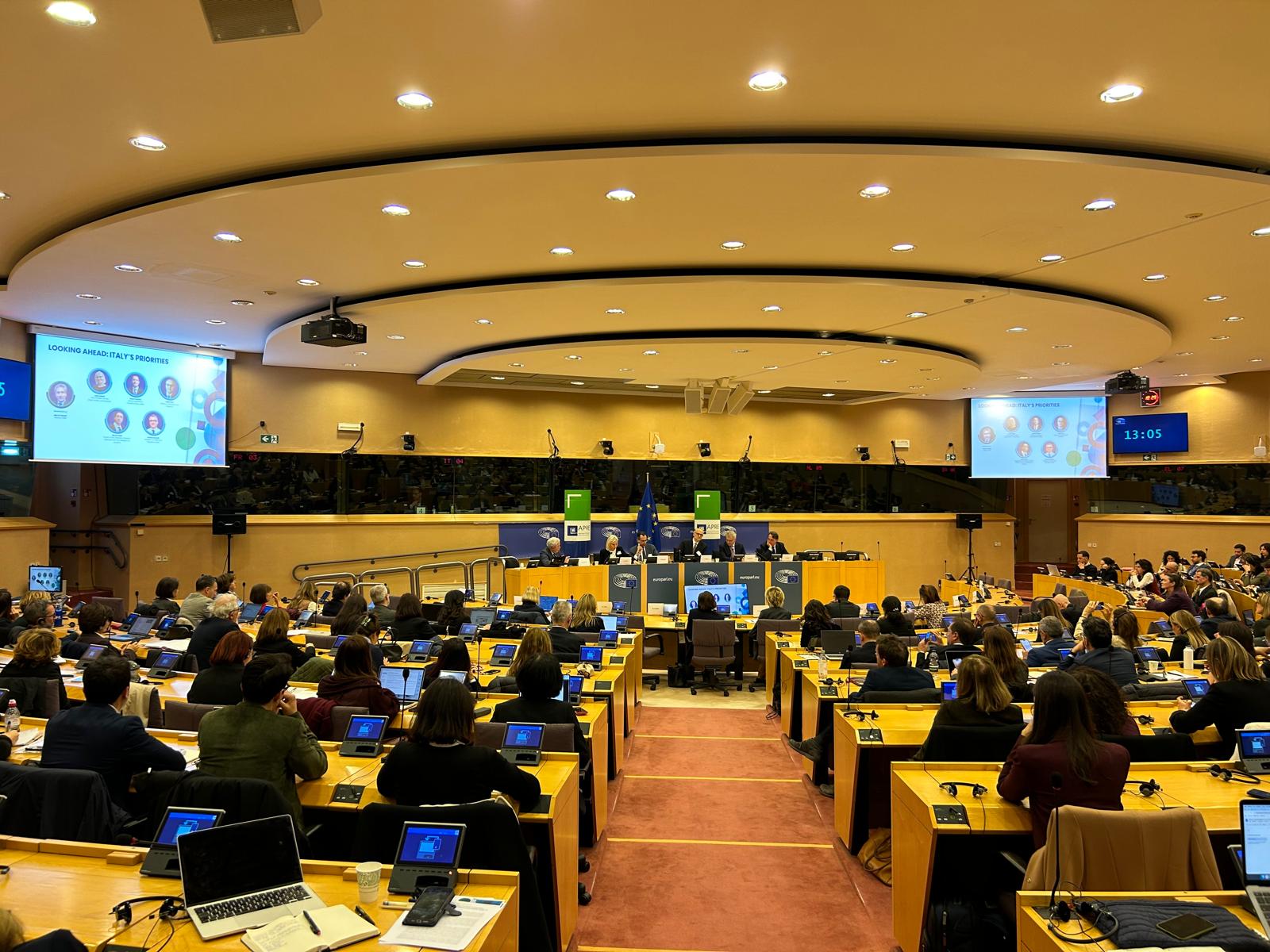
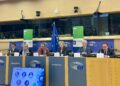
Brussels – Institutions, businesses, and experts came together to tackle a “decisive moment” for the future of European research and innovation policies, and for Italy’s role in this context. The occasion for launching this dialogue was the event – which attracted over 350 participants, 150 of whom were from Italy – entitled Italian research and innovation in Europe: towards the new Horizon Europe and the Competitiveness Fund organised yesterday afternoon (21 April) at the European Parliament by the Agency for the Promotion of European Research (APRE), the Italian association which has been supporting our country’s participation in EU research projects since 1990.
To “strengthen Italy’s position in the European debate on research, innovation and competitiveness” ahead of the adoption of the Multiannual Financial Framework (MFF) of the European Union for the period 2028–2034, the panelists shared their perspectives on the two key instruments for the R&D (Research and Development) sector: Horizon Europe, the main EU program for research funding, which for the current seven-year period had a budget of 95.5 billion euros and could reach 175 billion euros under the European Commission’s new proposal, and the emerging European Competitiveness Fund, a package of financial instruments designed to strengthen the competitiveness of businesses across Europe and support their investment in strategic sectors.
APRE President Maria Cristina Pedicchio opened the event and immediately emphasized the significance of the occasion. This phase of drawing up the new 2028–2034 multiannual European budget “is a very important step for Europe and, consequently, for Italy”. The new programming is already “well into the definition phase,” and the main issue concerns the relationship between research and industrial application. “We have excellent research, but we often fail to translate it into market success and economic growth,” she noted. In fact, “the debate on the future Horizon Europe and the European Competitiveness Fund does not concern just two funding programs, but the way in which Europe intends to link research, innovation, competitiveness, industrial capacity, and strategic autonomy.” Hence, the need to strike a balance between Horizon and the new Competitiveness Fund, in a win-win scenario where “both research and industry must benefit.” In this context, APRE’s initiative aims to “provide space for dialogue and support” between Italy and EU institutions through “analysis and data.”
This theme was also taken up in the message sent by the Minister for Universities and Research Anna Maria Bernini, who emphasized the need to ensure “scientific autonomy, stability, and separate governance” for Horizon, while maintaining an effective dialogue with the Competitiveness Fund. Among the priorities identified were scientific excellence, administrative simplification, and support for young researchers.
On the political front, Elena Donazzan (ECR), MEP for Fratelli d’Italia and Vice-Chair of the Committee on Industry, Research and Energy (ITRE), emphasized the need to turn strategies into concrete results. “What we write today will have repercussions for years to come,” she said, highlighting the urgency of strengthening technology transfer to local areas. “We must translate the vision into action,” she insisted, identifying as a priority the ability to “enable Italy to make the most of this extraordinary opportunity”. Donazzan also warned about the risk of European deindustrialization: “It means social impoverishment and a loss for the economic system. We can only make a difference by focusing on intelligence and innovation.”
The other vice-chair of the ITRE Committee, PD MEP Giorgio Gori (S&D), took a similar line, framing the issue in geopolitical terms. “Competitiveness is now at the heart of European policy, because the continent’s strategic autonomy depends on it.” Although the new framework will combine a strengthened Horizon program with a fund explicitly dedicated to industrial development, the former mayor of Bergamo warned that “this must not mean subordinating research to industry, because we would risk stifling it.” For this reason, the European Parliament insists on governance by independent experts and on safeguarding Horizon’s civilian nature, because “defense must be funded exclusively by the Competitiveness Fund.”
A broader perspective was offered by Forza Italia’s Letizia Moratti (EPP), the third Italian member of the ITRE Committee, who called for “moving beyond the patterns of the past” in a Europe that “is not growing.” The figures speak for themselves: the weight of the manufacturing sector on GDP has dropped from 20 percent to 14 percent over twenty years. In this context, “research is the strategic lever for growth, especially when it translates into innovation,” she said, whilst stressing the need for a paradigm shift: “We can no longer work in ‘silos’”, but instead we need “an integrated vision that brings together the public and private sectors, institutional levels and different areas of expertise, even if it means giving up a small part of our autonomy” for the sake of a broader project.
Alongside the political debate, the event also provided an analysis of data on Italian participation in Horizon Europe. The director of APRE, Marco Falsetti, highlighted both positives and negatives: when Italy coordinates projects, it manages to bring back to the country around 35 percent of the funding made available by the Commission, compared to a European average of 40 percent. Although there was a decline in 2024, according to Farsetti, “this is not a dramatic problem, but it highlights a quality issue” that is also linked to the “diversion of the best resources towards other commitments”, such as the NRRP. The challenge now is to “capitalize on what has been built” and bring it back into the European program. In fact, the data on Italy’s performance in Horizon Europe confirm the country’s position among the program’s most significant players. According to the figures presented, updated to 11 January 2026, Italy has secured 4.46 billion euros in funding from Horizon Europe for the 2021–25 period, with a financial return of
8.43 percent of the total budget allocated. The country ranks third in Europe in terms of the number of participants and fifth in terms of overall financial return. Therefore, according to APRE, the data “show that Italy has a strong presence in Horizon Europe, but is still called upon to strengthen its capacity to transform this presence into project leadership and into projects that are, on average, financially stronger.” In this context, “the Brussels meeting focused on the most sensitive issues in the negotiations on the future European framework for research and innovation: the relationship between Horizon Europe and the European Competitiveness Fund, the overall governance of the new system, the role of Member States in setting priorities, and the Framework Program’s ability to remain autonomous, transparent, and credible even within a framework of closer coordination with European competitiveness policies,” APRE sais in a press release.
A broader perspective on the global context was provided by Lucia Aleotti, a member of the Menarini Board of Directors and Vice President of Confindustria with responsibility for the Research Center. The Florentine businesswoman emphasized that the current phase is “very delicate and undergoing rapid transformation” and that “technological developments are compounded by geopolitical disruptions”. In such a context, according to Aleotti, “Europe must strengthen its competitiveness, and this requires a decisive technological leap.” While Confindustria supports the Commission’s proposal for a new Competitiveness Fund and the strengthening of Horizon Europe, it also warns of the need to “maintain a single governance structure for the two programs”.
While there remains a significant gap between this final – and decisive – point and the position put forward by the Italian government in the message sent by Minister Bernini, yesterday’s discussion revealed a point of consensus: Europe stands at a crossroads. On the one hand, the need to strengthen basic research and scientific autonomy; on the other, the urgency of transforming knowledge into innovation and competitiveness with concrete results on the market. A complex game that will be played out in the coming months in the trilogues between Parliament, the Commission, and the Member States.
English version by the Translation Service of Withub




![I partner dell'Ue chiedono meno debito. Posizioni che riaccendono il dibattito sulla riforma del patto di stabilità [foto: imagoeconomica]](https://www.eunews.it/wp-content/uploads/2023/02/Imagoeconomica_1556290-scaled.jpg)
![Il commissario per i Trasporti, Apostolos Tzitzikostas [Bruxelles, 5 novembre 2025]](https://www.eunews.it/wp-content/uploads/2025/11/tzitzikostas-251105-120x86.png)
