
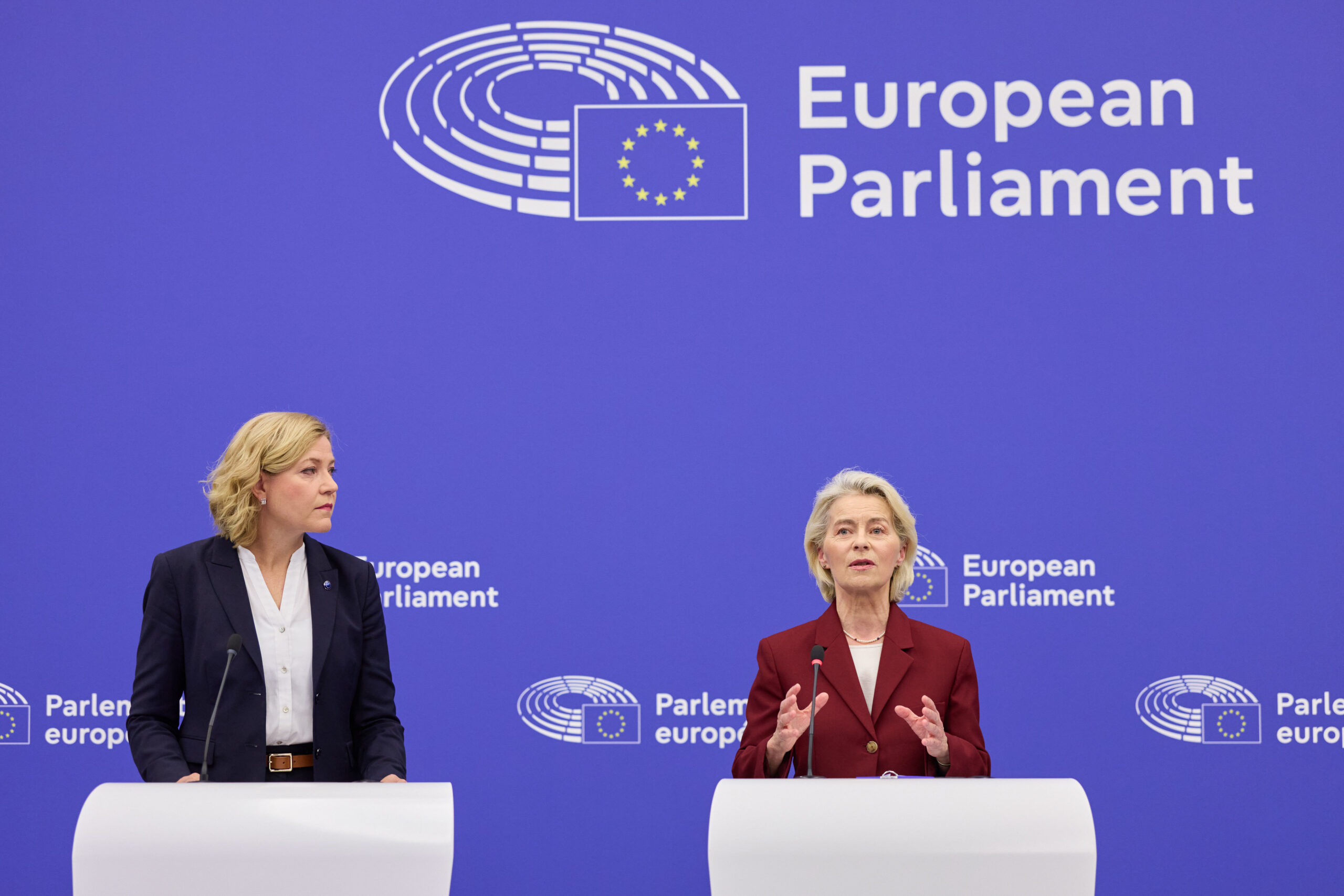

From our correspondent in Strasbourg – She had promised it, and it has arrived. The President of the European Commission, Ursula von der Leyen, today (17 September) presented the EU Kids Act to protect children from online risks and regulate their access to the internet. Among other measures, the proposal bans children under the age of 13 from using social media and sets the minimum age for opening an account at 15. In its official communications, the Commission emphasises the “gradual” approach of the text: certain functions and services must only be permitted from a certain age. The proposal also includes numerous obligations for platforms. Should the law come into force, these platforms will have to demonstrate that their services are age-appropriate and safe from the moment they are designed. “Today, our children are interacting with the most sophisticated technologies ever created – technologies that were not designed with their wellbeing in mind,” stated von der Leyen at a press conference on the sidelines of the European Parliament’s plenary session in Strasbourg (France).
The proposal is based on the report “Protecting and Empowering Children Online”, published this summer and drawn up by the Special Panel on children’s online safety, a group of experts set up by the European Commission with the aim of protecting children in the digital world, examining age limits for social media and drawing up new rules for online platforms. It is structured around four pillars. The first is the “differentiated access to social media”. In addition to the ban on opening a social media account independently before the age of 15, the proposal stipulates that, for young people aged between 13 and 15, “parental control” must be in place. More specifically, guardians will be able to create “mini-accounts” for the minors in their care, who, in turn, will only be able to access them via the guardian’s own account. During this period, platforms are required to provide age-appropriate content and other protective measures, such as “limiting social interactions and screen time (to a maximum of one hour per day).” An EU official explained that the Berlaymont building has focused primarily on this stage of adolescence because, according to researchers, it is particularly sensitive. Among the reasons cited are incidents of bullying and the resulting impacts on mental health. Experts have also suggested “adopting a gradual approach rather than a total ban,” the official clarified, as this is what “children need in modern society.” For children aged between 3 and 13, only “video-sharing services specifically designed for young children via accounts managed by a guardian” will be permitted. In this regard, the official stated that this strict distinction “will not apply to artificial intelligence software,” as researchers recognise its important role in certain sectors, such as education. He also clarified that the Commission cannot prevent artificial intelligence platforms from aligning their services with these requirements. However, if ChatGPT “allows a child to use its software, the software must comply with EU rules,” he emphasised.
The second pillar is “safety by design”. This comprises a set of requirements for all online services offering “social media, video-sharing platforms, online video games, and AI companions” – virtual companions based on artificial intelligence, which are information programmes or chat applications designed to simulate human relationships – and chatbots – a computer programme designed to simulate a conversation with a human being, via text or voice – “to users under the age of 18.” “The EU Kids Act now introduces a very clear list of permitted and prohibited behaviours for digital services, applicable to all users under the age of 18,” highlighted the Executive Vice-President for Technological Sovereignty, Security and Democracy, Henna Virkkunen, at a press conference alongside von der Leyen. For example, “strangers cannot send messages to minors, who cannot be targeted by personalised advertising or algorithms based on their past activities,” she explained. Specifically, platforms will have to ban “addictive features and recommendation feeds based on profiling that drag minors into ‘tunnels’ of harmful content.” “Infinite, uninterrupted scrolling and reward mechanisms” – digital strategies that stimulate the release of dopamine in the brain to encourage users to repeat an action – “push notifications” – a short message that an app or website sends directly to the screen of a smartphone, tablet or computer, without the user having to open the app or refresh the page – during “night-time hours”, and “unsolicited contact from strangers” will also be banned. Furthermore, for those under 18, AI-based companions and chatbots “must be disabled by default and must not simulate interpersonal relationships in ways that create emotional dependence.” In other words, “the EU Kids Act stipulates that they may no longer behave like human friends in ways that make children emotionally dependent on them,” the Vice-President explained.
In third place is “age verification that respects privacy”. Among the solutions proposed by the European Commission is, for example, the EU age verification app, which does not store identity documents or biometric data. In this context, the Commission has promised that “Member States will be closely involved in the creation of this ecosystem,” which is not yet in place. Age verification will have to be carried out when an account is created, while for existing accounts, providers will have to estimate the user’s age based on “reasonable indicators”, such as “the date an account was created or credit card details.” On this issue, an EU official has hinted at the possibility of coordinating with Member States to source the necessary data “from school registers,” although the matter is still being finalised. Meanwhile, according to an EU official, 20 countries have already begun tackling the issue and “are well on their way, while we are stepping up cooperation with a further seven to speed up the process.”
The final pillar is the “effective enforcement of the rules”. Von der Leyen made it clear that “an age limit does not exempt tech companies from responsibility for the content on their platforms.” So far, “platforms have been far too lax when it comes to our children’s mental health,” and today “we are reversing the burden of proof. It is now up to them to prove to us that they are safe,” she asserted. With this shift in the burden of proof, the Commission intends to make “very large online platform providers responsible for demonstrating that their services are ‘safe by design’.” These providers “will be required to submit a compliance plan to the Commission and to an independent auditor tasked with thoroughly assessing the new service, feature, or functionality. Should the auditor’s report reveal any shortcomings, the Commission reserves the right to require the provider to propose corrective measures.” According to an EU official, consideration should be given to an EU compliance plan, perhaps allowing “children to participate in independent audits with psychiatrists and doctors who have access to the companies’ data.” For the time being, the proposal merely introduces fast-track enforcement procedures against providers in the event of non-compliance with the EU KIDS Act, stipulating that the Commission must conclude its investigations within 90 days. Thus, “rather than leaving it to the authorities to prove harm after the event, the largest platforms will have to submit detailed plans for child safety in advance,” urged the head of the Berlaymont building.
Finally, von der Leyen reiterated that “it is not only children who are at risk”, but that “addictive design dynamics” are harmful to “everyone, children and adults alike.” That is why, she said, “we need a broader regulatory framework than the Digital Fairness Act” – a future European Union law designed to update and strengthen consumer protection in the digital world – announcing that new measures will be proposed in the autumn. Today’s legislative proposal has been forwarded to the European Parliament and the Council, thereby setting in motion the legislative process for its examination and adoption. According to data from the Eurobarometer presented by the President this morning, “92 per cent of Europeans say the EU should strengthen the protection of children and young people online.” Around “70 per cent are concerned about cyberbullying, harassment, and grooming.” The figures also show that “in Europe, young people spend on average between four and six hours a day in front of screens” and “for those who started using social media before the age of 10, the figure is even higher: they spend around seven–eight hours online.”
English version by the Translation Service of Withub