



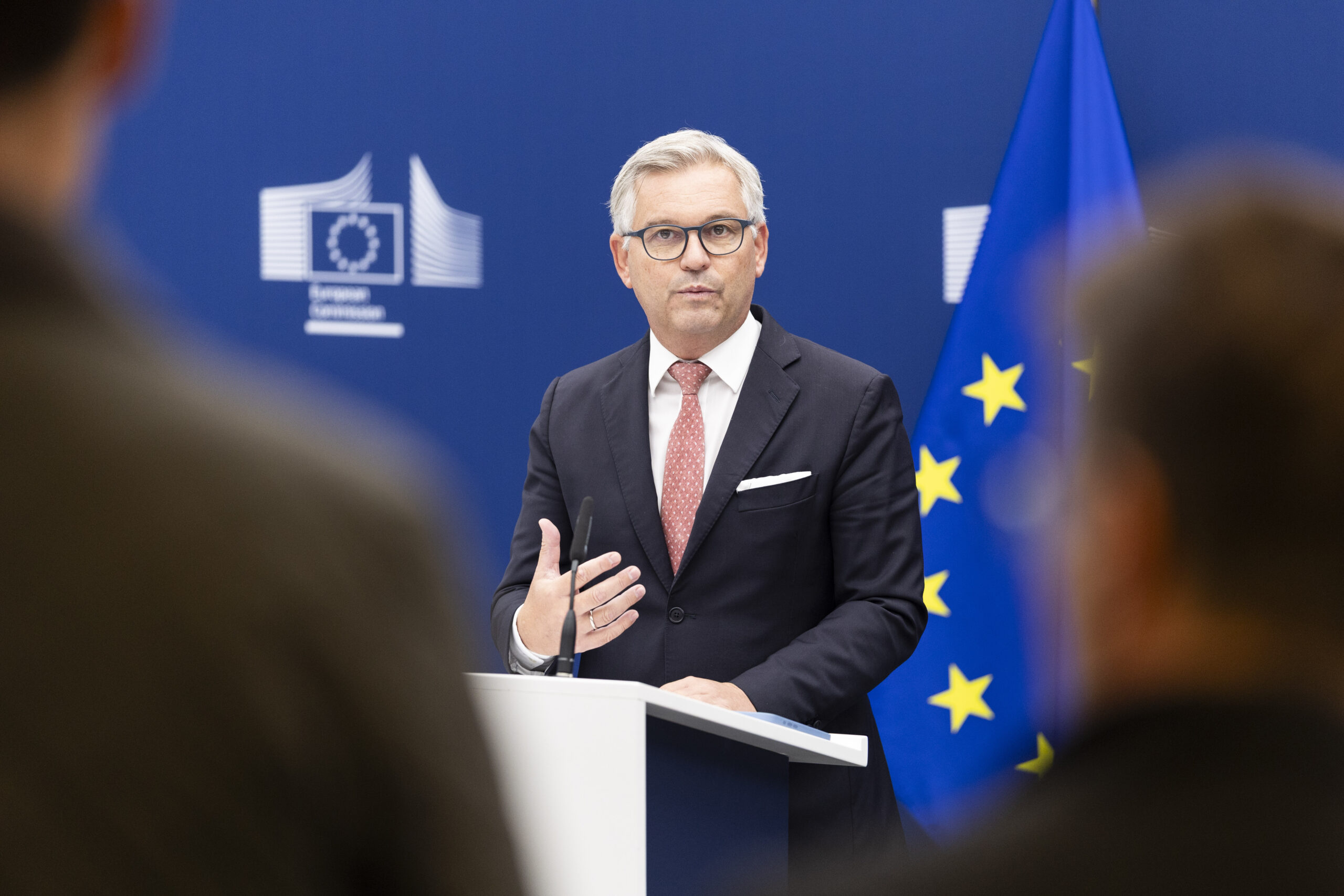
Brussels – The migration crisis in Ceuta continues to reverberate through the halls of the Berlaymont Building. The situation in the Spanish exclave “has been a test for the European Union,” said Migration Commissioner Magnus Brunner at a press conference today (29 September), adding that “I believe the EU has passed the test.” He was the one who pointed out that “no one entered the Schengen area, thanks in part to cooperation with Morocco.” But now Brussels wants to take “the next step.”
The European Commission today presented a five-point plan to “prevent, anticipate, and respond to sudden and mass illegal arrivals,” a plan designed to strengthen the EU’s capacity to respond to emergencies at its external borders. The plan had been announced by the President of the European Commission, Ursula von der Leyen, during her State of the Union address to the European Parliament.
Brunner’s first call is directed at the Member States, which are urged to ensure the “full implementation” of the Migration and Asylum Pact, which came into force in June. On this basis, the European Commission has identified five key areas: cooperation with partner countries, protection of external borders, monitoring and early-warning systems, combating trafficking networks, and returns.
To begin with, the Commissioner sees the need to enhance cooperation with partner countries to prevent irregular migration. The aim is to “take action before crises reach European borders,” according to a press release, by strengthening monitoring, information-sharing, and early-warning systems. Among the planned initiatives are a new skills and employment scheme for young people in the Mediterranean region and new tools to facilitate legal mobility pathways. In this regard, Brunner announced the launch of the Eastern Corridor Initiative with the IOM, designed to provide a coordinated response along migration routes. The initiative focuses in particular on the route from the Horn of Africa, through Yemen, to the Arabian Peninsula.
The second area concerns external borders, by strengthening of Frontex’s role. The Commission will work on a new European framework for emergency response. It will propose strengthening the agency’s mandate, including through a permanent corps better equipped to respond rapidly, a greater role in returns, and an enhanced capacity to monitor border and pre-border areas. The Commissioner assured that “Member States want a stronger, more flexible Frontex that can respond swiftly to certain types of crisis.”
The third point, on the other hand, focuses on the ability to detect crises before they escalate. The Commission proposes to strengthen Frontex’s mandate to also allow monitoring of social media in the context of border management. At the same time, Member States will be required to provide information to Eurosur promptly. Brussels also wishes to use the tools provided by the Digital Services Act to coordinate more swiftly with platforms, search engines and national authorities in the event of a crisis, including to combat disinformation that may fuel migrant arrivals. This is one of the lessons learnt from Ceuta, where false information circulating online helped mobilise thousands of people.
The fourth priority is the fight against migrant smugglers. The European Commission is calling on the Council to speed up the adoption of the new sanctions regime against smugglers, while urging the Parliament to finalise its position on the revision of the directive against facilitating unauthorised entry as a matter of urgency. There are also plans to strengthen cooperation with online platforms, financial institutions and payment services to identify trafficking activities and illicit financial flows.
Finally, Brussels aims to make returns more effective by strengthening cooperation with third countries on readmission and by enhancing Frontex’s role. Member States will also be required to implement the new regulation on returns and the border procedure, including through greater digitalisation of procedures.
The plan will be presented to the interior ministers of the 27 Member States at the Justice and Home Affairs Council on 1 and 2 October. The aim, following the “test” in Ceuta, is to develop a swifter European response should a new crisis arise at the EU’s borders.
English version by the Translation Service of Withub

![La presidente della Commissione europea, Ursula von der Leyen, pronuncia il discorso sullo Stato dell'Unione [Strasburgo, 26 settembre 2026. Foto: Fred MARVAUX Copyright: © European Union 2026 - Source : EP]](https://www.eunews.it/wp-content/uploads/2026/09/soteu26_2-350x250.png)





![Ilze Brands Kehris [foto: European Council]](https://www.eunews.it/wp-content/uploads/2026/10/ilze-120x86.png)
