
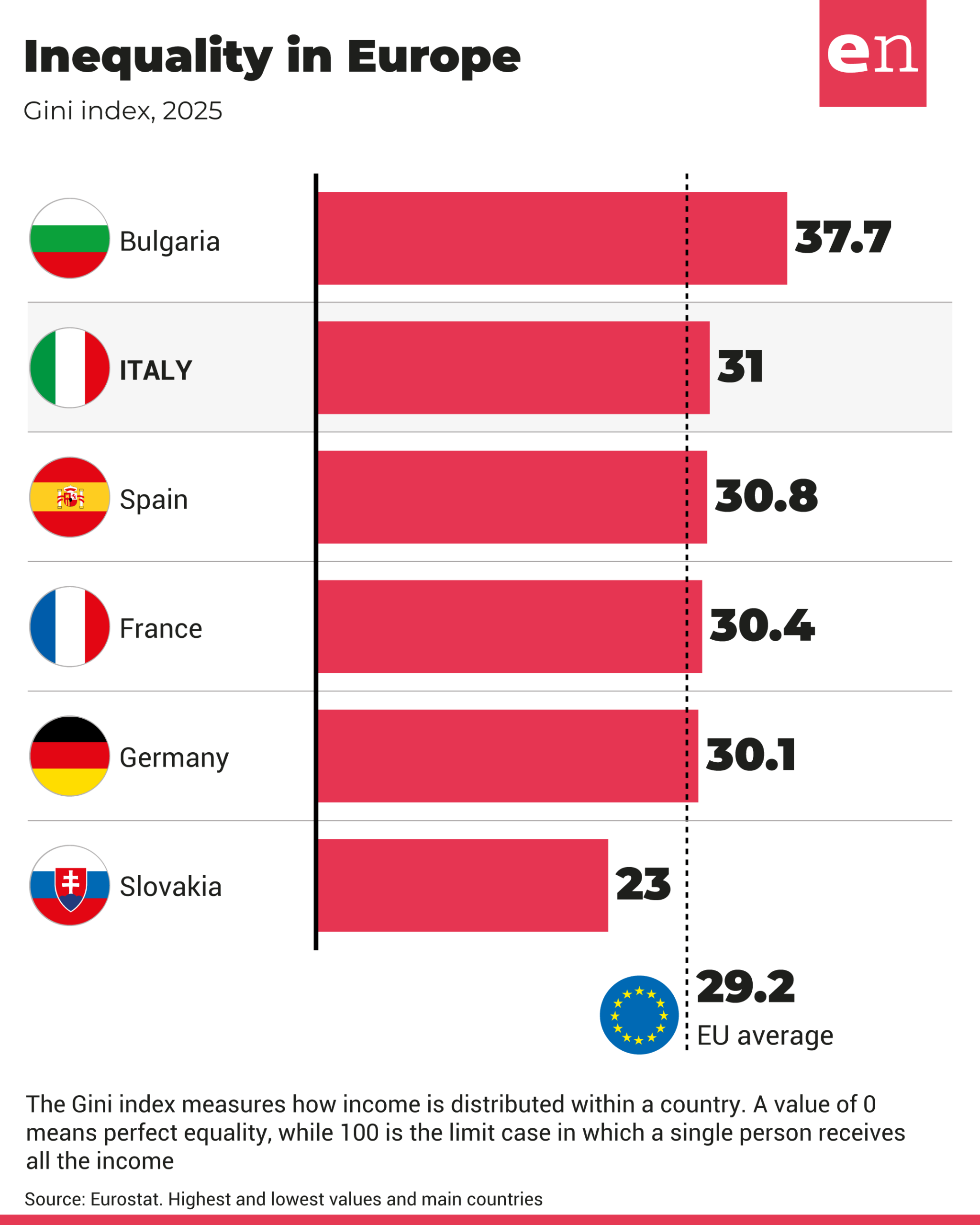
Brussel – Economic equality across the European Union is a pipe dream, but there is a glimmer of hope. According to Eurostat, the EU’s statistical office, income inequality in the Union has slightly diminished. More specifically, the Gini coefficient has fallen from 29.4 in 2024 to 29.2 in 2025. The Gini coefficient measures the level of inequality in income distribution: the lower it is, the more equitable the distribution. A value of 0 represents perfect equality, where everyone has the same income, while a value of 100 indicates complete inequality, where a single person receives the entire income. In 2025, the figure varied amongst Member States from 23 in Slovakia to 37.7 in Bulgaria. The countries with the most equitable income distribution were Belgium (23.4), the Czech Republic (24.0), Slovenia (24.6) and Poland (24.9). For Italy, the figure was 31.
The agency has also analysed the percentage of people at risk of poverty at the regional level, classifying them according to level 2 of the Nomenclature of Territorial Units for Statistics (NUTS). This is a geographical classification system that divides the Union’s economic territory into three levels of regions – NUTS 1, 2 and 3 – ranging from larger to smaller territorial units. Above NUTS 1 lies the ‘national’ level of the Member States. In general, the at-risk-of-poverty rate, calculated based on 2019 data, has fallen across the EU, standing at 13.0 per cent in 2025, compared with 16.5 per cent in 2019.
Of all the EU regions, the French overseas region of French Guiana recorded the highest proportion of people at risk of poverty (50.7 per cent). Across the EU, eight regions had a percentage of people at risk of poverty ranging from 30.1 to 39.3 per cent. These include: two of the French overseas departments (Réunion and Guadeloupe); two of the Spanish autonomous cities (Ceuta and Melilla); three regions in Italy (Calabria, Campania, and Sicily); one region in Greece (the Peloponnese).
Twenty-eight NUTS 2 regions in the EU recorded percentages of people at risk of poverty below 10 per cent. These include: six regions in Italy (Aosta Valley, Lombardy, the Autonomous Province of Bolzano, the Autonomous Province of Trento, Friuli-Venezia Giulia and Emilia-Romagna); five regions in Belgium (the Province of Limburg (BE), East Flanders, Flemish Brabant, West Flanders and the Province of Walloon Brabant); four regions in the Czech Republic (Prague, Central Bohemia, South-East Bohemia and Central Moravia) and in Hungary (Budapest, Pest, Közép-Dunántúl and Nyugat-Dunántúl); three regions in Poland (Silesia, Lower Silesia and the Warsaw Region); two regions in Slovakia (the Bratislava Region and Western Slovakia); one region each in Spain (the Basque Country), Denmark (Zealand), Austria (Burgenland) and Romania (Bucharest-Ilfov).
English version by the Translation Service of Withub