- Europe, like you've never read before -
Thursday, 5 February 2026
No Result
View All Result
  • it ITA
  • en ENG
Eunews
  • Politics
  • World
  • Business
  • News
  • Defence
  • Net & Tech
  • Agrifood
  • Other sections
    • Culture
    • Diritti
    • Energy
    • Green Economy
    • Finance & Insurance
    • Industry & Markets
    • Media
    • Mobility & Logistics
    • Sports
  • Newsletter
  • European 2024
    Eunews
    • Politics
    • World
    • Business
    • News
    • Defence
    • Net & Tech
    • Agrifood
    • Other sections
      • Culture
      • Diritti
      • Energy
      • Green Economy
      • Finance & Insurance
      • Industry & Markets
      • Media
      • Mobility & Logistics
      • Sports
    No Result
    View All Result
    Eunews
    No Result
    View All Result

    Home » Industry & Markets » Unions in Brussels: defence and aerospace sectors are fine, but the EU must not stand still

    Unions in Brussels: defence and aerospace sectors are fine, but the EU must not stand still

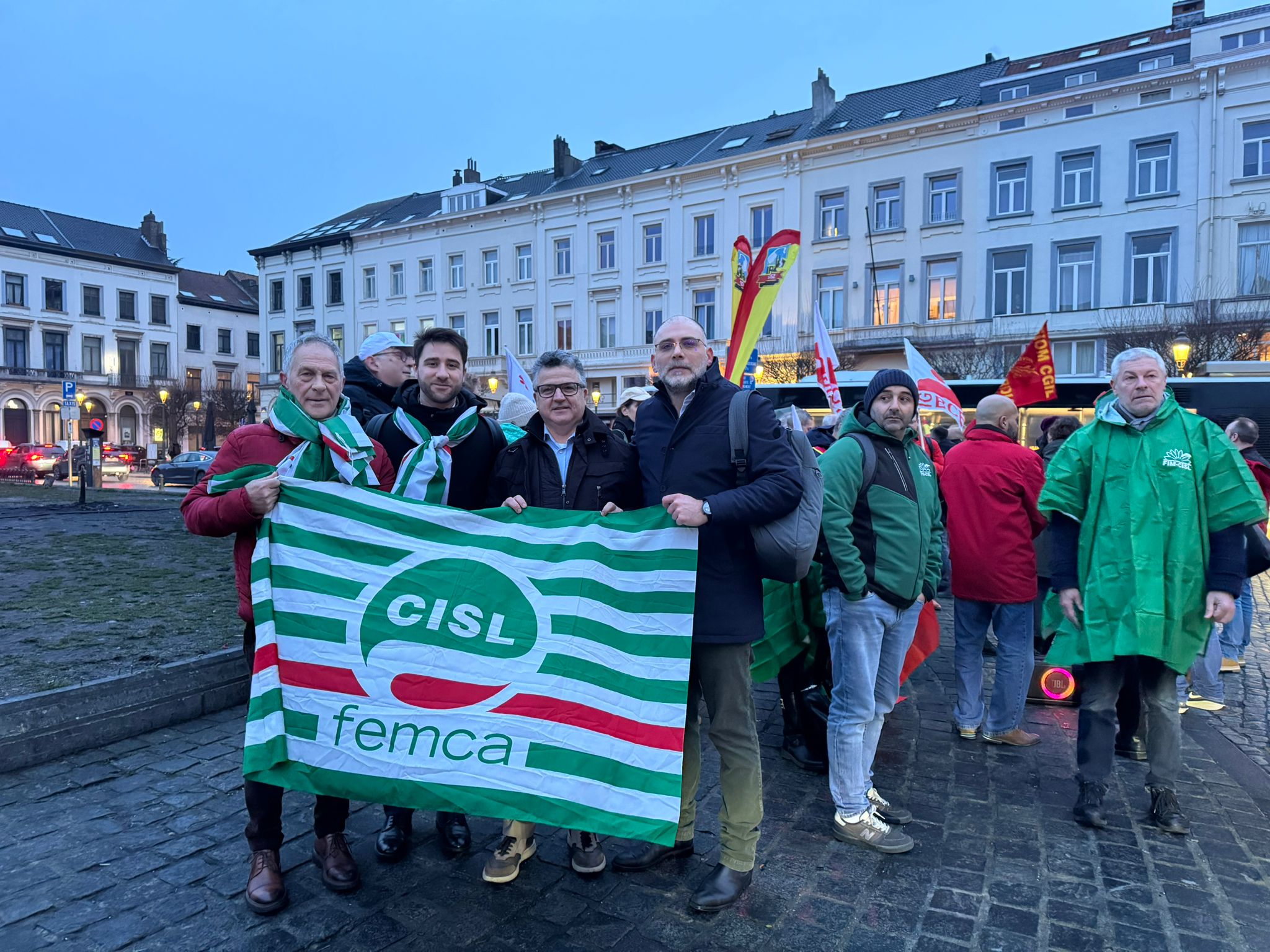
    Representatives of workers in the chemical, textile, and electricity sectors (Filctem-Cgil, Femca-Cisl, Flaei-Cisl and Uiltec-Uil) gathered today, as they did on 5 February 2025, in front of the European Parliament in Brussels.

    Annachiara Magenta</a> <a class="social twitter" href="https://twitter.com/annacmag" target="_blank">annacmag</a> by Annachiara Magenta annacmag
    5 February 2026
    in Industry & Markets

    Brussels – Same place, same reason, exactly one year later: the chemical, textile, and electricity workers’ unions Filctem-Cgil, Femca-Cisl, Flaei-Cisl, Uiltec-Uil met today, as they did on 5 February 2025, in front of the European Parliament in Brussels “to defend the rights of workers in sectors which, as highlighted in the recent Syndex report, are facing blocked investments, restructuring, and growing uncertainty.” These sectors do not include the defence and aerospace industries, which are the only ones to “remain competitive at a global level,” according to a joint statement issued by the trade unions. What has changed since last year? “The demands are the same, because we have seen a year of inaction on the part of the EU,” says Daniela Pilas, national secretary general of Uiltec. “What has changed is the context: after a year, despite our demands expressed in February 2025, we have lost parts of important sectors,” said Femca-Cisl national secretary Giovanni Rizzuto.

    “Our demands are real and immediate public and private investment in green and social industries; guaranteed local jobs in all public procurement and aid; job protection measures, such as SURE, to safeguard industries; mandatory plans for a just transition, accompanied by concrete actions; combating unfair global trade and overcapacity; clean and accessible energy for European industries,” according to the joint statement by Fim, Fiom, Uilm, Filctem, Femca, Flaei, and Uiltec.

     Trade unionists are calling for “urgent action”, without which “there is a risk of accelerated deindustrialisation, greater dependence on external suppliers and the loss of millions of quality jobs in industry.” The alarm was first raised by the Syndex report, a document commissioned by industriAll Europe, that provides a snapshot of the European industrial situation and, as reported in the note, “highlights that, on 19 sectors analysed, only aeronautics and defence are still keeping pace globally,” while all others “face frozen investment, restructuring, and growing uncertainty.” 

    “The deindustrialisation process is evident,” emphasises Filctem-Cgil Secretary General Marco Falcinelli, speaking to the press. The European Union, explains Falcinelli, “is becoming a continent dependent on non-European countries for the supply of raw materials” and this “is creating a very serious situation not only from an industrial point of view but also in terms of the overall impoverishment of the European industrial fabric and the condition of European welfare as a whole.” In fact, if the welfare system that has characterised the lives of Europeans until now is no longer guaranteed, “people no longer feel protected and turn their attention to extreme right-wing sovereignist forces, which risks undermining the very principles of the EU,” the secretary explains. On the opening of European markets, in light of recent trade agreements with Mercosur countries and India, Falcinelli notes that “these are important agreements” and calls on the European Commission to “continue in this direction, to put Europe in a position to have more commercial outlets, to not just be a land of conquest for the world’s big giants, on the one hand, the United States and on the other China.” On the latter two, he specifies that “they are no longer an outlet market for European products but are real competitors from a commercial and industrial point of view.” 

    The point made by the national secretary general of Uiltec, Daniela Pilas, is different. She also believes that the European Union is not doing enough; in fact, “we have witnessed a year of inaction on the part of the European Union with regard to decisions that would have determined the possibility of maintaining strong production chains, which are currently undergoing a major crisis.” But there is also a difference “in the speed of the northern and southern countries” of the EU. “In the north, conditions are more favourable from a competitive and energy point of view and in terms of resolving certain problems, for example the possibility of using stronger state aid,” she points out. On the other hand, Pilas continues, “we see a Southern Europe that is instead suffering in a structurally entrenched way from the energy‑cost crisis and from the limited ability, for example in our own country, to provide state aid capable of saving supply chains that are not considered strategic,” she adds. In concrete terms, the secretary emphasises the existence of “dossiers on the tables of parliamentarians that deserve important, strong and immediate review, such as the CBAM and investments in public procurement,” Pilas concludes. 

    A lot can change in a year. According to Giovanni Rizzuto, National Secretary of Femca-CISL, what has changed “is the context,” because the EU “has become a clay pot between the two large blocs“, the United States and Asia. Although “the EU has the know-how and expertise,” Rizzuto continues, “it lacks supportive industrial policies.” What is missing, therefore, is “a common project” and a real understanding of “global balances,” because “we cannot think of working in isolation.” The risk, he concludes, is that “we continue to talk about industrial policy, but if it is not defined with concrete actions, they are empty words.”

    English version by the Translation Service of Withub
    Tags: aerospazialeautomotivebruxellescgileuropean speakingindustrytextileuilunionswork

    Related Posts

    Politics

    EU Court annuls Puigdemont immunity waiver over “lack of impartiality”

    5 February 2026
    (credits: Tiziana Fabi)
    Diritti

    Migrants, 15 victims off Chios after conflict with Greek Coast Guard. EU: Traffickers responsible for tragedy

    4 February 2026
    Shopping in a Whole Foods Market supermarket in New York on Tuesday, April 1, 2025.  (Photo by Richard B. Levine)
    Business

    Eurozone inflation falls to 1.7 per cent in January; Italy at 1 per cent

    4 February 2026
    Business

    Young Europeans worried about defence and the cost of living, now and in the future

    4 February 2026
    Business

    Georgia and India push Russian oil, EU torn between discontent and embarrassment

    3 February 2026
    [Photo:
    Energy

    Renewables: Shadow of unfair Chinese competition in Europe’s wind sector; EU launches probe

    3 February 2026
    map visualization

    Agriculture, Court of Justice: EU countries may ban cultivation of GMOs on their territory

    by Annachiara Magenta annacmag
    5 February 2026

    The ruling by the EU Court of Justice responds to the Italian case in which a farmer had planted MON...

    August 4, 2024, Italy: A boat carrying 47 people from Bangladesh and Syria plus two others who appeared to be smugglers, they drove the boat away again and were found in the Central Mediterranean. More than 30,000 people have died or gone missing in the Mediterranean Sea since 2014 while trying to reach Europe, according to figures collected by the International Organisation for Migration. (Credit Image: © Sally Hayden/SOPA Images via ZUMA Press Wire)

    Hundreds of migrants missing in the Mediterranean and the EU’s “intolerable silence”

    by Simone De La Feld @SimoneDeLaFeld1
    5 February 2026

    In a question to the European Commission, the Democratic Party delegation in Brussels calls for "breaking the deadlock and taking...

    Press conference of the European Central Bank at the ECB in Frankfurt.EZB-Praesidentin Christine Lagarde bei der Pressekonferenz der Europaeischen Zentralbank in der EZB in Frankfurt. Erneut hat die EZB den Leitzins angehoben, um die Inflation einzudaemmen. Durch die Erhoehung um 0,5 Prozentpunkte steigt der Leitzins auf nun 3,5 Prozent. Frankfurt, 16.03.2023

    Tariffs and wars cloud economic outlook, ECB leaves rates unchanged

    by Emanuele Bonini emanuelebonini
    5 February 2026

    Lagarde: "The outlook remains uncertain, mainly due to the uncertainty surrounding trade policies and ongoing geopolitical tensions worldwide. New trade...

    Unions in Brussels: defence and aerospace sectors are fine, but the EU must not stand still

    by Annachiara Magenta annacmag
    5 February 2026

    Representatives of workers in the chemical, textile, and electricity sectors (Filctem-Cgil, Femca-Cisl, Flaei-Cisl and Uiltec-Uil) gathered today, as they did...

    • Director’s Point of View
    • Letters to the Editor
    • Opinions
    • About us
    • Contacts
    • Privacy Policy
    • Cookie policy

    Eunews is a registered newspaper
    Press Register of the Court of Turin n° 27


    Copyright © 2025 - WITHUB S.p.a., Via Rubens 19 - 20148 Milan
    VAT number: 10067080969 - ROC registration number n.30628
    Fully paid-up share capital 50.000,00€


    No Result
    View All Result
    • it ITA
    • en ENG
    • Newsletter
    • Politics
    • World politics
    • Business
    • General News
    • Defence & Security
    • Net & Tech
    • Agrifood
    • Altre sezioni
      • European Agenda
      • Culture
      • Diritti
      • Energy
      • Green Economy
      • Gallery
      • Finance & Insurance
      • Industry & Markets
      • Letters to the Editor
      • Media
      • Mobility & Logistics
      • News
      • Opinions
      • Sports
    • Director's Point of View
    • L’Europa come non l’avete mai ascoltata
    • Draghi Report
    • Eventi
    • Eunews Newsletter

    No Result
    View All Result
    • it ITA
    • en ENG
    • Newsletter
    • Politics
    • World politics
    • Business
    • General News
    • Defence & Security
    • Net & Tech
    • Agrifood
    • Altre sezioni
      • European Agenda
      • Culture
      • Diritti
      • Energy
      • Green Economy
      • Gallery
      • Finance & Insurance
      • Industry & Markets
      • Letters to the Editor
      • Media
      • Mobility & Logistics
      • News
      • Opinions
      • Sports
    • Director's Point of View
    • L’Europa come non l’avete mai ascoltata
    • Draghi Report
    • Eventi
    • Eunews Newsletter

    Attention