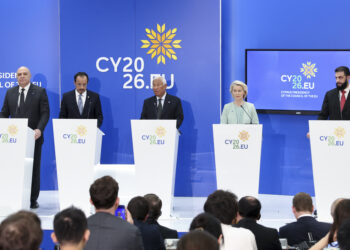

Brussels – “There are no minorities in Syria, but a single people protected by the state.” Asaad Hassan al-Shaibani, the Syrian Minister of Foreign Affairs, gave this response when asked at today’s press briefing (11 May) whether human rights in the country are sufficiently respected to allow for reconstruction.
This morning, the European Union reinstated its cooperation agreement with Syria, which provides for a series of financial measures for infrastructure and basic services. “This is a historic day,” commented Dubravka Šuica, the Commissioner for the Mediterranean. She added that “Syria has the EU’s support.” Furthermore: “We want to hear what its priorities are and understand how best to support it.”
The EU’s decision to partially suspend the agreement in 2011 came in response to human rights violations committed by Bashar al-Assad’s regime. However, this situation does not appear to have changed entirely with the change of leadership. As early as March 2026, Human Rights Watch (HRW) had expressed concern about the situation in Syria. “The ongoing and serious violations of fundamental rights require constant attention,” reads the formal statement by the 61st ordinary sessionof the United Nations Human Rights Council. Over the past year, the organisation has documented “widespread identity-based killings perpetrated by government forces, alongside summary executions, abductions and mass displacement, arbitrary arrests, aid blockades, and the disruption of essential services in the context of renewed fighting in north-eastern Syria.” These, says HRW, “are not isolated incidents, but reflect persistent structural failures.”
Among the ethnic and religious groups, the European Union Agency for Asylum highlights the Kurdish presence. The March 2025 agreement between the Syrian Democratic Forces and the transitional government provided that stateless Kurds would be granted citizenship and other constitutional rights, as well as the right to use and teach the Kurdish language. The agreement, according to the EUAA report ‘Country Guidance: Syria’ by the EUAA, has not yet been implemented, and many of the acts to which Kurds are exposed “are of such a serious nature as to constitute persecution: executions, murders, torture, arbitrary arrests, illegal detentions, abductions, enforced disappearances and forced displacement.” Such discrimination and persecutory behaviour, the EUAA points out, may be suffered by Druze, Alawites, Christians, and Palestinians.
The latest report by the OHCHR (Office of the United Nations High Commissioner for Human Rights), published in April 2026, reports killings, enforced disappearances, arbitrary detentions, and deportations of detainees in the north-east of the country. In March, three mass graves were discovered in Al-Hassakeh, one of which was located within a former detention centre run by the Syrian Democratic Forces (SDF). The OHCHR team gathered testimonies from relatives of people who disappeared whilst in the custody of the SDF or international coalition forces. The coalition stated, according to the report, that it had transferred 7,000 detainees to Iraq, around half of whom were Syrian, in January 2026.
The situation is no better in the south of the country.
Here, the UN office explains, there is concern for civilians, “because the operations carried out by Israeli forces occupying the area are putting lives at risk.” There has been an increase in “harassment, intimidation, detentions, and interrogations.” Furthermore, in the Quneitra governorate, Israeli forces “have set up checkpoints, searched homes, and arrested and detained civilians.” In February, the OHCHR reports, Israel allegedly sprayed chemical substances on agricultural land and restricted Syrian farmers’ access to their fields.
English version by the Translation Service of Withub