![[Foto: Unsplash]](https://www.eunews.it/wp-content/uploads/2026/06/andreas-gucklhorn-Ilpf2eUPpUE-unsplash-scaled.jpg)
Brussels – In 2025, according to data from the EU Statistical Office (Eurostat), the supply of natural gas and renewable energy in the European Union increased compared with 2024, while the supply of coal and petroleum products decreased. Eurostat noted that the supply of natural gas increased for the second consecutive year—following a sharp decline in 2023—rising by 2.3 per cent to approximately 13.1 million terajoules. The supply of renewable energy, on the other hand, grew by 1.4 per cent compared with 2024, totalling 11.5 million terajoules.
This positive figure is partly overshadowed by the decline in hydroelectric power, which has dragged down overall electricity generation from clean sources. Nuclear power is also growing, albeit slightly: +0.2 per cent, totalling over 650,000 gigawatt-hours. On the other hand, coal continues its decline. Lignite fell by 7.7 per cent and hard coal by 3.2 per cent, reaching their lowest levels since 1990. Petroleum products also declined, with supply reaching almost 449 million tonnes, a 2.8 per cent fall from the previous year.
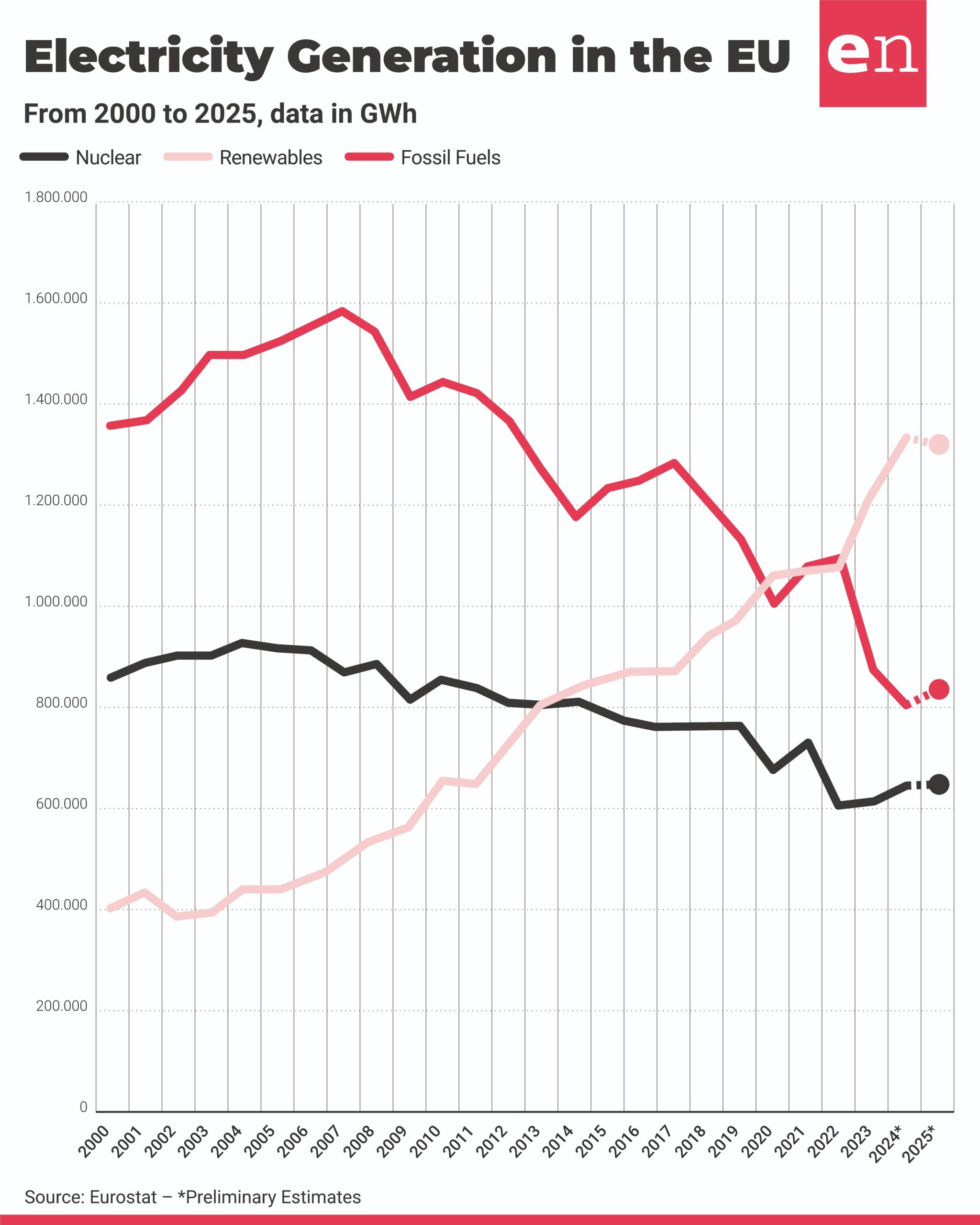
Renewables remain the leading source of electricity in the EU in 2025, accounting for 47.2 per cent of total generation, though this represents a slight 0.5 per cent decline compared with 2024. The share of fossil fuels, on the other hand, rose to 29.6 per cent of the total, up 3.2 per cent. Finally, the contribution of nuclear power remained stable, standing at 23.2 per cent of European electricity generation.
However, the production figures must be considered alongside those for imports. Nel 2024 l’UE produced only 43 per cent of its own energy, importing the remaining 57 per cent from abroad. This figure illustrates just how strategic the progress made in gas and renewables is. For natural gas, the main suppliers were Norway (30 per cent), the United States (17 per cent), Algeria and Russia (both 14 per cent), which together accounted for 75 per cent of non-EU imports. For oil, on the other hand, the main suppliers were the United States (16 per cent), Norway (12 per cent), Kazakhstan (9 per cent), and Saudi Arabia (8 per cent).
Against this backdrop, Italy stands out for its heavy reliance on gas. In 2024, natural gas accounted for 36 per cent of Italy’s energy mix, the highest share of any EU Member State. Italy also had the highest share of gas in its total energy imports, at 37 per cent. This dual exposure makes the diversification of supply a strategic priority.
In addition to the figures, there are the EU’s climate targets. In 2024, the share of renewables in gross final energy consumption stood at 25 per cent, up from 10 per cent in 2004, but still a long way from the 42.5 per cent target set for 2030.
English version by the Translation Service of Withub



![Il ministro dei Trasporti, Matteo Salvini [Bruxelles, 5 dicembre 2024. Foto: Emanuele Bonini per Eunews]](https://www.eunews.it/wp-content/uploads/2024/12/salvini241205-120x86.jpeg)