- Europe, like you've never read before -
Wednesday, 1 July 2026
No Result
View All Result
  • it ITA
  • en ENG
Eunews
  • Politics
  • World
  • Business
  • News
  • Defence
  • Health
  • Agrifood
  • Other sections
    • Culture
    • Diritti
    • Energy
    • Green Economy
    • Finance & Insurance
    • Industry & Markets
    • Media
    • Mobility & Logistics
    • Net & Tech
    • Sports
  • Newsletter
  • European 2024
    Eunews
    • Politics
    • World
    • Business
    • News
    • Defence
    • Health
    • Agrifood
    • Other sections
      • Culture
      • Diritti
      • Energy
      • Green Economy
      • Finance & Insurance
      • Industry & Markets
      • Media
      • Mobility & Logistics
      • Net & Tech
      • Sports
    No Result
    View All Result
    Eunews
    No Result
    View All Result

    Home » Business » Cars: Confindustria and EPP call for technological neutrality and alternative fuels

    Cars: Confindustria and EPP call for technological neutrality and alternative fuels

    At the event ‘The Future of Mobility in Europe: Balancing Decarbonisation, Competitiveness and European Industrial Excellence’, discussions centred on how to strike a balance between industrial competition and the energy transition. Salini (FI): “What happened at Volkswagen shows just how damaging forced transitions can be.”

    Iolanda Cuomo by Iolanda Cuomo
    1 July 2026
    in Business, Industry & Markets
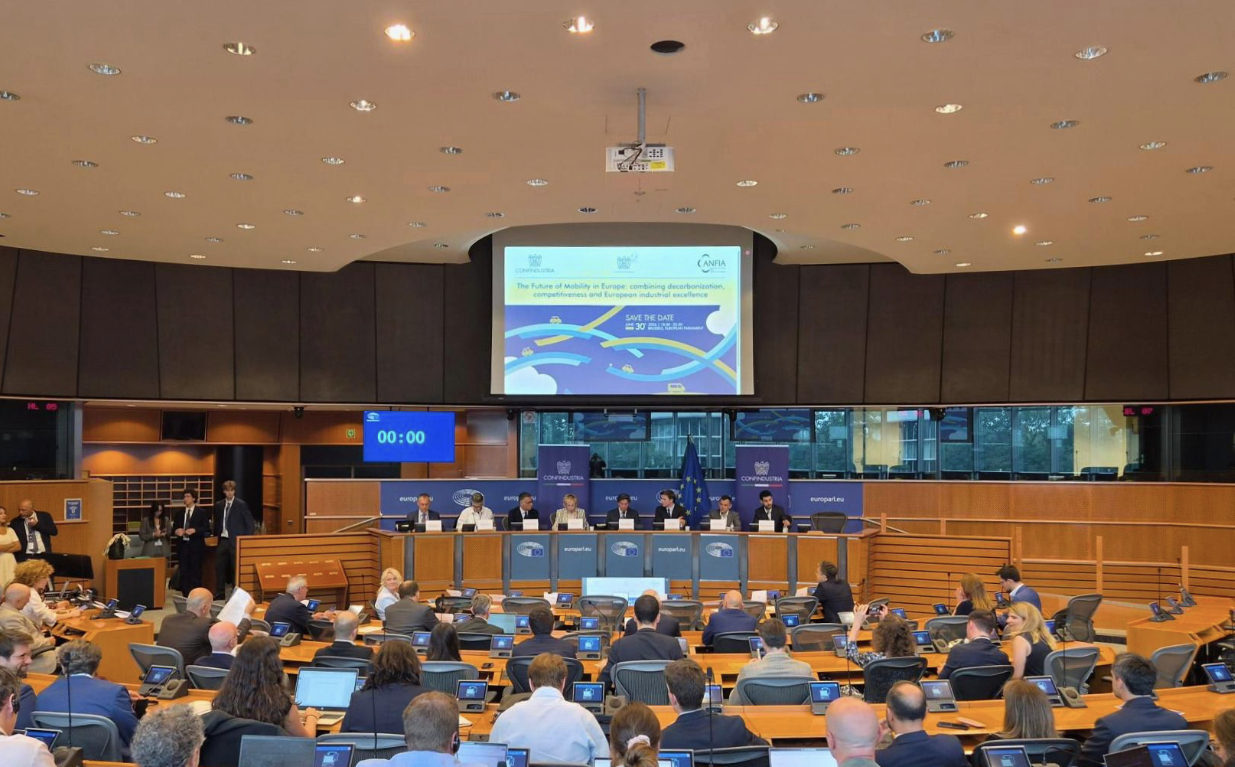
    Foto dell'evento “Il futuro della mobilità in Europa: coniugare decarbonizzazione, competitività ed eccellenza industriale europea”. Crediti: Canali social della delegazione europea di Confindustria

    Foto dell'evento “Il futuro della mobilità in Europa: coniugare decarbonizzazione, competitività ed eccellenza industriale europea”. Crediti: Canali social della delegazione europea di Confindustria

    Brussels – The European Commission, with its automotive package unveiled at the end of 2025, which the co-legislators, the European Parliament and the Council of the EU, are currently working on, has shown only superficial flexibility with regard to the sector’s needs, and a shift in approach is now required to ensure a balance between industrial, environmental, and economic needs. Once again, Forza Italia MEP, Massimiliano Salini, called for pragmatism yesterday (30 June) on the sidelines of the conference “The future of mobility in Europe: combining decarbonisation, competitiveness and European industrial excellence”, organised by Confindustria, Confindustria Energia, and the National Association of the Automotive Industry Supply Chain (ANFIA) at the European Parliament. 

    Salini explained that “the aim is to use the work on the package — the proposed revision of the CO₂‑emissions regulation for light vehicles and vans — as a lever to overturn the approach of the 2023 regulation, which in our view contains too many errors. It dismantles a fundamental principle behind the EU’s prosperity: competition among the best technologies when pursuing major goals such as decarbonising mobility while keeping a globally competitive industry.” In particular, according to Salini, “the flexibility introduced in the revision proposed by the Commission” last December “is not enough.” Moreover, it is “mere window-dressing,” which, “in particular, does not meet our vision of adequate competition between electric vehicles and vehicles powered by alternative fuels in a way that strikes an appropriate balance between the imperatives of industrial competition, decarbonisation, and the interests of citizens’ pockets, who need a transition that is not forced.” And, as rapporteur for the ⁠European Parliament on the proposed revision of the regulation on CO₂ emissions for cars and vans, Salini highlighted that “what happened at Volkswagen” – namely, the announcement of possible 100,000 jobs cuts – “shows how forced transitions do a great deal of harm.” 

    This issue concerning the German giant was also highlighted by Stefan Pan, vice-president of Confindustria responsible for European Union affairs. “If politics dictates everything, we run the risk of what Volkswagen has described as being just the tip of the iceberg,” he pointed out. “We are a very dynamic, very active industry, keen to invest, so let us get on with it; we’ll spread our wings, and we can win the battle. But we need technological neutrality to do so. What we are asking for is to be open to all technologies that help us decarbonise,” Pan insisted. And this does not concern “just electric engines, but also carrying out research into fully sustainable fuels, e-fuels, and biofuels”. Given that “no one in Europe invests as much in research and development as the automotive sector,” we must “maintain and grow 13 million jobs,” while remaining open to “all technologies that help decarbonise: not just the electric motor, but also, for example, research into fully sustainable fuels”, he argued. As far as businesses, the principle translates into “allowing companies to choose the best path to achieve the objective, harnessing our great capacity for innovation with gradual approaches that enable us to survive and overcome the challenge posed by competitors such as China and the United States, who have changed the rules of the game.”

    The debate was divided into two round-table discussions – ‘The European strategy for the future of the automotive sector: striking a balance between climate ambition and competitiveness’ and ‘Powering the future of mobility: harnessing the untapped potential of renewable and sustainable fuels’. Among the participants was Forza Italia (EPP) MEP Letizia Moratti, who stressed the technology-neutral approach. “Large companies can relocate production to adapt to new regulations, but workers, families, and SMEs throughout the supply chain cannot do so. This is therefore the main problem we must address, and the key solution is to ensure that SMEs and families are not put in a difficult position. This is where we must restore a technology-neutral approach. Electrification will remain central; there is no doubt about that, but it cannot be the only solution,” she explained in her speech. According to Moratti, “biofuels, e-fuels, range-extending technologies and any innovation capable of contributing to decarbonisation should find a place within the regulatory framework, both before and after 2035.”
    According to ANFIA president Roberto Vavassori, yesterday’s meeting itself, dedicated to discussing the revision of the Regulation, “shows that the forecasts made in 2019 have not fully materialised, for reasons unrelated to the automotive sector’s commitment to the transition.” For example, “the market share of electric vehicles continues to grow, but at different rates compared with those estimated by the European institutions.” However, “it is unacceptable that a strategic sector – which has already invested over 250 billion euros in converting production facilities, processes, and skills – be penalised for failing to meet market targets over which the industry has no full control. China itself, which is often used as a benchmark, has not set itself any targets and will probably never reach the percentages of electric cars that we are imposing on ourselves in Europe,” Vavassori added. For the president, therefore, “revising the targets is not a step backwards in relation to the investments already made by manufacturers and component suppliers: it is, instead, a necessary step towards achieving climate targets without compromising industrial competitiveness and employment.”
    English version by the Translation Service of Withub
    Tags: biofuelcarcinaco2 emissionsconfindustriadieselemissionsenergy transitioneuropean speakingFurgoniLetizia Morattimaximilian saliniStefano Panunited states

    Related Posts

    Source: Copernicus
    General News

    Warm seas: ocean temperatures hit a record 20.98°C in June

    1 July 2026
    Business

    Fewer imports, tighter quotas, higher tariffs: new EU steel rules take effect

    30 June 2026
    [Foto: Unsplash]
    Business

    Renewables and natural gas set to rise in 2025, while coal hits its lowest level since 1990

    29 June 2026
    Fabbrica di automobili elettriche Rivian. Crediti: Imagoeconomica via Rivian X
    In Brief

    The 27 Member States remain divided over zero-emission cars

    26 June 2026
    map visualization
    VALORE CASE CASA COSTO COSTI VENDITA TASSI INTERESSE MUTUI MUTUO BILANCIA GENERATE AI IA

    What does a rise in interest rates mean, and what are its implications?

    by Emanuele Bonini emanuelebonini
    1 July 2026

    A rise in borrowing costs has negative repercussions for citizens, businesses, government bonds, and even banks. Eunews provides an overview

    Il governatore della banca centrale del Canada, Tiff Macklem, e la presidente della BCE, Christine Lagarde [Sintra, 1 luglio. Foto:

    Lagarde: “The interest rate rise was an unavoidable choice”

    by Emanuele Bonini emanuelebonini
    1 July 2026

    The ECB President: “All the conditions were in place to do so. The risks are now more balanced than they...

    Source: Imagoeconomica

    The share of electricity from renewables in the EU rises to 46 per cent in the first quarter of 2026

    by Redazione eunewsit
    1 July 2026

    Brussels – According to Eurostat, the EU’s statistical office, electricity generated from renewable sources in the European Union is on...

    Foto dell'evento “Il futuro della mobilità in Europa: coniugare decarbonizzazione, competitività ed eccellenza industriale europea”. Crediti: Canali social della delegazione europea di Confindustria

    Cars: Confindustria and EPP call for technological neutrality and alternative fuels

    by Iolanda Cuomo
    1 July 2026

    At the event ‘The Future of Mobility in Europe: Balancing Decarbonisation, Competitiveness and European Industrial Excellence’, discussions centred on how...

    • Director’s Point of View
    • Opinions
    • About us
    • Contacts
    • Privacy Policy
    • Cookie policy

    Eunews is a registered newspaper
    Press Register of the Court of Turin n° 27


    Copyright © 2025 - WITHUB S.p.a., Via Rubens 19 - 20148 Milan
    VAT number: 10067080969 - ROC registration number n.30628
    Fully paid-up share capital 50.000,00€


    No Result
    View All Result
    • it ITA
    • en ENG
    • Politics
    • Newsletter
    • World politics
    • Business
    • General News
    • Defence & Security
    • Health
    • Agrifood
    • Altre sezioni
      • Culture
      • Diritti
      • Energy
      • Green Economy
      • Gallery
      • Finance & Insurance
      • Industry & Markets
      • Media
      • Mobility & Logistics
      • Net & Tech
      • News
      • Opinions
      • Sports
    • Director’s Point of View
    • Draghi Report
    • Eunews Newsletter

    No Result
    View All Result
    • it ITA
    • en ENG
    • Politics
    • Newsletter
    • World politics
    • Business
    • General News
    • Defence & Security
    • Health
    • Agrifood
    • Altre sezioni
      • Culture
      • Diritti
      • Energy
      • Green Economy
      • Gallery
      • Finance & Insurance
      • Industry & Markets
      • Media
      • Mobility & Logistics
      • Net & Tech
      • News
      • Opinions
      • Sports
    • Director’s Point of View
    • Draghi Report
    • Eunews Newsletter

    Attention