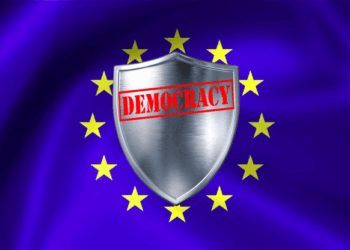


Brussels – The United States is reportedly willing and ready to influence elections in Europe. The United States is reportedly willing and ready to influence elections in Europe. Whether it’s leaks, rumours, or pure speculation, the spectre of a US threat — and of its president Donald Trump — in the EU’s decision‑making process is beginning to circulate online, to the point of becoming a source of concern in the European Parliament. Fabio De Masi, a non-attached MEP, wants to get to the bottom of the matter, asking whether and how the European Commission is prepared to respond to threats coming from a country that is now a former ally.
While the organisation and conduct of elections “are the competence and responsibility of the Member States”, the Commissioner for Justice, Michael McGrath, assures that the European Commission “is intensifying its support to Member States and stakeholders to enhance
electoral integrity and preparedness, protect election-related infrastructure, minimise risks of
foreign interference, and strengthen cooperation.“
It should be noted that, in his response to the parliamentary question, McGrath never explicitly rules out the possibility that the United States might pose a problem for the EU. This means that there remains an implicit acknowledgement in the background that threats of foreign interference in European electoral processes no longer relate solely to Russia and China, the EU’s declared enemies, but are also linked to Donald Trump’s United States.
In this regard, the European Commission intends to investigate whether potentially harmful funding is coming from the United States, namely from parties seeking to influence the pre-election debate and, consequently, sway voting intentions. “Under the European Cooperation Network on Elections, the Commission works with the Member States on several strands, including the transparency and integrity of funding in politics,” McGrath noted. The European Commission does so by looking “at issues of common interest such as anonymous donations and cryptocurrency, in full respect of the allocation of competences.”
Elections in the EU and US interference
The risk of US intervention – whether direct or indirect – in the elections of European Union member states is not remote. After all, Elon Musk, the American tycoon who owns X and Tesla and is a former adviser to President Trump on public spending, personally campaigned to support the far-right AfD party in the German elections. At the same time, US Vice-President J.D. Vance urged Hungarians to vote for the outgoing prime minister, Viktor Orbán, in a clear anti-EU appeal. Furthermore, Trump has personally attacked and criticised the Spanish Prime Minister, the socialist Pedro Sánchez.
2027 will be of crucial importance for the EU: it begins with the German presidential election (30 January), which could, on its own, send shockwaves through the EU, one way or another. On 7 March, voters will go to the polls to elect a new parliament in Estonia, which will then have to appoint a new prime minister and government. In April, it will be the turn of the French presidential election: Emmanuel Macron cannot stand for re-election, and it remains to be seen which political force will lead the country, with the far-right RN party set to capitalise on legal proceedings to boost its support. In the first half of next year alone, the EU’s political and economic engine – which now fears Trump’s United States – risks being affected by foreign interference.
English version by the Translation Service of Withub