
Brussels – The number of pupils attending primary schools in the European Union is falling. According to Eurostat, the EU’s statistical office, in 2024, 23.2 million children were enrolled in primary schools, marking a decrease of 0.2 per cent (-35,153 pupils) compared with 2023. Compared with 2014, however, the figure has risen by 2.9 per cent (+659,086).
Looking at individual Member States, the highest figure was recorded in France (4.1 million), followed by Germany (3.3 million), Spain (2.8 million) and Italy (2.6 million). Malta (27,537), Luxembourg (43,020), and Cyprus (60,596) recorded the lowest figures. According to Eurostat, “the number of pupils in primary education reflects population size, demographic structure, and differences in the typical age at which primary education begins, as well as the age at which children are expected to start compulsory formal education.” Compared with 2014, the number of pupils increased in fifteen EU Member States and decreased in the remaining eleven—taking only those cases where data were available into account. Consequently, relative increases were observed in Luxembourg (+21.4 per cent) and in Slovenia (+18.2 per cent). Hopwever,Poland (-25.7 per cent), Croatia (-10.3 per cent) and Portugal (-10.0 per cent) recorded decreases. Over a ten-year period—from 2014 to 2024—in Italy, the number of pupils fell from 2.8 million to 2.6 million, a reduction of around 267,000 children.
In 2024, there was an average of 13.3 pupils per teacher across the EU. This figure is defined by the Agency as the and is calculated by dividing the number of pupils and students at each level of education by the number of full-time teachers. Taking this into account, in 2024, Greece (7.4) and Luxembourg (8.2) stood out for having the lowest figures, being the only EU countries with figures below ten. Germany (15.2), the Netherlands (16.3), the Czech Republic and France (both 17.9), and Romania (18.2) all reported ratios above 15.
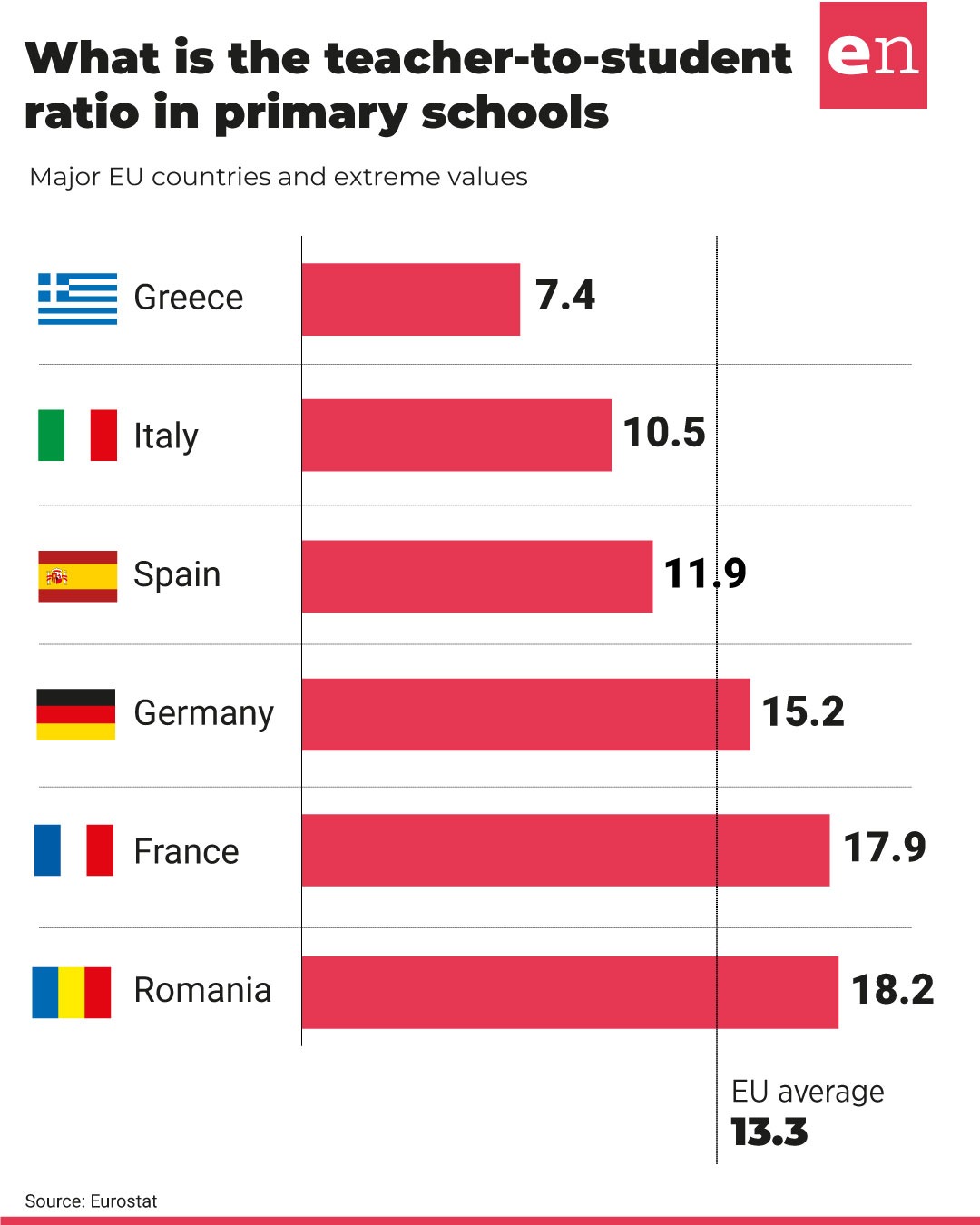
Compared with 2014, the pupil-teacher ratio at EU level fell from 14.2 to 13.3 in 2024. The same trend was observed in twenty-three EU Member States, with the most significant decreases in Bulgaria (from 17.8 to 10.4) and Slovenia (from 15.9 to 10.8). In Austria, the ratio remained unchanged at 12.0. The other countries recorded increases, particularly Lithuania, which rose from 10.2 to 13.7. In Italy, the figure fell from 12.4 to 10.5. Eurostat published these figures on the occasion of International Literacy Day, recognising the importance of primary school in providing the fundamental skills of reading, writing, and mathematics.
English version by the Translation Service of Withub