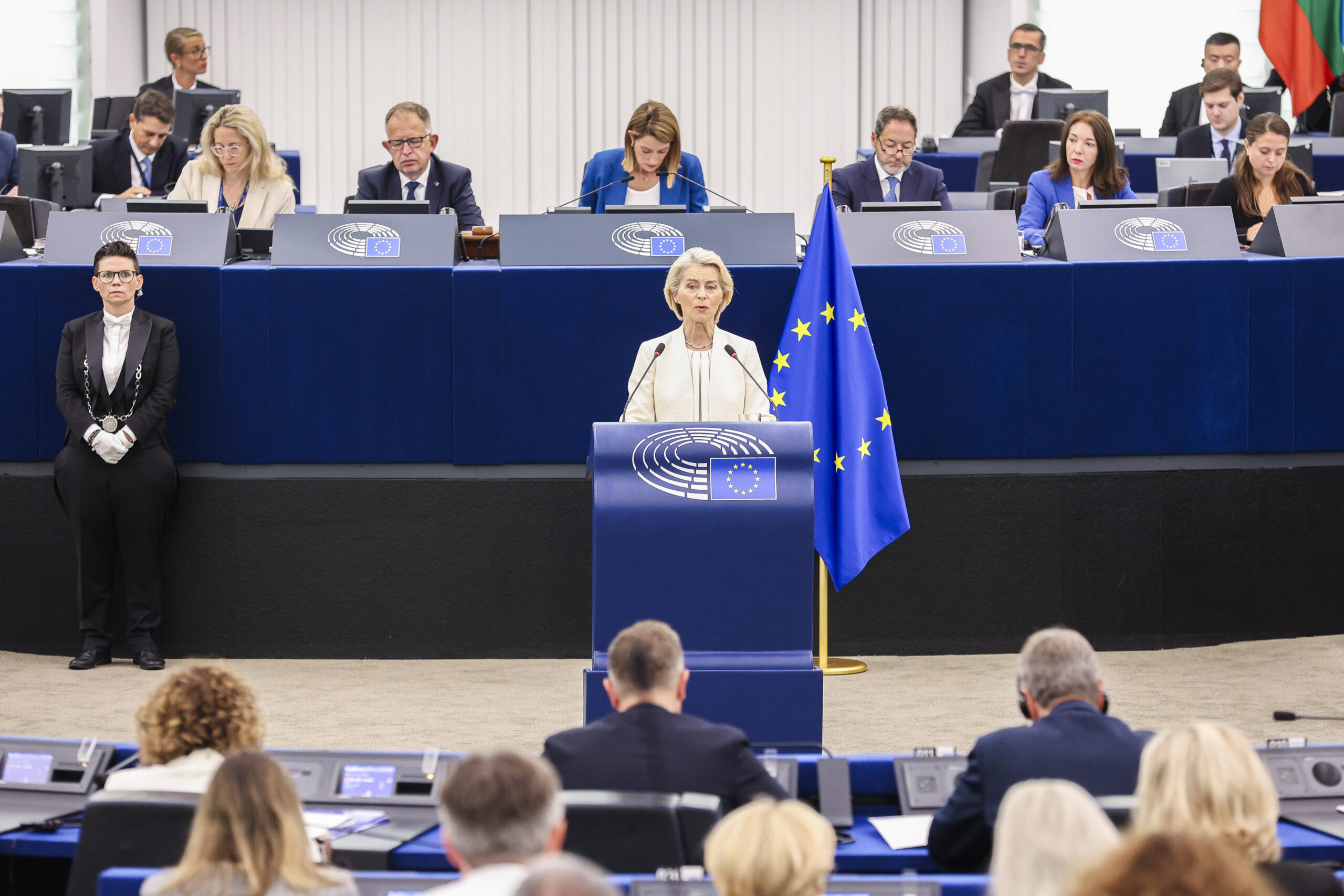

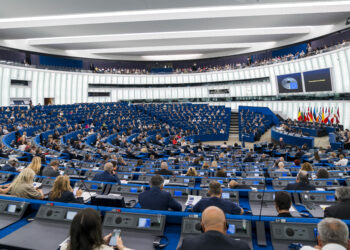
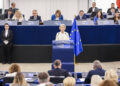
Brussels – Europe must learn to manage what it can no longer stop. This is the central theme of the State of the Union delivered today (16 September) by Ursula von der Leyen before the European Parliament in Strasbourg. According to the Commission President, two transformations in particular could represent the “tipping points” for the Union’s security and prosperity: artificial intelligence and climate change. Two different challenges, but united by the same question: how can we prepare for a world that is changing faster than institutions can adapt?
Artificial intelligence: “to pace the frontier”
AI is no longer just a technology of the future. It is already present in factories, hospitals, agriculture, energy networks and defence systems. And for this very reason, according to von der Leyen, Europe must succeed in balancing innovation and security. “AI has the potential to improve people’s lives radically,” said the President, but “we must ensure that its risks are managed.”
The most striking development concerns the so-called frontier models, the most advanced AI models. “The dangers of self-improving models are becoming ever more apparent,” she warned, also highlighting the risk that ever more powerful systems could be used for cyberattacks or to develop malicious code. “If the people developing the technology are clear, then we should be too,” is the chair’s message.
Hence, there is a willingness to slow down the development of the most advanced models. “After the HuggingFace incident, developers are ringing the alarm. And CEOs of the most advanced companies tell us that it is time to slow down on the self-recursive models. To pace the frontier,” she said, announcing that she would invite leading AI laboratories to Brussels to discuss how to “support ongoing industry efforts to pace the frontier.”
But Brussels has no intention of falling behind in the technology race-quite the contrary. “The AI Act is crucial,” von der Leyen asserted, because it puts the EU “in a position to help shape global efforts” on the safety of artificial intelligence. And Europe will work with partners such as Canada and the UK on model evaluation, security and early-warning systems.
The other challenge is to bring AI from the digital world into the real economy. The aim is to harness European data and industrial capacity to apply artificial intelligence to healthcare, manufacturing, precision agriculture, transport, energy, defence and space. And always keeping people at the centre: technology, as von der Leyen emphasised, must enhance people’s capabilities, not replace them.
Climate: ‘the summer of truth’
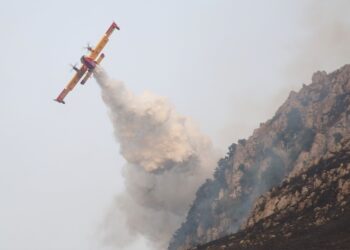
While AI represents the future, climate change is the present that Europe has already begun to experience. Von der Leyen has bluntly described the past few months as “the summer of truth”. A summer of wildfires, droughts, dried-up rivers and heatwaves that “almost no part of our continent” has managed to avoid.
“The impact of all this is simply devastating,” the president said, recalling that 660,000 hectares burnt and around 12 million tonnes of crops lost. “Key rivers like the Danube, der Rhein and La Garonne are disappearing before our eyes,” she added. And Europe, she pointed out, is warming at twice the global average rate. The response, however, will not be to backtrack on climate targets. “But there is no doubt: Europe can, must and will stay the course on its climate targets,” von der Leyen stressed. But the transition, she admitted, “is complex” and Brussels will have to “adjust and learn along the way.”
The shift in approach announced by the Commission focuses primarily on adaptation. A new European framework for climate resilience is due in October, identifying the EU’s 100 most vulnerable areas, while Brussels will draw up a European plan to tackle heatwaves, featuring early warning systems, improved healthcare preparedness and measures in cities.
And then there is the financial cost of disasters. “Today, only around 25 per cent of catastrophe losses in Europe are covered by private insurance,” von der Leyen noted. “This means that, far too often, national budgets become the insurer of last resort.” Hence, the announcement by the Climate Insurance Alliance: “We must take action to close this gap.”
The same logic applies to water, energy and fires. Brussels wants to speed up electrification, strengthen the networks, take action on water management and explore the idea of a European firefighting fleet. No longer just reacting to emergencies, but preparing before they happen.
AI and climate change thus find themselves on the same footing: two transformations that the EU cannot simply halt, but in relation to which it can still choose how prepared, self-reliant and capable it will be of managing the change.
English version by the Translation Service of Withub


![La presidente della Commissione europea, Ursula von der Leyen, pronuncia il discorso sullo Stato dell'Unione [Strasburgo, 26 settembre 2026. Foto: Fred MARVAUX Copyright: © European Union 2026 - Source : EP]](https://www.eunews.it/wp-content/uploads/2026/09/soteu26_2-120x86.png)