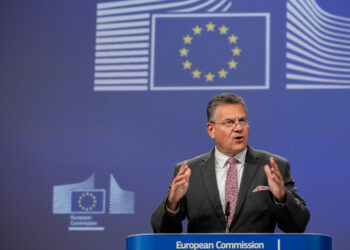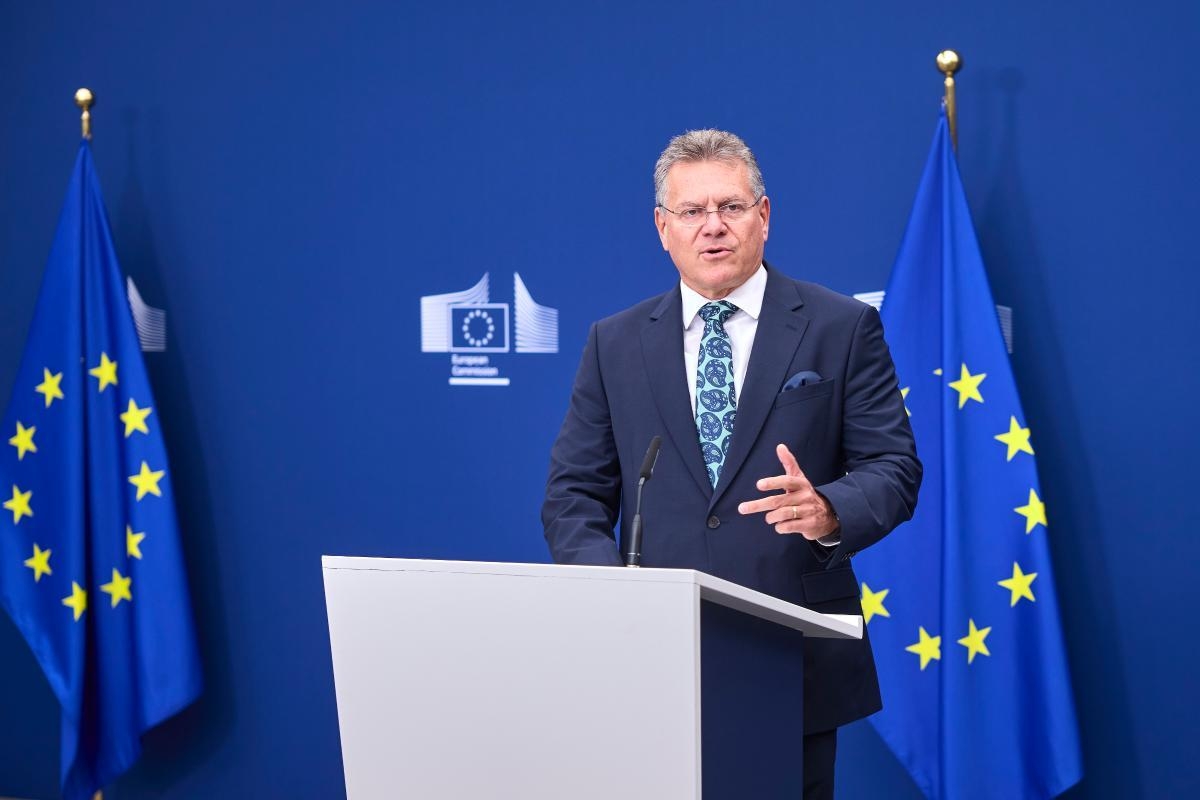

Brussels – The dialogue with China on economic relations goes beyond the trade balance and concerns the future of the European economy as a whole. The European Commissioner for Trade, Maroš Šefčovič, is clear on the debate surrounding relations with Beijing and, at a press briefing today (22 September) in Brussels on the agreement reached to proceed with a free trade agreement with the Philippines, he found the time to answer some questions from journalists on the work currently underway to rebalance trade with the Asian giant. There is one central issue that the President of the Commission, Ursula von der Leyen, also highlighted in her State of the Union address: results are needed.
Brussels’ objective remains unchanged, and according to Šefčovič it is “essential to recognise that our discussion on trade relations with China goes far beyond the traditional debate on the trade balance” because “it is clear that, given the scale of the deficit, the speed at which it is growing and the impact it has on key economic and industrial sectors of the European Union, we are talking about the future of our economy, the future of our industry and, I would add, the future of the European social model,” he explained. The issue is, therefore, “highly political” and the EU has “a need for progress and agreements at a political level.” Therefore, “it will be very important for me to confirm the validity of our communication, by demonstrating that it works and that it delivers concrete results.”
The current phase of EU relations with Beijing is “unprecedented in terms of the intensity of bilateral contacts.” The Commissioner will visit China on 8 and 9 October, and efforts are now focused on the second session of the Trade and Investment Consultation Mechanism (TIC), scheduled for early October. “Naturally, we want to make the most of every single day to prepare as thoroughly as possible,” he noted, recalling the video conference he held last week with the Minister of Commerce, Wang Wentao – a call that represents “a very important step” as it allowed them to “take stock of the teams’ work” and provide “guidance to our teams on how to make the most of the remaining two weeks”, he explained. Now, the Director-General of the European Commission’s DG Trade and her team “are on their way to Beijing” and, according to Šefčovič, this “step will also further advance our discussions.”
Therefore, there is ongoing dialogue, and the focus of the Commissioner’s visit will be, on the one hand, on the measures to be implemented “to rebalance trade with China” and “to manage, on both sides, Chinese exports to the European Union in the future”, and, on the other, the “issue of European access to the Chinese market,” “to boost trade volumes and facilitate overall access for European economic operators to the Chinese market.” In addition to these two issues, there will also be the matter of export controls, for example on rare earths.
For the time being, the Commissioner is trying to see the glass as half full. “What I can say is that we believe there is a genuine commitment on the part of our Chinese counterparts, and certainly on our part.” But he is not naive. The dialogue must “move from rhetoric to concrete results, because that is clearly what would be expected of me on my return. And I need a credible outcome,” he reiterated. And “this is where we are focusing our energies, in the hope of bringing positive news back to Europe,” he concluded.
English version by the Translation Service of Withub