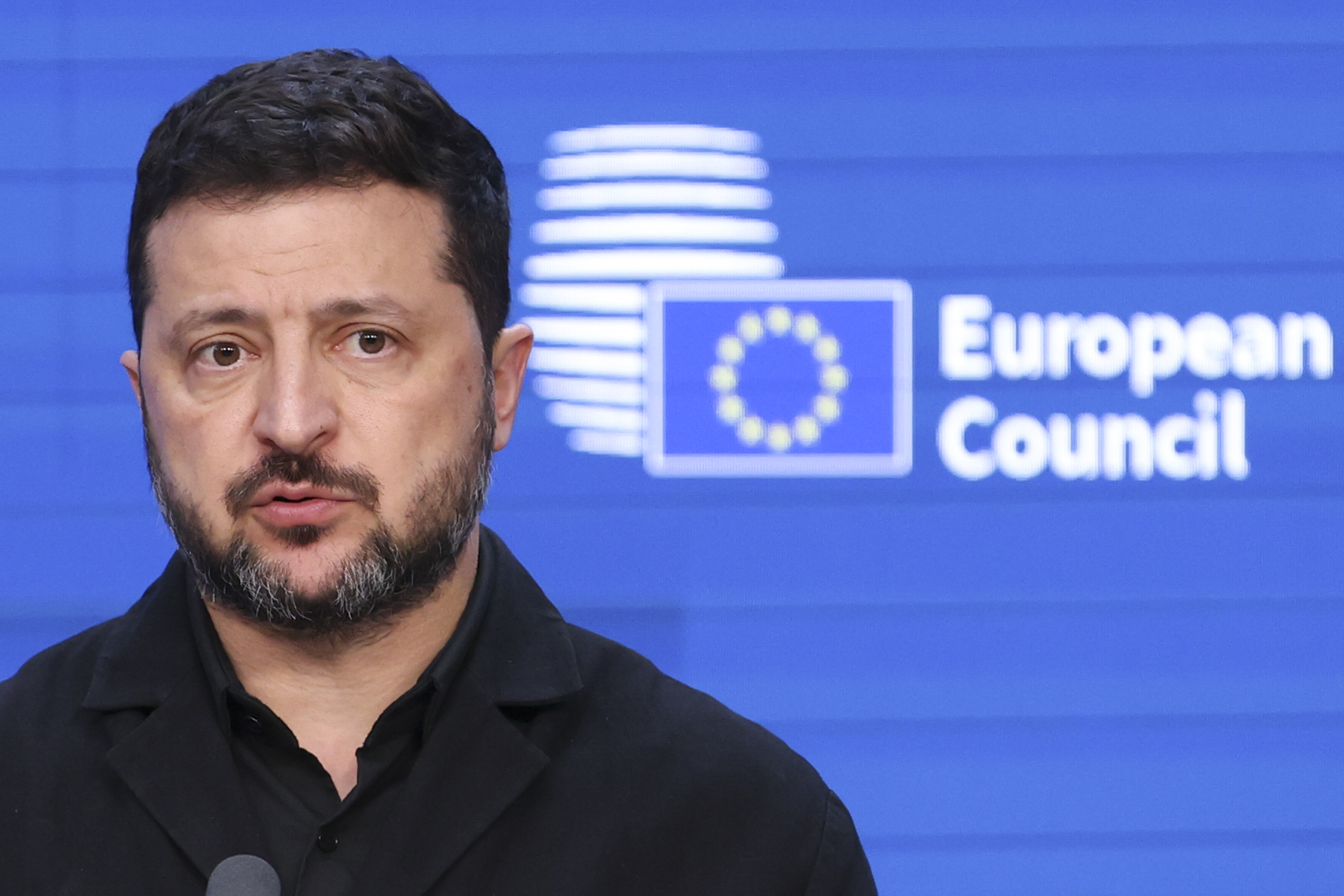
Brussels – Starlink has not been deactivated, but its speed has been restricted, and there are signs that it will be restored. This reassurance comes from the President of Ukraine, Volodymyr Zelensky, speaking to journalists who packed the press conference room at the Council building. Having arrived in Brussels yesterday (15 October) to meet first with the Secretary-General of NATO, Mark Rutte, and then to hold a series of bilateral meetings with EU leaders on the sidelines of the European Summit, Zelensky attended part of the Summit meeting today (16 October). “Upon his arrival in the hall, he was greeted with applause from the leaders,” European sources reported. At the press conference, he confirmed that he had felt the support of the heads of state and government of the European Union countries. However, he also acknowledged the need to remain pragmatic, as the coming year of war will cost €155 billion.
“I have received nothing but support from my European colleagues. I am grateful for this; they understand Ukraine’s position,” he assured at a press conference, almost as if to try to allay fears of a rift with the US following US President Donald Trump‘s decision to suspend the sanctions against Russia in order to resume purchases of Russian diesel.
Europeans have stood by Kyiv from the outset, but the 90 billion loan for the two-year period 2026–2027 is likely to cover far less than two-thirds of the estimated funding requirement. The pressing issue is therefore that of expenditure. “Next year, the war will cost €155 billion. And we need at least a further 70 billion from you: for defence, for armaments, and for our resilience,” explains the president. In his view, this is “a realistic figure” that he is asking Europeans to raise. “It will help us contain Russia,” he continues. Linked to this is the issue of drone production. “There are some very simple facts. Thanks to drones, we are able to stop most Russian attacks along the front line. With these technologies, we are cutting off Russian supply lines. Furthermore, our drones help to weaken Moscow’s economy,” he explains. “At present, we could produce two to three times as many drones, depending on the type. But quite simply, we do not have sufficient funds,” he observes.
The financial issue is one from which the discussion on the use of frozen Russian assets should not be excluded. During his bilateral meetings yesterday – described as “productive” – with the King of the Belgians, Philippe, and the Belgian Prime Minister, Bart De Wever, Zelensky raised the issue of Russian assets. Belgium holds the majority of frozen Russian assets in Europe. “We know full well that they want the assets back,” explains Zelensky, adding that Ukraine should “receive the assets, or a portion of them,” before Russia manages to do so.
In addition to meeting with Belgium’s leaders, Zelensky held bilateral talks yesterday with the President of France, Emmanuel Macron, the Prime Minister of Denmark, Mette Frederiksen, the Prime Minister of Poland, Donald Tusk, and the Prime Minister of Hungary, Péter Magyar. And today, addressing all 27 Member States, Zelensky emphasised the need for “a robust package of EU sanctions. The 22nd” because “we need concrete sanctions against every company and every individual involved in the production of Russian ballistic missiles, advanced communication systems, and drones, as well as against those involved in the Russian financial system.”
With regard to the situation concerning the Starlink satellites, whose power has been reduced by SpaceX’s chief executive, Elon Musk, the president clarifies that “Starlink has not been deactivated, but its speed limits have been reduced.” As a result of this restriction, “we have no longer been able to shoot down certain Shahed drones” and, consequently, for Kyiv, this represents the loss of “one of the tools at our disposal to protect the civilian population.” A “very painful and regrettable” situation, he comments. Zelensky emphasises that “one might think that Ukraine is using Starlink to carry out deep strikes against Russia, but that is not the case.” Ukraine “used Starlink to intercept the missiles striking civilians and infrastructure, killing families,” and, secondly, “for medium-range strikes against military targets.” Now “we are no longer able to do so.” But there is a note of hope: “Our Ministry of Defence is in constant contact with its counterparts, and my contacts have informed me that signals have come from the White House regarding a possible restoration of these capabilities.” In any case, Kyiv is seeking alternatives to Washington, although collaboration with other European states to potentially replace the services offered by Starlink satellites does not mean “a complete replacement,” but rather working “with certain countries, including France, to secure additional capabilities.”
At the European Council, Zelensky reiterated his request for more Patriot missiles, the long-range surface-to-air missile system designed for air defence and missile defence. Before the war in Iran, the United States was Ukraine’s main supplier, but due to the opening of a new front, it has reduced sales, while Kyiv needs them to cope with the coming winter. “Most of the PAC-2 and PAC-3 missiles are currently being sent to the Middle East, and it is no secret that, at the moment, we are not the priority for supplies,” notes Zelensky. “Speaking of the winter package, we are talking about PAC-2 and PAC-3 interceptors, and I have provided my European counterparts with details of the minimum essential requirements,” he points out, emphasising that there are enough PAC-2 and PAC-3 interceptors in Europe for Ukraine to get through this winter. “Based on the figures I have indicated we wish to obtain for this winter period, Europe does have those figures.”
Finally, the elephant in the room: the President of the United States. When reporters remind Zelensky that Donald Trump recently claimed it is easier to deal with Russian President Vladimir Putin than with him, the Ukrainian President smiles and recalls that he has “had a couple of meetings with the American President” and has “always found topics for discussion on which to reach decisions.” He adds: “I defend the interests of Ukraine and its people solely. We have been attacked, we have been occupied, our people have been killed.” And “however much Russia may wish to curtail our rights, it is clear that we have the right to defend ourselves; it is an established principle, and we will do so. We will stand tall, but the priority is to bring the war to an end,” he continues. For the Ukrainian president, “the priority is negotiations. Yet, at the moment, Putin is not seeking any negotiation.” And there is no other option. “Right now we are holding out and fighting. What is the alternative? Annihilation,” but “not everyone understands this because Ukraine is still holding out.” Nor is it a question of concessions, because “the Donbas, for the Russians, will not be enough” to satisfy Moscow’s appetites. “Putin is not seeking any negotiation. He is merely playing with words; it all looks like a farce, not a genuine desire to end the conflict. He does not want the war to end.”
According to Zelensky, “it is understandable that NATO countries do not want an escalation at this time. It’s understandable – he continues – when we’re talking about one, two, or ten drones, but the situation will become far more serious when we’re talking about ballistic missiles, cruise missiles, and thousands of munitions.” If the Kremlin is allowed to win, what will happen? “Twenty million Ukrainian citizens will flood into Europe because it is destroying us and forcing us to leave.” Finally, he replied with a smile to a journalist who asked whether – in the face of the looming mid-term elections and a dip in popularity – the Ukrainian president might be Trump’s scapegoat. A closing remark that drew laughter from the press room.
English version by the Translation Service of Withub